Zedong Xiang , Huida Guan , Qi Xie , Xianrun Hu , Wenkang Liu , Sitong Zhang , Qianping Chen , Jinchun Lei , Qin Shen , Wei Liu , Manlin Li , Changhong Wang
{"title":"基于药代动力学和质谱成像的方法探讨正常和胃热证大鼠口服左金丸后活性生物碱的组织分布倾向。","authors":"Zedong Xiang , Huida Guan , Qi Xie , Xianrun Hu , Wenkang Liu , Sitong Zhang , Qianping Chen , Jinchun Lei , Qin Shen , Wei Liu , Manlin Li , Changhong Wang","doi":"10.1016/j.jep.2025.119627","DOIUrl":null,"url":null,"abstract":"<div><h3>Ethnopharmacological relevance</h3><div>Zuojin Pill (ZJP) is a traditional Chinese medicine (TCM) formula composed of Coptidis Rhizoma and Euodiae Fructus in a ratio of 6:1 (w/w), which has been widely used for treating gastrointestinal disorders, especially stomach heat syndrome (SHS). However, the active alkaloids in ZJP showed low plasma exposure in rats following oral administration, which failed to explain their potent pharmacological effects, thereby limiting further mechanism studies.</div></div><div><h3>Aim of the study</h3><div>This study aimed to investigate the <em>in vivo</em> exposure and tissue distribution propensities of the active alkaloids in normal and SHS rats following oral administration of ZJP.</div></div><div><h3>Material and methods</h3><div>A rat model of SHS was induced by oral administration of chili pepper decoction and anhydrous ethanol. Then, the plasma and tissue pharmacokinetics of active alkaloids, including four protoberberine alkaloids (PBAs) and three indole alkaloids (IDAs), were investigated following oral administration of ZJP. Furthermore, desorption electrospray ionization mass spectrometry imaging (DESI-MSI) was employed to characterize the spatial distribution of active alkaloids in the stomach and liver. Western blot and immunofluorescence were used to evaluate the gastric mucosal barrier integrity.</div></div><div><h3>Results</h3><div>Based on the tissue-to-plasma partition coefficient (Kp) values, the <em>in vivo</em> exposure levels of berberine (BBR), palmatine (PAL), coptisine (COP), and dehydroevodiamine (DHE) were found to be higher in tissues than in plasma, indicating a distinct tissue distribution propensity. Each alkaloid displayed the highest exposure in the gastrointestinal tissues, due to local penetration facilitated by its direct contact with the mucosal lining. Pathological states reduced the overall exposure of PBAs in the gastric mucosa. In non-gastrointestinal tissues, most alkaloids, especially BBR and COP, exhibited a potent liver distribution propensity with minimal impact from pathological states. According to DESI-MSI results, PBAs showed high exposure in the damaged regions of gastric mucosa, which was attributed to mucosal barrier damage and enhanced permeability. In the liver, PBAs were primarily localized in the parenchyma surrounding the central vein and portal area.</div></div><div><h3>Conclusion</h3><div>This study demonstrated the stomach and liver distribution propensity of the active alkaloids in ZJP, providing a scientific basis for these alkaloids as the pharmacodynamic material basis of ZJP against SHS from the perspective of drug exposure.</div></div>","PeriodicalId":15761,"journal":{"name":"Journal of ethnopharmacology","volume":"346 ","pages":"Article 119627"},"PeriodicalIF":5.4000,"publicationDate":"2025-04-25","publicationTypes":"Journal Article","fieldsOfStudy":null,"isOpenAccess":false,"openAccessPdf":"","citationCount":"0","resultStr":"{\"title\":\"Exploring the tissue distribution propensity of active alkaloids in normal and stomach heat syndrome rats following oral administration of Zuojin Pill based on pharmacokinetics and mass spectrometry imaging\",\"authors\":\"Zedong Xiang , Huida Guan , Qi Xie , Xianrun Hu , Wenkang Liu , Sitong Zhang , Qianping Chen , Jinchun Lei , Qin Shen , Wei Liu , Manlin Li , Changhong Wang\",\"doi\":\"10.1016/j.jep.2025.119627\",\"DOIUrl\":null,\"url\":null,\"abstract\":\"<div><h3>Ethnopharmacological relevance</h3><div>Zuojin Pill (ZJP) is a traditional Chinese medicine (TCM) formula composed of Coptidis Rhizoma and Euodiae Fructus in a ratio of 6:1 (w/w), which has been widely used for treating gastrointestinal disorders, especially stomach heat syndrome (SHS). However, the active alkaloids in ZJP showed low plasma exposure in rats following oral administration, which failed to explain their potent pharmacological effects, thereby limiting further mechanism studies.</div></div><div><h3>Aim of the study</h3><div>This study aimed to investigate the <em>in vivo</em> exposure and tissue distribution propensities of the active alkaloids in normal and SHS rats following oral administration of ZJP.</div></div><div><h3>Material and methods</h3><div>A rat model of SHS was induced by oral administration of chili pepper decoction and anhydrous ethanol. Then, the plasma and tissue pharmacokinetics of active alkaloids, including four protoberberine alkaloids (PBAs) and three indole alkaloids (IDAs), were investigated following oral administration of ZJP. Furthermore, desorption electrospray ionization mass spectrometry imaging (DESI-MSI) was employed to characterize the spatial distribution of active alkaloids in the stomach and liver. Western blot and immunofluorescence were used to evaluate the gastric mucosal barrier integrity.</div></div><div><h3>Results</h3><div>Based on the tissue-to-plasma partition coefficient (Kp) values, the <em>in vivo</em> exposure levels of berberine (BBR), palmatine (PAL), coptisine (COP), and dehydroevodiamine (DHE) were found to be higher in tissues than in plasma, indicating a distinct tissue distribution propensity. Each alkaloid displayed the highest exposure in the gastrointestinal tissues, due to local penetration facilitated by its direct contact with the mucosal lining. Pathological states reduced the overall exposure of PBAs in the gastric mucosa. In non-gastrointestinal tissues, most alkaloids, especially BBR and COP, exhibited a potent liver distribution propensity with minimal impact from pathological states. According to DESI-MSI results, PBAs showed high exposure in the damaged regions of gastric mucosa, which was attributed to mucosal barrier damage and enhanced permeability. In the liver, PBAs were primarily localized in the parenchyma surrounding the central vein and portal area.</div></div><div><h3>Conclusion</h3><div>This study demonstrated the stomach and liver distribution propensity of the active alkaloids in ZJP, providing a scientific basis for these alkaloids as the pharmacodynamic material basis of ZJP against SHS from the perspective of drug exposure.</div></div>\",\"PeriodicalId\":15761,\"journal\":{\"name\":\"Journal of ethnopharmacology\",\"volume\":\"346 \",\"pages\":\"Article 119627\"},\"PeriodicalIF\":5.4000,\"publicationDate\":\"2025-04-25\",\"publicationTypes\":\"Journal Article\",\"fieldsOfStudy\":null,\"isOpenAccess\":false,\"openAccessPdf\":\"\",\"citationCount\":\"0\",\"resultStr\":null,\"platform\":\"Semanticscholar\",\"paperid\":null,\"PeriodicalName\":\"Journal of ethnopharmacology\",\"FirstCategoryId\":\"3\",\"ListUrlMain\":\"https://www.sciencedirect.com/science/article/pii/S0378874125003113\",\"RegionNum\":2,\"RegionCategory\":\"医学\",\"ArticlePicture\":[],\"TitleCN\":null,\"AbstractTextCN\":null,\"PMCID\":null,\"EPubDate\":\"2025/3/13 0:00:00\",\"PubModel\":\"Epub\",\"JCR\":\"Q1\",\"JCRName\":\"CHEMISTRY, MEDICINAL\",\"Score\":null,\"Total\":0}","platform":"Semanticscholar","paperid":null,"PeriodicalName":"Journal of ethnopharmacology","FirstCategoryId":"3","ListUrlMain":"https://www.sciencedirect.com/science/article/pii/S0378874125003113","RegionNum":2,"RegionCategory":"医学","ArticlePicture":[],"TitleCN":null,"AbstractTextCN":null,"PMCID":null,"EPubDate":"2025/3/13 0:00:00","PubModel":"Epub","JCR":"Q1","JCRName":"CHEMISTRY, MEDICINAL","Score":null,"Total":0}
Exploring the tissue distribution propensity of active alkaloids in normal and stomach heat syndrome rats following oral administration of Zuojin Pill based on pharmacokinetics and mass spectrometry imaging
Ethnopharmacological relevance
Zuojin Pill (ZJP) is a traditional Chinese medicine (TCM) formula composed of Coptidis Rhizoma and Euodiae Fructus in a ratio of 6:1 (w/w), which has been widely used for treating gastrointestinal disorders, especially stomach heat syndrome (SHS). However, the active alkaloids in ZJP showed low plasma exposure in rats following oral administration, which failed to explain their potent pharmacological effects, thereby limiting further mechanism studies.
Aim of the study
This study aimed to investigate the in vivo exposure and tissue distribution propensities of the active alkaloids in normal and SHS rats following oral administration of ZJP.
Material and methods
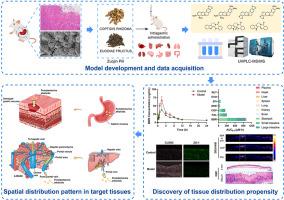
A rat model of SHS was induced by oral administration of chili pepper decoction and anhydrous ethanol. Then, the plasma and tissue pharmacokinetics of active alkaloids, including four protoberberine alkaloids (PBAs) and three indole alkaloids (IDAs), were investigated following oral administration of ZJP. Furthermore, desorption electrospray ionization mass spectrometry imaging (DESI-MSI) was employed to characterize the spatial distribution of active alkaloids in the stomach and liver. Western blot and immunofluorescence were used to evaluate the gastric mucosal barrier integrity.
Results
Based on the tissue-to-plasma partition coefficient (Kp) values, the in vivo exposure levels of berberine (BBR), palmatine (PAL), coptisine (COP), and dehydroevodiamine (DHE) were found to be higher in tissues than in plasma, indicating a distinct tissue distribution propensity. Each alkaloid displayed the highest exposure in the gastrointestinal tissues, due to local penetration facilitated by its direct contact with the mucosal lining. Pathological states reduced the overall exposure of PBAs in the gastric mucosa. In non-gastrointestinal tissues, most alkaloids, especially BBR and COP, exhibited a potent liver distribution propensity with minimal impact from pathological states. According to DESI-MSI results, PBAs showed high exposure in the damaged regions of gastric mucosa, which was attributed to mucosal barrier damage and enhanced permeability. In the liver, PBAs were primarily localized in the parenchyma surrounding the central vein and portal area.
Conclusion
This study demonstrated the stomach and liver distribution propensity of the active alkaloids in ZJP, providing a scientific basis for these alkaloids as the pharmacodynamic material basis of ZJP against SHS from the perspective of drug exposure.
期刊介绍:
The Journal of Ethnopharmacology is dedicated to the exchange of information and understandings about people''s use of plants, fungi, animals, microorganisms and minerals and their biological and pharmacological effects based on the principles established through international conventions. Early people confronted with illness and disease, discovered a wealth of useful therapeutic agents in the plant and animal kingdoms. The empirical knowledge of these medicinal substances and their toxic potential was passed on by oral tradition and sometimes recorded in herbals and other texts on materia medica. Many valuable drugs of today (e.g., atropine, ephedrine, tubocurarine, digoxin, reserpine) came into use through the study of indigenous remedies. Chemists continue to use plant-derived drugs (e.g., morphine, taxol, physostigmine, quinidine, emetine) as prototypes in their attempts to develop more effective and less toxic medicinals.





 京公网安备 11010802042870号
京ICP备2023020795号-1
京公网安备 11010802042870号
京ICP备2023020795号-1

 分享
分享
 求助内容:
求助内容: 应助结果提醒方式:
 扫码关注我们
