Agamemnon E. Crumpton, Caitilín McManus, Simon Aldridge
{"title":"弱路易斯酸性硼烷结合CO的非共价相互作用","authors":"Agamemnon E. Crumpton, Caitilín McManus, Simon Aldridge","doi":"10.1002/anie.202501774","DOIUrl":null,"url":null,"abstract":"<p>Known boron carbonyl complexes either exploit very high Lewis acidity or a low oxidation state boron centre in order to capture CO. By contrast, we report a carbonyl complex featuring a simple tri-coordinate borane, characterized by a Lewis acidity which is only marginally higher than B(NMe<sub>2</sub>)<sub>3</sub>. {(Ph<sub>2</sub>P)xanth}<sub>3</sub>B features a solid-state structure in which two of the three B-bound xanth(PPh<sub>2</sub>) units are projected above the BC<sub>3</sub> plane, generating an <i>up</i>, <i>up</i>, <i>down</i> conformation. Quantum chemical methods, however, reveal that the alternative <i>up</i>, <i>up</i>, <i>up</i> alignment, characterized by a cage-like geometry and enhanced intramolecular noncovalent interactions, is favored significantly in silico (by ca. 33.0 kcal mol<sup>−1</sup>). Although this conformation is optimal for binding polar <i>C</i><sub>3</sub>-symmetric H-bond donors such as NH<sub>3</sub> (and related guests such as H<sub>2</sub>O and MeNH<sub>2</sub>) the binding of essentially nonpolar substrates such as CO would be expected to be weak at best. However, exposure of {(Ph<sub>2</sub>P)xanth}<sub>3</sub>B to CO under mild conditions (1 bar, 25 °C) reversibly yields {(Ph<sub>2</sub>P)xanth}<sub>3</sub>B·CO, a tractable cage-like borane carbonyl adduct featuring a central BCO moiety shrouded by xanth(PPh<sub>2</sub>) moieties. Dispersion forces are critical to substrate binding: the two binding modes in which the B-bound CO guest is located inside/outside the host cage differ in energy by 59.5 kcal mol<sup>−1</sup>.</p>","PeriodicalId":125,"journal":{"name":"Angewandte Chemie International Edition","volume":"64 22","pages":""},"PeriodicalIF":16.9000,"publicationDate":"2025-03-18","publicationTypes":"Journal Article","fieldsOfStudy":null,"isOpenAccess":false,"openAccessPdf":"https://onlinelibrary.wiley.com/doi/epdf/10.1002/anie.202501774","citationCount":"0","resultStr":"{\"title\":\"Leveraging Noncovalent Interactions for the Binding of CO by a Weakly Lewis Acidic Borane\",\"authors\":\"Agamemnon E. Crumpton, Caitilín McManus, Simon Aldridge\",\"doi\":\"10.1002/anie.202501774\",\"DOIUrl\":null,\"url\":null,\"abstract\":\"<p>Known boron carbonyl complexes either exploit very high Lewis acidity or a low oxidation state boron centre in order to capture CO. By contrast, we report a carbonyl complex featuring a simple tri-coordinate borane, characterized by a Lewis acidity which is only marginally higher than B(NMe<sub>2</sub>)<sub>3</sub>. {(Ph<sub>2</sub>P)xanth}<sub>3</sub>B features a solid-state structure in which two of the three B-bound xanth(PPh<sub>2</sub>) units are projected above the BC<sub>3</sub> plane, generating an <i>up</i>, <i>up</i>, <i>down</i> conformation. Quantum chemical methods, however, reveal that the alternative <i>up</i>, <i>up</i>, <i>up</i> alignment, characterized by a cage-like geometry and enhanced intramolecular noncovalent interactions, is favored significantly in silico (by ca. 33.0 kcal mol<sup>−1</sup>). Although this conformation is optimal for binding polar <i>C</i><sub>3</sub>-symmetric H-bond donors such as NH<sub>3</sub> (and related guests such as H<sub>2</sub>O and MeNH<sub>2</sub>) the binding of essentially nonpolar substrates such as CO would be expected to be weak at best. However, exposure of {(Ph<sub>2</sub>P)xanth}<sub>3</sub>B to CO under mild conditions (1 bar, 25 °C) reversibly yields {(Ph<sub>2</sub>P)xanth}<sub>3</sub>B·CO, a tractable cage-like borane carbonyl adduct featuring a central BCO moiety shrouded by xanth(PPh<sub>2</sub>) moieties. Dispersion forces are critical to substrate binding: the two binding modes in which the B-bound CO guest is located inside/outside the host cage differ in energy by 59.5 kcal mol<sup>−1</sup>.</p>\",\"PeriodicalId\":125,\"journal\":{\"name\":\"Angewandte Chemie International Edition\",\"volume\":\"64 22\",\"pages\":\"\"},\"PeriodicalIF\":16.9000,\"publicationDate\":\"2025-03-18\",\"publicationTypes\":\"Journal Article\",\"fieldsOfStudy\":null,\"isOpenAccess\":false,\"openAccessPdf\":\"https://onlinelibrary.wiley.com/doi/epdf/10.1002/anie.202501774\",\"citationCount\":\"0\",\"resultStr\":null,\"platform\":\"Semanticscholar\",\"paperid\":null,\"PeriodicalName\":\"Angewandte Chemie International Edition\",\"FirstCategoryId\":\"92\",\"ListUrlMain\":\"https://onlinelibrary.wiley.com/doi/10.1002/anie.202501774\",\"RegionNum\":1,\"RegionCategory\":\"化学\",\"ArticlePicture\":[],\"TitleCN\":null,\"AbstractTextCN\":null,\"PMCID\":null,\"EPubDate\":\"\",\"PubModel\":\"\",\"JCR\":\"Q1\",\"JCRName\":\"CHEMISTRY, MULTIDISCIPLINARY\",\"Score\":null,\"Total\":0}","platform":"Semanticscholar","paperid":null,"PeriodicalName":"Angewandte Chemie International Edition","FirstCategoryId":"92","ListUrlMain":"https://onlinelibrary.wiley.com/doi/10.1002/anie.202501774","RegionNum":1,"RegionCategory":"化学","ArticlePicture":[],"TitleCN":null,"AbstractTextCN":null,"PMCID":null,"EPubDate":"","PubModel":"","JCR":"Q1","JCRName":"CHEMISTRY, MULTIDISCIPLINARY","Score":null,"Total":0}
引用次数: 0
摘要
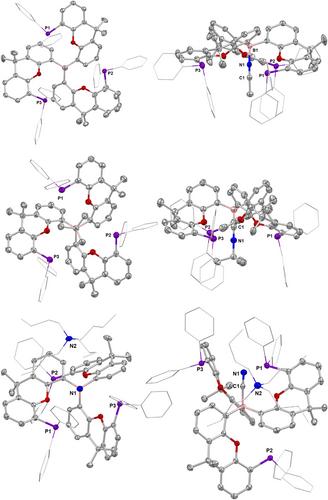
已知的硼羰基复合物要么利用极高的路易斯酸度,要么利用低氧化态硼中心来捕获一氧化碳。{(Ph2P)xanth}3B的固态结构中,三个与硼结合的xanth(PPh2)单元中的两个单元凸出于BC3平面之上,从而产生了上、上、下的构象。然而,量子化学方法揭示了另一种向上、向上、向上的构象,这种构象的特点是具有笼状几何结构和增强的分子内非共价相互作用。虽然这种构象是结合极性 C3 对称氢键供体(如 NH3)(以及相关客体(如 H2O 和 MeNH2))的最佳构象,但与 CO 等基本非极性底物的结合充其量也只能是微弱的。然而,{(Ph2P)xanth}3B 在温和的条件下(1 bar,25°C)与 CO 接触,会可逆地产生{(Ph2P)xanth}3B-CO,这是一种笼状的硼烷羰基加合物,其特点是中心的 BCO 分子被 xanth(PPh2) 分子包裹。分散力对底物结合至关重要:B-结合的 CO 客体位于宿主笼内部/外部的两种结合模式的能量相差 59.5 kcal mol-1。
Leveraging Noncovalent Interactions for the Binding of CO by a Weakly Lewis Acidic Borane
Known boron carbonyl complexes either exploit very high Lewis acidity or a low oxidation state boron centre in order to capture CO. By contrast, we report a carbonyl complex featuring a simple tri-coordinate borane, characterized by a Lewis acidity which is only marginally higher than B(NMe2)3. {(Ph2P)xanth}3B features a solid-state structure in which two of the three B-bound xanth(PPh2) units are projected above the BC3 plane, generating an up, up, down conformation. Quantum chemical methods, however, reveal that the alternative up, up, up alignment, characterized by a cage-like geometry and enhanced intramolecular noncovalent interactions, is favored significantly in silico (by ca. 33.0 kcal mol−1). Although this conformation is optimal for binding polar C3-symmetric H-bond donors such as NH3 (and related guests such as H2O and MeNH2) the binding of essentially nonpolar substrates such as CO would be expected to be weak at best. However, exposure of {(Ph2P)xanth}3B to CO under mild conditions (1 bar, 25 °C) reversibly yields {(Ph2P)xanth}3B·CO, a tractable cage-like borane carbonyl adduct featuring a central BCO moiety shrouded by xanth(PPh2) moieties. Dispersion forces are critical to substrate binding: the two binding modes in which the B-bound CO guest is located inside/outside the host cage differ in energy by 59.5 kcal mol−1.
期刊介绍:
Angewandte Chemie, a journal of the German Chemical Society (GDCh), maintains a leading position among scholarly journals in general chemistry with an impressive Impact Factor of 16.6 (2022 Journal Citation Reports, Clarivate, 2023). Published weekly in a reader-friendly format, it features new articles almost every day. Established in 1887, Angewandte Chemie is a prominent chemistry journal, offering a dynamic blend of Review-type articles, Highlights, Communications, and Research Articles on a weekly basis, making it unique in the field.




 京公网安备 11010802042870号
京ICP备2023020795号-1
京公网安备 11010802042870号
京ICP备2023020795号-1

 分享
分享
 求助内容:
求助内容: 应助结果提醒方式:
 扫码关注我们
