Yang Luo , Yang Chen , Chunxia Jian , Junjie Zhou , Yingkun Mou , Yuan Jin , Shaoyan Wang , Bingcheng Xu
{"title":"半干旱草原雨季地表植被和凋落物对降水再分布的影响","authors":"Yang Luo , Yang Chen , Chunxia Jian , Junjie Zhou , Yingkun Mou , Yuan Jin , Shaoyan Wang , Bingcheng Xu","doi":"10.1016/j.jhydrol.2025.133079","DOIUrl":null,"url":null,"abstract":"<div><div>Studying the characteristics of rainfall redistribution and their influencing factors in grassland communities is crucial for understanding rainfall effectiveness and ecohydrological processes in semiarid regions. Small plot-scale experiments were conducted in three typical grassland communities (<em>Bothriochloa ischaemum</em>, <em>Artemisia gmelinii</em>, and <em>Stipa bungeana</em>) using three simulated rainfall amounts (10 mm, 20 mm, and 40 mm). Four treatments were applied: PR (surface plants removed), LR (litter removed), LR + PR (both plants and litter removed), and CK (no treatment). These treatments were used to measure the percentages of surface plant interception (PI%), litter interception (LI%), runoff (RO%), and soil water storage (SWS%) during the rainy season (July to September) in the Zhifanggou watershed, Shaanxi Province, China. Results indicated that the average PI%, LI%, RO%, and SWS% for the three community types were 7.94 %, 9.55 %, 17.65 %, and 64.87 %, respectively. Growth month, community type, and rainfall amount significantly influenced these four components (<em>p</em> < 0.05). Specifically, interception losses and soil moisture storage were highest in August. The <em>A. gmelinii</em> community exhibited higher interception and soil water storage than the other two grassland communities. Rainfall amount negatively affected PI%, LI%, and SWS% while positively influencing RO%. Stepwise regression analysis revealed that aboveground biomass was the best predictor for PI%, and litter thickness was the best predictor for LI%. Soil water content in the 0∼30 cm layer was the primary factor affecting RO% and SWS%. Furthermore, the PR treatment significantly reduced LI% by approximately 2.02 % and increased RO% by about 9.89 % compared to CK, while the LR treatment increased RO% by about 9.62 %. The LR + PR treatment significantly reduced SWS% by approximately 15.72 % and increased RO% by 30.33 %. These findings demonstrate that grassland plants and litter contribute to soil water replenishment, outweighing interception losses during the rainy season. This suggests that vegetation rehabilitation enhances soil water storage and is beneficial for managing water resources in semiarid regions.</div></div>","PeriodicalId":362,"journal":{"name":"Journal of Hydrology","volume":"657 ","pages":"Article 133079"},"PeriodicalIF":6.3000,"publicationDate":"2025-08-01","publicationTypes":"Journal Article","fieldsOfStudy":null,"isOpenAccess":false,"openAccessPdf":"","citationCount":"0","resultStr":"{\"title\":\"Effects of surface vegetation and litter on rainfall redistribution during the rainy season in semiarid grasslands\",\"authors\":\"Yang Luo , Yang Chen , Chunxia Jian , Junjie Zhou , Yingkun Mou , Yuan Jin , Shaoyan Wang , Bingcheng Xu\",\"doi\":\"10.1016/j.jhydrol.2025.133079\",\"DOIUrl\":null,\"url\":null,\"abstract\":\"<div><div>Studying the characteristics of rainfall redistribution and their influencing factors in grassland communities is crucial for understanding rainfall effectiveness and ecohydrological processes in semiarid regions. Small plot-scale experiments were conducted in three typical grassland communities (<em>Bothriochloa ischaemum</em>, <em>Artemisia gmelinii</em>, and <em>Stipa bungeana</em>) using three simulated rainfall amounts (10 mm, 20 mm, and 40 mm). Four treatments were applied: PR (surface plants removed), LR (litter removed), LR + PR (both plants and litter removed), and CK (no treatment). These treatments were used to measure the percentages of surface plant interception (PI%), litter interception (LI%), runoff (RO%), and soil water storage (SWS%) during the rainy season (July to September) in the Zhifanggou watershed, Shaanxi Province, China. Results indicated that the average PI%, LI%, RO%, and SWS% for the three community types were 7.94 %, 9.55 %, 17.65 %, and 64.87 %, respectively. Growth month, community type, and rainfall amount significantly influenced these four components (<em>p</em> < 0.05). Specifically, interception losses and soil moisture storage were highest in August. The <em>A. gmelinii</em> community exhibited higher interception and soil water storage than the other two grassland communities. Rainfall amount negatively affected PI%, LI%, and SWS% while positively influencing RO%. Stepwise regression analysis revealed that aboveground biomass was the best predictor for PI%, and litter thickness was the best predictor for LI%. Soil water content in the 0∼30 cm layer was the primary factor affecting RO% and SWS%. Furthermore, the PR treatment significantly reduced LI% by approximately 2.02 % and increased RO% by about 9.89 % compared to CK, while the LR treatment increased RO% by about 9.62 %. The LR + PR treatment significantly reduced SWS% by approximately 15.72 % and increased RO% by 30.33 %. These findings demonstrate that grassland plants and litter contribute to soil water replenishment, outweighing interception losses during the rainy season. This suggests that vegetation rehabilitation enhances soil water storage and is beneficial for managing water resources in semiarid regions.</div></div>\",\"PeriodicalId\":362,\"journal\":{\"name\":\"Journal of Hydrology\",\"volume\":\"657 \",\"pages\":\"Article 133079\"},\"PeriodicalIF\":6.3000,\"publicationDate\":\"2025-08-01\",\"publicationTypes\":\"Journal Article\",\"fieldsOfStudy\":null,\"isOpenAccess\":false,\"openAccessPdf\":\"\",\"citationCount\":\"0\",\"resultStr\":null,\"platform\":\"Semanticscholar\",\"paperid\":null,\"PeriodicalName\":\"Journal of Hydrology\",\"FirstCategoryId\":\"89\",\"ListUrlMain\":\"https://www.sciencedirect.com/science/article/pii/S0022169425004172\",\"RegionNum\":1,\"RegionCategory\":\"地球科学\",\"ArticlePicture\":[],\"TitleCN\":null,\"AbstractTextCN\":null,\"PMCID\":null,\"EPubDate\":\"2025/3/15 0:00:00\",\"PubModel\":\"Epub\",\"JCR\":\"Q1\",\"JCRName\":\"ENGINEERING, CIVIL\",\"Score\":null,\"Total\":0}","platform":"Semanticscholar","paperid":null,"PeriodicalName":"Journal of Hydrology","FirstCategoryId":"89","ListUrlMain":"https://www.sciencedirect.com/science/article/pii/S0022169425004172","RegionNum":1,"RegionCategory":"地球科学","ArticlePicture":[],"TitleCN":null,"AbstractTextCN":null,"PMCID":null,"EPubDate":"2025/3/15 0:00:00","PubModel":"Epub","JCR":"Q1","JCRName":"ENGINEERING, CIVIL","Score":null,"Total":0}
Effects of surface vegetation and litter on rainfall redistribution during the rainy season in semiarid grasslands
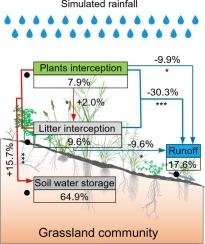
Studying the characteristics of rainfall redistribution and their influencing factors in grassland communities is crucial for understanding rainfall effectiveness and ecohydrological processes in semiarid regions. Small plot-scale experiments were conducted in three typical grassland communities (Bothriochloa ischaemum, Artemisia gmelinii, and Stipa bungeana) using three simulated rainfall amounts (10 mm, 20 mm, and 40 mm). Four treatments were applied: PR (surface plants removed), LR (litter removed), LR + PR (both plants and litter removed), and CK (no treatment). These treatments were used to measure the percentages of surface plant interception (PI%), litter interception (LI%), runoff (RO%), and soil water storage (SWS%) during the rainy season (July to September) in the Zhifanggou watershed, Shaanxi Province, China. Results indicated that the average PI%, LI%, RO%, and SWS% for the three community types were 7.94 %, 9.55 %, 17.65 %, and 64.87 %, respectively. Growth month, community type, and rainfall amount significantly influenced these four components (p < 0.05). Specifically, interception losses and soil moisture storage were highest in August. The A. gmelinii community exhibited higher interception and soil water storage than the other two grassland communities. Rainfall amount negatively affected PI%, LI%, and SWS% while positively influencing RO%. Stepwise regression analysis revealed that aboveground biomass was the best predictor for PI%, and litter thickness was the best predictor for LI%. Soil water content in the 0∼30 cm layer was the primary factor affecting RO% and SWS%. Furthermore, the PR treatment significantly reduced LI% by approximately 2.02 % and increased RO% by about 9.89 % compared to CK, while the LR treatment increased RO% by about 9.62 %. The LR + PR treatment significantly reduced SWS% by approximately 15.72 % and increased RO% by 30.33 %. These findings demonstrate that grassland plants and litter contribute to soil water replenishment, outweighing interception losses during the rainy season. This suggests that vegetation rehabilitation enhances soil water storage and is beneficial for managing water resources in semiarid regions.
期刊介绍:
The Journal of Hydrology publishes original research papers and comprehensive reviews in all the subfields of the hydrological sciences including water based management and policy issues that impact on economics and society. These comprise, but are not limited to the physical, chemical, biogeochemical, stochastic and systems aspects of surface and groundwater hydrology, hydrometeorology and hydrogeology. Relevant topics incorporating the insights and methodologies of disciplines such as climatology, water resource systems, hydraulics, agrohydrology, geomorphology, soil science, instrumentation and remote sensing, civil and environmental engineering are included. Social science perspectives on hydrological problems such as resource and ecological economics, environmental sociology, psychology and behavioural science, management and policy analysis are also invited. Multi-and interdisciplinary analyses of hydrological problems are within scope. The science published in the Journal of Hydrology is relevant to catchment scales rather than exclusively to a local scale or site.




 京公网安备 11010802042870号
京ICP备2023020795号-1
京公网安备 11010802042870号
京ICP备2023020795号-1

 分享
分享
 求助内容:
求助内容: 应助结果提醒方式:
 扫码关注我们
