Chiang-Mei Chen, Chun-Chih Huang, Sang Pyo Kim, Chun-Yu Wei
{"title":"近乎极端带电的纳瑞艾黑洞灾难性地发射电荷。2。旋转的效果","authors":"Chiang-Mei Chen, Chun-Chih Huang, Sang Pyo Kim, Chun-Yu Wei","doi":"10.1103/physrevd.111.065017","DOIUrl":null,"url":null,"abstract":"Kerr-Newman black holes in a de Sitter (dS) space have the limit of rotating Nariai black holes with the near-horizon geometry of a warped dS</a:mi>3</a:mn></a:msub>×</a:mo>S</a:mi>1</a:mn></a:msup>/</a:mo>Z</a:mi>2</a:mn></a:msub></a:math> when the black hole horizon and the cosmological horizon coincide or approach close to each other. We study the rotation effect on the spontaneous emission of charges in the near-extremal rotating charged Nariai black hole and compare it to those from the near-extremal Nariai black hole in [C.-M. Chen , ] and near-extremal Kerr-Newman black hole in de Sitter space in [C.-M. Chen and S. P. Kim, ]. In strong contrast to the near-extremal Kerr-Newman black hole in dS space, the near-extremal rotating Nariai black hole also has an exponential amplification for the emission of high-energy charges, which becomes catastrophic regardless of angular momentum when two horizons coincide. The radius of rotating Nariai black holes monotonically increases as the angular momentum and charge of black holes increase, which gives a weaker electric field on the horizon than Nariai black holes. Thus, the angular momentum of black holes that drags particles on the horizon decreases the mean number of charges by a factor not by an order. We observe a catastrophic emission of boson condensation for charges with an effective energy equal to the chemical potential in the spacelike outer region of the cosmological horizon. Remarkably, the Schwinger emission of charges in the standard particle model may prevent the rotating Nariai black holes from evolving into spacetimes with a naked singularity when the angular momentum is close to the allowed maximum, which Nariai black holes cannot avoid. <jats:supplementary-material> <jats:copyright-statement>Published by the American Physical Society</jats:copyright-statement> <jats:copyright-year>2025</jats:copyright-year> </jats:permissions> </jats:supplementary-material>","PeriodicalId":20167,"journal":{"name":"Physical Review D","volume":"125 1","pages":""},"PeriodicalIF":5.3000,"publicationDate":"2025-03-18","publicationTypes":"Journal Article","fieldsOfStudy":null,"isOpenAccess":false,"openAccessPdf":"","citationCount":"0","resultStr":"{\"title\":\"Catastrophic emission of charges from near-extremal charged Nariai black holes. II. Rotation effect\",\"authors\":\"Chiang-Mei Chen, Chun-Chih Huang, Sang Pyo Kim, Chun-Yu Wei\",\"doi\":\"10.1103/physrevd.111.065017\",\"DOIUrl\":null,\"url\":null,\"abstract\":\"Kerr-Newman black holes in a de Sitter (dS) space have the limit of rotating Nariai black holes with the near-horizon geometry of a warped dS</a:mi>3</a:mn></a:msub>×</a:mo>S</a:mi>1</a:mn></a:msup>/</a:mo>Z</a:mi>2</a:mn></a:msub></a:math> when the black hole horizon and the cosmological horizon coincide or approach close to each other. We study the rotation effect on the spontaneous emission of charges in the near-extremal rotating charged Nariai black hole and compare it to those from the near-extremal Nariai black hole in [C.-M. Chen , ] and near-extremal Kerr-Newman black hole in de Sitter space in [C.-M. Chen and S. P. Kim, ]. In strong contrast to the near-extremal Kerr-Newman black hole in dS space, the near-extremal rotating Nariai black hole also has an exponential amplification for the emission of high-energy charges, which becomes catastrophic regardless of angular momentum when two horizons coincide. The radius of rotating Nariai black holes monotonically increases as the angular momentum and charge of black holes increase, which gives a weaker electric field on the horizon than Nariai black holes. Thus, the angular momentum of black holes that drags particles on the horizon decreases the mean number of charges by a factor not by an order. We observe a catastrophic emission of boson condensation for charges with an effective energy equal to the chemical potential in the spacelike outer region of the cosmological horizon. Remarkably, the Schwinger emission of charges in the standard particle model may prevent the rotating Nariai black holes from evolving into spacetimes with a naked singularity when the angular momentum is close to the allowed maximum, which Nariai black holes cannot avoid. <jats:supplementary-material> <jats:copyright-statement>Published by the American Physical Society</jats:copyright-statement> <jats:copyright-year>2025</jats:copyright-year> </jats:permissions> </jats:supplementary-material>\",\"PeriodicalId\":20167,\"journal\":{\"name\":\"Physical Review D\",\"volume\":\"125 1\",\"pages\":\"\"},\"PeriodicalIF\":5.3000,\"publicationDate\":\"2025-03-18\",\"publicationTypes\":\"Journal Article\",\"fieldsOfStudy\":null,\"isOpenAccess\":false,\"openAccessPdf\":\"\",\"citationCount\":\"0\",\"resultStr\":null,\"platform\":\"Semanticscholar\",\"paperid\":null,\"PeriodicalName\":\"Physical Review D\",\"FirstCategoryId\":\"101\",\"ListUrlMain\":\"https://doi.org/10.1103/physrevd.111.065017\",\"RegionNum\":2,\"RegionCategory\":\"物理与天体物理\",\"ArticlePicture\":[],\"TitleCN\":null,\"AbstractTextCN\":null,\"PMCID\":null,\"EPubDate\":\"\",\"PubModel\":\"\",\"JCR\":\"Q1\",\"JCRName\":\"Physics and Astronomy\",\"Score\":null,\"Total\":0}","platform":"Semanticscholar","paperid":null,"PeriodicalName":"Physical Review D","FirstCategoryId":"101","ListUrlMain":"https://doi.org/10.1103/physrevd.111.065017","RegionNum":2,"RegionCategory":"物理与天体物理","ArticlePicture":[],"TitleCN":null,"AbstractTextCN":null,"PMCID":null,"EPubDate":"","PubModel":"","JCR":"Q1","JCRName":"Physics and Astronomy","Score":null,"Total":0}
引用次数: 0
摘要
当黑洞视界与宇宙视界重合或接近时,德西特(dS)空间中的Kerr-Newman黑洞具有旋转Nariai黑洞的极限,其近视界几何形状为弯曲的dS3×S1/Z2。本文研究了近极旋转带电荷Nariai黑洞的旋转对电荷自发发射的影响,并与[c - m]的近极Nariai黑洞的自发发射进行了比较。[c - m]; de Sitter空间的近极值Kerr-Newman黑洞;[j]。与dS空间中的近极值Kerr-Newman黑洞形成强烈对比的是,近极值旋转的narai黑洞在高能电荷的发射方面也具有指数放大,当两个视界重合时,无论角动量如何,这都是灾难性的。旋转Nariai黑洞的半径随着黑洞角动量和电荷的增加而单调增加,这使得视界上的电场比Nariai黑洞弱。因此,在视界上拖拽粒子的黑洞角动量减少了一个因子而不是一个数量级的平均电荷数。我们观察到在宇宙视界的类空间外区域,有效能量等于化学势的电荷发生玻色子凝聚的灾难性发射。值得注意的是,当角动量接近允许的最大值时,标准粒子模型中的Schwinger电荷发射可能会阻止旋转的Nariai黑洞演化成具有裸奇点的时空,而这是Nariai黑洞无法避免的。2025年由美国物理学会出版
Catastrophic emission of charges from near-extremal charged Nariai black holes. II. Rotation effect
Kerr-Newman black holes in a de Sitter (dS) space have the limit of rotating Nariai black holes with the near-horizon geometry of a warped dS3×S1/Z2 when the black hole horizon and the cosmological horizon coincide or approach close to each other. We study the rotation effect on the spontaneous emission of charges in the near-extremal rotating charged Nariai black hole and compare it to those from the near-extremal Nariai black hole in [C.-M. Chen , ] and near-extremal Kerr-Newman black hole in de Sitter space in [C.-M. Chen and S. P. Kim, ]. In strong contrast to the near-extremal Kerr-Newman black hole in dS space, the near-extremal rotating Nariai black hole also has an exponential amplification for the emission of high-energy charges, which becomes catastrophic regardless of angular momentum when two horizons coincide. The radius of rotating Nariai black holes monotonically increases as the angular momentum and charge of black holes increase, which gives a weaker electric field on the horizon than Nariai black holes. Thus, the angular momentum of black holes that drags particles on the horizon decreases the mean number of charges by a factor not by an order. We observe a catastrophic emission of boson condensation for charges with an effective energy equal to the chemical potential in the spacelike outer region of the cosmological horizon. Remarkably, the Schwinger emission of charges in the standard particle model may prevent the rotating Nariai black holes from evolving into spacetimes with a naked singularity when the angular momentum is close to the allowed maximum, which Nariai black holes cannot avoid. Published by the American Physical Society2025
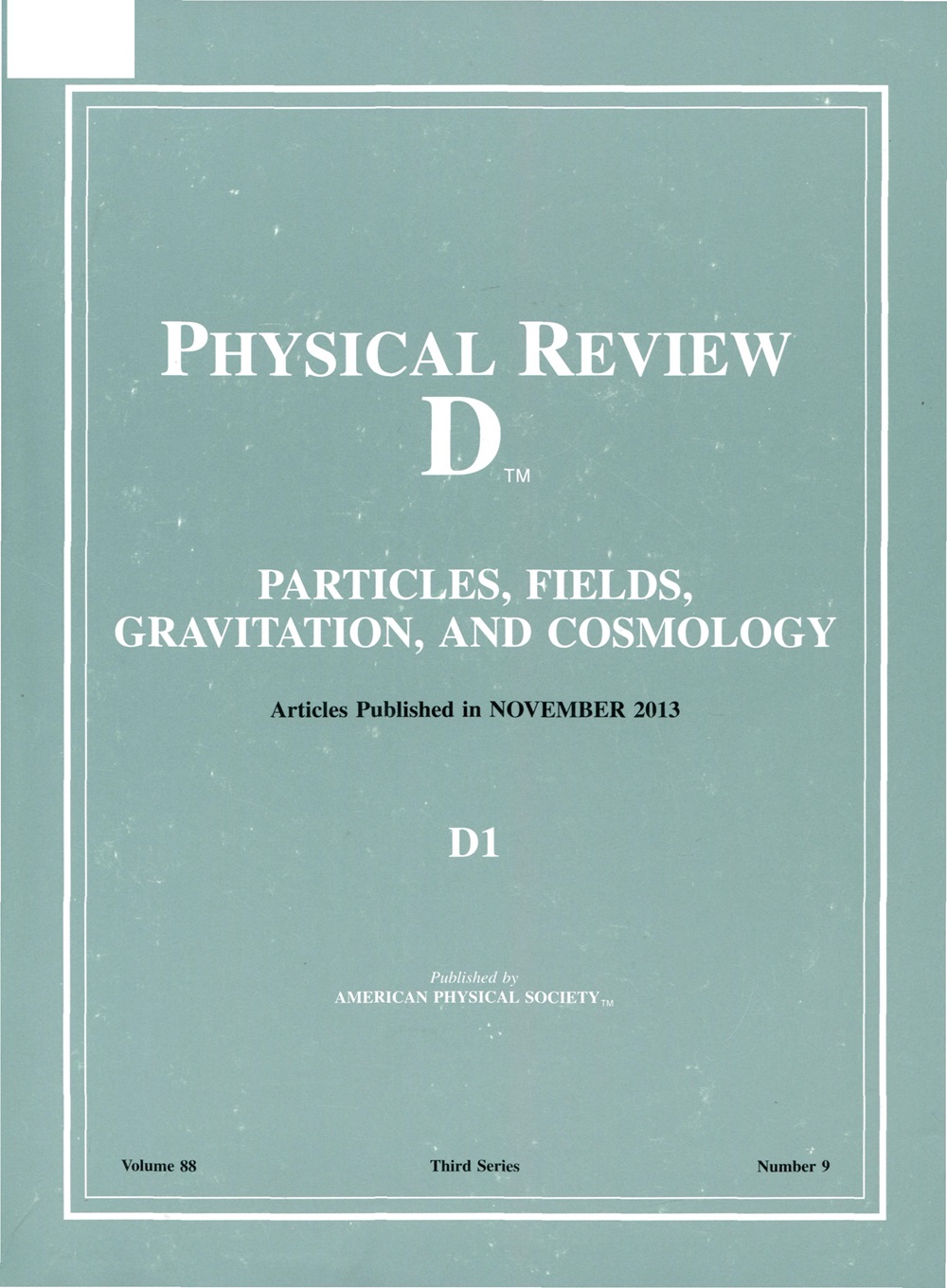
期刊介绍:
Physical Review D (PRD) is a leading journal in elementary particle physics, field theory, gravitation, and cosmology and is one of the top-cited journals in high-energy physics.
PRD covers experimental and theoretical results in all aspects of particle physics, field theory, gravitation and cosmology, including:
Particle physics experiments,
Electroweak interactions,
Strong interactions,
Lattice field theories, lattice QCD,
Beyond the standard model physics,
Phenomenological aspects of field theory, general methods,
Gravity, cosmology, cosmic rays,
Astrophysics and astroparticle physics,
General relativity,
Formal aspects of field theory, field theory in curved space,
String theory, quantum gravity, gauge/gravity duality.




 京公网安备 11010802042870号
京ICP备2023020795号-1
京公网安备 11010802042870号
京ICP备2023020795号-1

 分享
分享
 求助内容:
求助内容: 应助结果提醒方式:
 扫码关注我们
