Xing-Yu Zhou , Wen-Gang Huang , Xue-Cheng Sun , Hui Zou , Li Zhou , Zong-Quan Wu
{"title":"含金鸡纳生物碱垂饰的旋光聚合物:一种用于不对称亨利反应的高效手性有机催化剂","authors":"Xing-Yu Zhou , Wen-Gang Huang , Xue-Cheng Sun , Hui Zou , Li Zhou , Zong-Quan Wu","doi":"10.1039/d4py01284d","DOIUrl":null,"url":null,"abstract":"<div><div>Inspired by the highly efficient and enantioselective reactions catalyzed by biomacromolecules, the development of artificial helical polymer-supported catalysts is an attractive and meaningful field. In this work, a series of helical polymers, poly-<sub><em>n</em></sub>s, with controlled molecular mass (<em>M</em><sub>n</sub>s) and narrow molecular mass distribution (<em>M</em><sub>w</sub>/<em>M</em><sub>n</sub>s) bearing cinchona alkaloid pendants were obtained by asymmetric polymerization of the corresponding monomer. The poly-<sub><em>n</em></sub>s exhibited an intense positive Cotton effect at 364 nm, indicating that a preferred right-handed helix was formed in their backbone. Due to the catalytic groups on the pendants and helix in the backbone, the poly-<sub><em>n</em></sub>s exhibited satisfactory catalytic efficiency in the asymmetric Henry reaction. Compared to small molecule () with a similar structure, the enantioselectivity of the Henry reaction was significantly enhanced using poly-<sub><em>n</em></sub> as catalyst. The enantiomeric excess (ee) value of the Henry reaction could be up to 75%. Furthermore, the helical polyisocyanide catalyst could be recovered and reused facilely for at least five cycles without apparent significant loss of its enantioselectivity.</div></div>","PeriodicalId":100,"journal":{"name":"Polymer Chemistry","volume":"16 16","pages":"Pages 1869-1874"},"PeriodicalIF":3.9000,"publicationDate":"2025-01-07","publicationTypes":"Journal Article","fieldsOfStudy":null,"isOpenAccess":false,"openAccessPdf":"","citationCount":"0","resultStr":"{\"title\":\"Optically active helical polymers bearing cinchona alkaloid pendants: an efficient chiral organocatalyst for asymmetric Henry reaction†\",\"authors\":\"Xing-Yu Zhou , Wen-Gang Huang , Xue-Cheng Sun , Hui Zou , Li Zhou , Zong-Quan Wu\",\"doi\":\"10.1039/d4py01284d\",\"DOIUrl\":null,\"url\":null,\"abstract\":\"<div><div>Inspired by the highly efficient and enantioselective reactions catalyzed by biomacromolecules, the development of artificial helical polymer-supported catalysts is an attractive and meaningful field. In this work, a series of helical polymers, poly-<sub><em>n</em></sub>s, with controlled molecular mass (<em>M</em><sub>n</sub>s) and narrow molecular mass distribution (<em>M</em><sub>w</sub>/<em>M</em><sub>n</sub>s) bearing cinchona alkaloid pendants were obtained by asymmetric polymerization of the corresponding monomer. The poly-<sub><em>n</em></sub>s exhibited an intense positive Cotton effect at 364 nm, indicating that a preferred right-handed helix was formed in their backbone. Due to the catalytic groups on the pendants and helix in the backbone, the poly-<sub><em>n</em></sub>s exhibited satisfactory catalytic efficiency in the asymmetric Henry reaction. Compared to small molecule () with a similar structure, the enantioselectivity of the Henry reaction was significantly enhanced using poly-<sub><em>n</em></sub> as catalyst. The enantiomeric excess (ee) value of the Henry reaction could be up to 75%. Furthermore, the helical polyisocyanide catalyst could be recovered and reused facilely for at least five cycles without apparent significant loss of its enantioselectivity.</div></div>\",\"PeriodicalId\":100,\"journal\":{\"name\":\"Polymer Chemistry\",\"volume\":\"16 16\",\"pages\":\"Pages 1869-1874\"},\"PeriodicalIF\":3.9000,\"publicationDate\":\"2025-01-07\",\"publicationTypes\":\"Journal Article\",\"fieldsOfStudy\":null,\"isOpenAccess\":false,\"openAccessPdf\":\"\",\"citationCount\":\"0\",\"resultStr\":null,\"platform\":\"Semanticscholar\",\"paperid\":null,\"PeriodicalName\":\"Polymer Chemistry\",\"FirstCategoryId\":\"92\",\"ListUrlMain\":\"https://www.sciencedirect.com/org/science/article/pii/S1759995425001032\",\"RegionNum\":2,\"RegionCategory\":\"化学\",\"ArticlePicture\":[],\"TitleCN\":null,\"AbstractTextCN\":null,\"PMCID\":null,\"EPubDate\":\"2025/3/19 0:00:00\",\"PubModel\":\"Epub\",\"JCR\":\"Q2\",\"JCRName\":\"POLYMER SCIENCE\",\"Score\":null,\"Total\":0}","platform":"Semanticscholar","paperid":null,"PeriodicalName":"Polymer Chemistry","FirstCategoryId":"92","ListUrlMain":"https://www.sciencedirect.com/org/science/article/pii/S1759995425001032","RegionNum":2,"RegionCategory":"化学","ArticlePicture":[],"TitleCN":null,"AbstractTextCN":null,"PMCID":null,"EPubDate":"2025/3/19 0:00:00","PubModel":"Epub","JCR":"Q2","JCRName":"POLYMER SCIENCE","Score":null,"Total":0}
Optically active helical polymers bearing cinchona alkaloid pendants: an efficient chiral organocatalyst for asymmetric Henry reaction†
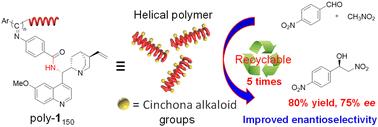
Inspired by the highly efficient and enantioselective reactions catalyzed by biomacromolecules, the development of artificial helical polymer-supported catalysts is an attractive and meaningful field. In this work, a series of helical polymers, poly-ns, with controlled molecular mass (Mns) and narrow molecular mass distribution (Mw/Mns) bearing cinchona alkaloid pendants were obtained by asymmetric polymerization of the corresponding monomer. The poly-ns exhibited an intense positive Cotton effect at 364 nm, indicating that a preferred right-handed helix was formed in their backbone. Due to the catalytic groups on the pendants and helix in the backbone, the poly-ns exhibited satisfactory catalytic efficiency in the asymmetric Henry reaction. Compared to small molecule () with a similar structure, the enantioselectivity of the Henry reaction was significantly enhanced using poly-n as catalyst. The enantiomeric excess (ee) value of the Henry reaction could be up to 75%. Furthermore, the helical polyisocyanide catalyst could be recovered and reused facilely for at least five cycles without apparent significant loss of its enantioselectivity.
期刊介绍:
Polymer Chemistry welcomes submissions in all areas of polymer science that have a strong focus on macromolecular chemistry. Manuscripts may cover a broad range of fields, yet no direct application focus is required.




 京公网安备 11010802042870号
京ICP备2023020795号-1
京公网安备 11010802042870号
京ICP备2023020795号-1

 分享
分享
 求助内容:
求助内容: 应助结果提醒方式:
 扫码关注我们
