{"title":"在线社交网络中的混合谣言揭穿:一种差分博弈方法","authors":"Chenquan Gan;Wei Yang;Qingyi Zhu;Meng Li;Deepak Kumar Jain;Vitomir Štruc;Da-Wen Huang","doi":"10.1109/TSMC.2025.3526734","DOIUrl":null,"url":null,"abstract":"Online social networks (OSNs) facilitate the rapid and extensive spreading of rumors. While most existing methods for debunking rumors consider a solitary debunker, they overlook that rumor-mongering and debunking are interdependent and confrontational behaviors. In reality, a debunker must consider the impact of rumor-mongering behavior when making decisions. Moreover, a single rumor-debunking strategy is ineffective in addressing the complexity of the rumor environment in networks. Therefore, this article proposes a hybrid rumor-debunking approach that combines truth dissemination and regulatory measures based on the differential game theory under adversarial behaviors of rumor-mongering and debunking. Toward this end, we first establish a rumor propagation model using node-based modeling techniques that can be applied to any network structure. Next, we mathematically describe and analyze the processes of rumor-mongering and debunking. Finally, we validate the theoretical results of the proposed method through various comparative experiments, including comparisons with a random strategy, a uniform strategy, and single strategy models on real-world datasets collected from Facebook, Twitter, and YouTube. Furthermore, we harness two actual rumor events to estimate parameters and predict rumor propagation, thereby affirming the veracity and effectiveness of our rumor propagation model.","PeriodicalId":48915,"journal":{"name":"IEEE Transactions on Systems Man Cybernetics-Systems","volume":"55 4","pages":"2513-2527"},"PeriodicalIF":8.7000,"publicationDate":"2025-01-22","publicationTypes":"Journal Article","fieldsOfStudy":null,"isOpenAccess":false,"openAccessPdf":"https://ieeexplore.ieee.org/stamp/stamp.jsp?tp=&arnumber=10849987","citationCount":"0","resultStr":"{\"title\":\"Hybrid Rumor Debunking in Online Social Networks: A Differential Game Approach\",\"authors\":\"Chenquan Gan;Wei Yang;Qingyi Zhu;Meng Li;Deepak Kumar Jain;Vitomir Štruc;Da-Wen Huang\",\"doi\":\"10.1109/TSMC.2025.3526734\",\"DOIUrl\":null,\"url\":null,\"abstract\":\"Online social networks (OSNs) facilitate the rapid and extensive spreading of rumors. While most existing methods for debunking rumors consider a solitary debunker, they overlook that rumor-mongering and debunking are interdependent and confrontational behaviors. In reality, a debunker must consider the impact of rumor-mongering behavior when making decisions. Moreover, a single rumor-debunking strategy is ineffective in addressing the complexity of the rumor environment in networks. Therefore, this article proposes a hybrid rumor-debunking approach that combines truth dissemination and regulatory measures based on the differential game theory under adversarial behaviors of rumor-mongering and debunking. Toward this end, we first establish a rumor propagation model using node-based modeling techniques that can be applied to any network structure. Next, we mathematically describe and analyze the processes of rumor-mongering and debunking. Finally, we validate the theoretical results of the proposed method through various comparative experiments, including comparisons with a random strategy, a uniform strategy, and single strategy models on real-world datasets collected from Facebook, Twitter, and YouTube. Furthermore, we harness two actual rumor events to estimate parameters and predict rumor propagation, thereby affirming the veracity and effectiveness of our rumor propagation model.\",\"PeriodicalId\":48915,\"journal\":{\"name\":\"IEEE Transactions on Systems Man Cybernetics-Systems\",\"volume\":\"55 4\",\"pages\":\"2513-2527\"},\"PeriodicalIF\":8.7000,\"publicationDate\":\"2025-01-22\",\"publicationTypes\":\"Journal Article\",\"fieldsOfStudy\":null,\"isOpenAccess\":false,\"openAccessPdf\":\"https://ieeexplore.ieee.org/stamp/stamp.jsp?tp=&arnumber=10849987\",\"citationCount\":\"0\",\"resultStr\":null,\"platform\":\"Semanticscholar\",\"paperid\":null,\"PeriodicalName\":\"IEEE Transactions on Systems Man Cybernetics-Systems\",\"FirstCategoryId\":\"94\",\"ListUrlMain\":\"https://ieeexplore.ieee.org/document/10849987/\",\"RegionNum\":1,\"RegionCategory\":\"计算机科学\",\"ArticlePicture\":[],\"TitleCN\":null,\"AbstractTextCN\":null,\"PMCID\":null,\"EPubDate\":\"\",\"PubModel\":\"\",\"JCR\":\"Q1\",\"JCRName\":\"AUTOMATION & CONTROL SYSTEMS\",\"Score\":null,\"Total\":0}","platform":"Semanticscholar","paperid":null,"PeriodicalName":"IEEE Transactions on Systems Man Cybernetics-Systems","FirstCategoryId":"94","ListUrlMain":"https://ieeexplore.ieee.org/document/10849987/","RegionNum":1,"RegionCategory":"计算机科学","ArticlePicture":[],"TitleCN":null,"AbstractTextCN":null,"PMCID":null,"EPubDate":"","PubModel":"","JCR":"Q1","JCRName":"AUTOMATION & CONTROL SYSTEMS","Score":null,"Total":0}
Hybrid Rumor Debunking in Online Social Networks: A Differential Game Approach
Online social networks (OSNs) facilitate the rapid and extensive spreading of rumors. While most existing methods for debunking rumors consider a solitary debunker, they overlook that rumor-mongering and debunking are interdependent and confrontational behaviors. In reality, a debunker must consider the impact of rumor-mongering behavior when making decisions. Moreover, a single rumor-debunking strategy is ineffective in addressing the complexity of the rumor environment in networks. Therefore, this article proposes a hybrid rumor-debunking approach that combines truth dissemination and regulatory measures based on the differential game theory under adversarial behaviors of rumor-mongering and debunking. Toward this end, we first establish a rumor propagation model using node-based modeling techniques that can be applied to any network structure. Next, we mathematically describe and analyze the processes of rumor-mongering and debunking. Finally, we validate the theoretical results of the proposed method through various comparative experiments, including comparisons with a random strategy, a uniform strategy, and single strategy models on real-world datasets collected from Facebook, Twitter, and YouTube. Furthermore, we harness two actual rumor events to estimate parameters and predict rumor propagation, thereby affirming the veracity and effectiveness of our rumor propagation model.
期刊介绍:
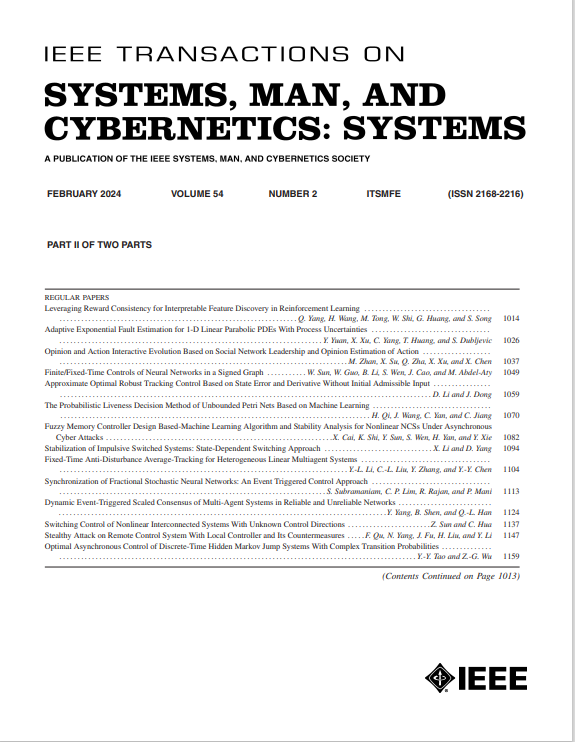
The IEEE Transactions on Systems, Man, and Cybernetics: Systems encompasses the fields of systems engineering, covering issue formulation, analysis, and modeling throughout the systems engineering lifecycle phases. It addresses decision-making, issue interpretation, systems management, processes, and various methods such as optimization, modeling, and simulation in the development and deployment of large systems.




 京公网安备 11010802042870号
京ICP备2023020795号-1
京公网安备 11010802042870号
京ICP备2023020795号-1

 分享
分享
 求助内容:
求助内容: 应助结果提醒方式:
 扫码关注我们
