Roger Y Kim, Katharine A Rendle, Nandita Mitra, Christine Neslund-Dudas, Robert T Greenlee, Stacey A Honda, Marilyn M Schapira, Michael J Simoff, Jihyoun Jeon, Rafael Meza, Debra P Ritzwoller, Anil Vachani
{"title":"坚持年度肺癌筛查和癌症诊断率。","authors":"Roger Y Kim, Katharine A Rendle, Nandita Mitra, Christine Neslund-Dudas, Robert T Greenlee, Stacey A Honda, Marilyn M Schapira, Michael J Simoff, Jihyoun Jeon, Rafael Meza, Debra P Ritzwoller, Anil Vachani","doi":"10.1001/jamanetworkopen.2025.0942","DOIUrl":null,"url":null,"abstract":"<p><strong>Importance: </strong>Adherence to annual lung cancer screening (LCS) is a proposed quality metric for LCS programs, but data linking annual adherence to lung cancer outcomes are lacking.</p><p><strong>Objective: </strong>To investigate annual LCS adherence rates across 2 subsequent LCS rounds among adults undergoing baseline LCS and examine the association of adherence with lung cancer diagnosis rates.</p><p><strong>Design, setting, and participants: </strong>This retrospective cohort study included adults aged 55 to 75 years who formerly or currently smoked and underwent baseline LCS between January 1, 2015, and December 31, 2018, across 5 US health care systems in the Population-Based Research to Optimize the Screening Process-Lung Consortium. Participants with missing Lung Computed Tomography Screening Reporting & Data System scores or a lung cancer diagnosis prior to LCS initiation were excluded. Data were analyzed from October 2023 to October 2024.</p><p><strong>Exposures: </strong>For negative baseline screening results, T1 and T2 screening adherence was defined as chest computed tomography (CT) between 10 and 18 months and 22 and 30 months after baseline, respectively. For positive baseline screening results, T1 and T2 adherence was defined as chest CT between 11 and 21 months and 28 and 36 months after baseline, respectively.</p><p><strong>Main outcomes and measures: </strong>The main outcomes were annual T1 and T2 LCS adherence rates and associations between T1 and T2 screening adherence; annual incident lung cancer diagnoses in rounds T0 (0-12 months after baseline), T1 (>12 to 24 months after baseline), and T2 (>24 to 36 months after baseline); and cancer stage distribution.</p><p><strong>Results: </strong>A total of 10 170 individuals received baseline LCS (median age, 65 years [IQR, 60-69 years]; 5415 [53.2%] male). During round T1, 6141 of 10 033 eligible patients (61.2% [95% CI, 60.2%-62.2%]) were adherent, and during round T2, 5028 of 9966 eligible patients (50.5% [95% CI, 49.5%-51.4%]) were adherent. T1 adherence was significantly associated with T2 adherence (adjusted relative risk, 2.40; 95% CI, 2.06-2.79). Across 36 months of follow-up, 279 patients (2.7%; 95% CI, 2.4%-3.1%) were diagnosed with lung cancer. Incident lung cancer diagnosis rates were 1.3% (95% CI, 1.1%-1.6%), 0.7% (95% CI, 0.5%-0.8%), and 0.8% (95% CI, 0.6%-0.9%) during rounds T0, T1, and T2, respectively. Lung cancer diagnosis rates were higher among individuals who were LCS adherent vs nonadherent during both rounds T1 (59 of 6141 [1.0%; 95% CI, 0.7%-1.2%] vs 8 of 3892 [0.2%; 95% CI, 0.1%-0.4%]; P < .001) and T2 (63 of 5028 [1.3%; 95% CI, 1.0%-1.6%] vs 12 of 4938 [0.2%; 95% CI, 0.1%-0.4%]; P < .001). A greater proportion of early-stage lung cancers were diagnosed among individuals adherent to screening at T2 compared with those who were not (46 of 63 [73.0%] vs 3 of 12 [25.0%]; P = .006).</p><p><strong>Conclusions and relevance: </strong>In this multicenter cohort study of adults undergoing LCS, screening adherence was associated with increased overall and early-stage lung cancer detection rates; however, adherence decreased annually after baseline screening, suggesting that it is an important LCS quality metric.</p>","PeriodicalId":14694,"journal":{"name":"JAMA Network Open","volume":"8 3","pages":"e250942"},"PeriodicalIF":9.7000,"publicationDate":"2025-03-03","publicationTypes":"Journal Article","fieldsOfStudy":null,"isOpenAccess":false,"openAccessPdf":"https://www.ncbi.nlm.nih.gov/pmc/articles/PMC11920840/pdf/","citationCount":"0","resultStr":"{\"title\":\"Adherence to Annual Lung Cancer Screening and Rates of Cancer Diagnosis.\",\"authors\":\"Roger Y Kim, Katharine A Rendle, Nandita Mitra, Christine Neslund-Dudas, Robert T Greenlee, Stacey A Honda, Marilyn M Schapira, Michael J Simoff, Jihyoun Jeon, Rafael Meza, Debra P Ritzwoller, Anil Vachani\",\"doi\":\"10.1001/jamanetworkopen.2025.0942\",\"DOIUrl\":null,\"url\":null,\"abstract\":\"<p><strong>Importance: </strong>Adherence to annual lung cancer screening (LCS) is a proposed quality metric for LCS programs, but data linking annual adherence to lung cancer outcomes are lacking.</p><p><strong>Objective: </strong>To investigate annual LCS adherence rates across 2 subsequent LCS rounds among adults undergoing baseline LCS and examine the association of adherence with lung cancer diagnosis rates.</p><p><strong>Design, setting, and participants: </strong>This retrospective cohort study included adults aged 55 to 75 years who formerly or currently smoked and underwent baseline LCS between January 1, 2015, and December 31, 2018, across 5 US health care systems in the Population-Based Research to Optimize the Screening Process-Lung Consortium. Participants with missing Lung Computed Tomography Screening Reporting & Data System scores or a lung cancer diagnosis prior to LCS initiation were excluded. Data were analyzed from October 2023 to October 2024.</p><p><strong>Exposures: </strong>For negative baseline screening results, T1 and T2 screening adherence was defined as chest computed tomography (CT) between 10 and 18 months and 22 and 30 months after baseline, respectively. For positive baseline screening results, T1 and T2 adherence was defined as chest CT between 11 and 21 months and 28 and 36 months after baseline, respectively.</p><p><strong>Main outcomes and measures: </strong>The main outcomes were annual T1 and T2 LCS adherence rates and associations between T1 and T2 screening adherence; annual incident lung cancer diagnoses in rounds T0 (0-12 months after baseline), T1 (>12 to 24 months after baseline), and T2 (>24 to 36 months after baseline); and cancer stage distribution.</p><p><strong>Results: </strong>A total of 10 170 individuals received baseline LCS (median age, 65 years [IQR, 60-69 years]; 5415 [53.2%] male). During round T1, 6141 of 10 033 eligible patients (61.2% [95% CI, 60.2%-62.2%]) were adherent, and during round T2, 5028 of 9966 eligible patients (50.5% [95% CI, 49.5%-51.4%]) were adherent. T1 adherence was significantly associated with T2 adherence (adjusted relative risk, 2.40; 95% CI, 2.06-2.79). Across 36 months of follow-up, 279 patients (2.7%; 95% CI, 2.4%-3.1%) were diagnosed with lung cancer. Incident lung cancer diagnosis rates were 1.3% (95% CI, 1.1%-1.6%), 0.7% (95% CI, 0.5%-0.8%), and 0.8% (95% CI, 0.6%-0.9%) during rounds T0, T1, and T2, respectively. Lung cancer diagnosis rates were higher among individuals who were LCS adherent vs nonadherent during both rounds T1 (59 of 6141 [1.0%; 95% CI, 0.7%-1.2%] vs 8 of 3892 [0.2%; 95% CI, 0.1%-0.4%]; P < .001) and T2 (63 of 5028 [1.3%; 95% CI, 1.0%-1.6%] vs 12 of 4938 [0.2%; 95% CI, 0.1%-0.4%]; P < .001). A greater proportion of early-stage lung cancers were diagnosed among individuals adherent to screening at T2 compared with those who were not (46 of 63 [73.0%] vs 3 of 12 [25.0%]; P = .006).</p><p><strong>Conclusions and relevance: </strong>In this multicenter cohort study of adults undergoing LCS, screening adherence was associated with increased overall and early-stage lung cancer detection rates; however, adherence decreased annually after baseline screening, suggesting that it is an important LCS quality metric.</p>\",\"PeriodicalId\":14694,\"journal\":{\"name\":\"JAMA Network Open\",\"volume\":\"8 3\",\"pages\":\"e250942\"},\"PeriodicalIF\":9.7000,\"publicationDate\":\"2025-03-03\",\"publicationTypes\":\"Journal Article\",\"fieldsOfStudy\":null,\"isOpenAccess\":false,\"openAccessPdf\":\"https://www.ncbi.nlm.nih.gov/pmc/articles/PMC11920840/pdf/\",\"citationCount\":\"0\",\"resultStr\":null,\"platform\":\"Semanticscholar\",\"paperid\":null,\"PeriodicalName\":\"JAMA Network Open\",\"FirstCategoryId\":\"3\",\"ListUrlMain\":\"https://doi.org/10.1001/jamanetworkopen.2025.0942\",\"RegionNum\":1,\"RegionCategory\":\"医学\",\"ArticlePicture\":[],\"TitleCN\":null,\"AbstractTextCN\":null,\"PMCID\":null,\"EPubDate\":\"\",\"PubModel\":\"\",\"JCR\":\"Q1\",\"JCRName\":\"MEDICINE, GENERAL & INTERNAL\",\"Score\":null,\"Total\":0}","platform":"Semanticscholar","paperid":null,"PeriodicalName":"JAMA Network Open","FirstCategoryId":"3","ListUrlMain":"https://doi.org/10.1001/jamanetworkopen.2025.0942","RegionNum":1,"RegionCategory":"医学","ArticlePicture":[],"TitleCN":null,"AbstractTextCN":null,"PMCID":null,"EPubDate":"","PubModel":"","JCR":"Q1","JCRName":"MEDICINE, GENERAL & INTERNAL","Score":null,"Total":0}
Adherence to Annual Lung Cancer Screening and Rates of Cancer Diagnosis.
Importance: Adherence to annual lung cancer screening (LCS) is a proposed quality metric for LCS programs, but data linking annual adherence to lung cancer outcomes are lacking.
Objective: To investigate annual LCS adherence rates across 2 subsequent LCS rounds among adults undergoing baseline LCS and examine the association of adherence with lung cancer diagnosis rates.
Design, setting, and participants: This retrospective cohort study included adults aged 55 to 75 years who formerly or currently smoked and underwent baseline LCS between January 1, 2015, and December 31, 2018, across 5 US health care systems in the Population-Based Research to Optimize the Screening Process-Lung Consortium. Participants with missing Lung Computed Tomography Screening Reporting & Data System scores or a lung cancer diagnosis prior to LCS initiation were excluded. Data were analyzed from October 2023 to October 2024.
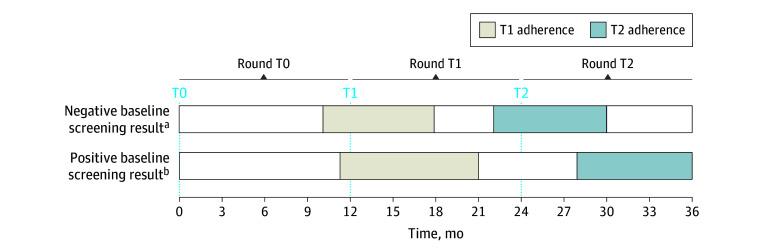
Exposures: For negative baseline screening results, T1 and T2 screening adherence was defined as chest computed tomography (CT) between 10 and 18 months and 22 and 30 months after baseline, respectively. For positive baseline screening results, T1 and T2 adherence was defined as chest CT between 11 and 21 months and 28 and 36 months after baseline, respectively.
Main outcomes and measures: The main outcomes were annual T1 and T2 LCS adherence rates and associations between T1 and T2 screening adherence; annual incident lung cancer diagnoses in rounds T0 (0-12 months after baseline), T1 (>12 to 24 months after baseline), and T2 (>24 to 36 months after baseline); and cancer stage distribution.
Results: A total of 10 170 individuals received baseline LCS (median age, 65 years [IQR, 60-69 years]; 5415 [53.2%] male). During round T1, 6141 of 10 033 eligible patients (61.2% [95% CI, 60.2%-62.2%]) were adherent, and during round T2, 5028 of 9966 eligible patients (50.5% [95% CI, 49.5%-51.4%]) were adherent. T1 adherence was significantly associated with T2 adherence (adjusted relative risk, 2.40; 95% CI, 2.06-2.79). Across 36 months of follow-up, 279 patients (2.7%; 95% CI, 2.4%-3.1%) were diagnosed with lung cancer. Incident lung cancer diagnosis rates were 1.3% (95% CI, 1.1%-1.6%), 0.7% (95% CI, 0.5%-0.8%), and 0.8% (95% CI, 0.6%-0.9%) during rounds T0, T1, and T2, respectively. Lung cancer diagnosis rates were higher among individuals who were LCS adherent vs nonadherent during both rounds T1 (59 of 6141 [1.0%; 95% CI, 0.7%-1.2%] vs 8 of 3892 [0.2%; 95% CI, 0.1%-0.4%]; P < .001) and T2 (63 of 5028 [1.3%; 95% CI, 1.0%-1.6%] vs 12 of 4938 [0.2%; 95% CI, 0.1%-0.4%]; P < .001). A greater proportion of early-stage lung cancers were diagnosed among individuals adherent to screening at T2 compared with those who were not (46 of 63 [73.0%] vs 3 of 12 [25.0%]; P = .006).
Conclusions and relevance: In this multicenter cohort study of adults undergoing LCS, screening adherence was associated with increased overall and early-stage lung cancer detection rates; however, adherence decreased annually after baseline screening, suggesting that it is an important LCS quality metric.
期刊介绍:
JAMA Network Open, a member of the esteemed JAMA Network, stands as an international, peer-reviewed, open-access general medical journal.The publication is dedicated to disseminating research across various health disciplines and countries, encompassing clinical care, innovation in health care, health policy, and global health.
JAMA Network Open caters to clinicians, investigators, and policymakers, providing a platform for valuable insights and advancements in the medical field. As part of the JAMA Network, a consortium of peer-reviewed general medical and specialty publications, JAMA Network Open contributes to the collective knowledge and understanding within the medical community.






 京公网安备 11010802042870号
京ICP备2023020795号-1
京公网安备 11010802042870号
京ICP备2023020795号-1

 分享
分享
 求助内容:
求助内容: 应助结果提醒方式:
 扫码关注我们
