{"title":"基于三维CT图像重建技术的侧位压缩II螺钉路径及入路参数的解剖学研究。","authors":"Xingye Du, Yong Liu, Xuefeng Jiang","doi":"10.1111/os.70011","DOIUrl":null,"url":null,"abstract":"<p><strong>Objective: </strong>Lateral compression II (LC-II) fractures, a common type of pelvic injury, often require closed reduction and percutaneous screw fixation due to posterior pelvic ring instability. However, existing methods fail to adequately account for the internal structure of the screw path and lack precise anatomical guidance, increasing surgical risks. This study utilized digital medical software to analyze the LC-II screw path and entry parameters, providing the anatomical references.</p><p><strong>Methods: </strong>This retrospective study enrolled 43 adult patients (21 males and 22 females) who underwent a complete computed tomography (CT) scan examination from February 2017 to February 2019. The digital three-dimensional (3D) pelvic model was reconstructed, and the ideal LC-II screw path was designed by the cross-section method. The primary evaluation parameters included the screw path length (D <sub>AP</sub>), maximum diameter (D <sub>max</sub>), distances at narrow points (D1 and D2), bone thickness parameters (OW1 and IW1; OW2 and IW2), and screw entry angles (∠α, ∠β, ∠γ).</p><p><strong>Results: </strong>Of 43 patients, 42 successfully completed LC-II screw path construction. Among 21 female patients, 5 (23.8%) could accommodate screws with a maximum diameter of < 6.5 mm. Compared with female patients, male patients exhibited significantly higher D <sub>AP</sub>, D <sub>max</sub>, D <sub>2</sub>, OW<sub>1</sub>, IW<sub>1</sub>, IW<sub>1</sub>/OW<sub>1</sub>, and IW<sub>2</sub>/OW<sub>2</sub> (p < 0.05). The ∠γ was significantly lower in male patients. Furthermore, digital 3D pelvic model observations revealed that LC-II screws bone entry points in the anterior iliac region were all located posterior to the anterior inferior iliac spine (AIIS). The angles between the LC-II screw and coronal plane were 48.06° in males and 45.10° in females, while the angles between the LC-II screw and sagittal plane were 27.14° and 25.60°, respectively.</p><p><strong>Conclusion: </strong>This study utilized digital medical software to construct the LC-II screw path and analyze sex-based differences, highlighting the importance of individualized preoperative path planning and providing essential anatomical evidence for the precise and safe percutaneous insertion of LC-II screws.</p>","PeriodicalId":19566,"journal":{"name":"Orthopaedic Surgery","volume":" ","pages":"1454-1463"},"PeriodicalIF":2.1000,"publicationDate":"2025-05-01","publicationTypes":"Journal Article","fieldsOfStudy":null,"isOpenAccess":false,"openAccessPdf":"https://www.ncbi.nlm.nih.gov/pmc/articles/PMC12050174/pdf/","citationCount":"0","resultStr":"{\"title\":\"Anatomical Study of Lateral Compression II Screw Path and Entry Parameters Based on Three-Dimensional CT Image Reconstruction Techniques.\",\"authors\":\"Xingye Du, Yong Liu, Xuefeng Jiang\",\"doi\":\"10.1111/os.70011\",\"DOIUrl\":null,\"url\":null,\"abstract\":\"<p><strong>Objective: </strong>Lateral compression II (LC-II) fractures, a common type of pelvic injury, often require closed reduction and percutaneous screw fixation due to posterior pelvic ring instability. However, existing methods fail to adequately account for the internal structure of the screw path and lack precise anatomical guidance, increasing surgical risks. This study utilized digital medical software to analyze the LC-II screw path and entry parameters, providing the anatomical references.</p><p><strong>Methods: </strong>This retrospective study enrolled 43 adult patients (21 males and 22 females) who underwent a complete computed tomography (CT) scan examination from February 2017 to February 2019. The digital three-dimensional (3D) pelvic model was reconstructed, and the ideal LC-II screw path was designed by the cross-section method. The primary evaluation parameters included the screw path length (D <sub>AP</sub>), maximum diameter (D <sub>max</sub>), distances at narrow points (D1 and D2), bone thickness parameters (OW1 and IW1; OW2 and IW2), and screw entry angles (∠α, ∠β, ∠γ).</p><p><strong>Results: </strong>Of 43 patients, 42 successfully completed LC-II screw path construction. Among 21 female patients, 5 (23.8%) could accommodate screws with a maximum diameter of < 6.5 mm. Compared with female patients, male patients exhibited significantly higher D <sub>AP</sub>, D <sub>max</sub>, D <sub>2</sub>, OW<sub>1</sub>, IW<sub>1</sub>, IW<sub>1</sub>/OW<sub>1</sub>, and IW<sub>2</sub>/OW<sub>2</sub> (p < 0.05). The ∠γ was significantly lower in male patients. Furthermore, digital 3D pelvic model observations revealed that LC-II screws bone entry points in the anterior iliac region were all located posterior to the anterior inferior iliac spine (AIIS). The angles between the LC-II screw and coronal plane were 48.06° in males and 45.10° in females, while the angles between the LC-II screw and sagittal plane were 27.14° and 25.60°, respectively.</p><p><strong>Conclusion: </strong>This study utilized digital medical software to construct the LC-II screw path and analyze sex-based differences, highlighting the importance of individualized preoperative path planning and providing essential anatomical evidence for the precise and safe percutaneous insertion of LC-II screws.</p>\",\"PeriodicalId\":19566,\"journal\":{\"name\":\"Orthopaedic Surgery\",\"volume\":\" \",\"pages\":\"1454-1463\"},\"PeriodicalIF\":2.1000,\"publicationDate\":\"2025-05-01\",\"publicationTypes\":\"Journal Article\",\"fieldsOfStudy\":null,\"isOpenAccess\":false,\"openAccessPdf\":\"https://www.ncbi.nlm.nih.gov/pmc/articles/PMC12050174/pdf/\",\"citationCount\":\"0\",\"resultStr\":null,\"platform\":\"Semanticscholar\",\"paperid\":null,\"PeriodicalName\":\"Orthopaedic Surgery\",\"FirstCategoryId\":\"3\",\"ListUrlMain\":\"https://doi.org/10.1111/os.70011\",\"RegionNum\":2,\"RegionCategory\":\"医学\",\"ArticlePicture\":[],\"TitleCN\":null,\"AbstractTextCN\":null,\"PMCID\":null,\"EPubDate\":\"2025/3/18 0:00:00\",\"PubModel\":\"Epub\",\"JCR\":\"Q2\",\"JCRName\":\"ORTHOPEDICS\",\"Score\":null,\"Total\":0}","platform":"Semanticscholar","paperid":null,"PeriodicalName":"Orthopaedic Surgery","FirstCategoryId":"3","ListUrlMain":"https://doi.org/10.1111/os.70011","RegionNum":2,"RegionCategory":"医学","ArticlePicture":[],"TitleCN":null,"AbstractTextCN":null,"PMCID":null,"EPubDate":"2025/3/18 0:00:00","PubModel":"Epub","JCR":"Q2","JCRName":"ORTHOPEDICS","Score":null,"Total":0}
Anatomical Study of Lateral Compression II Screw Path and Entry Parameters Based on Three-Dimensional CT Image Reconstruction Techniques.
Objective: Lateral compression II (LC-II) fractures, a common type of pelvic injury, often require closed reduction and percutaneous screw fixation due to posterior pelvic ring instability. However, existing methods fail to adequately account for the internal structure of the screw path and lack precise anatomical guidance, increasing surgical risks. This study utilized digital medical software to analyze the LC-II screw path and entry parameters, providing the anatomical references.
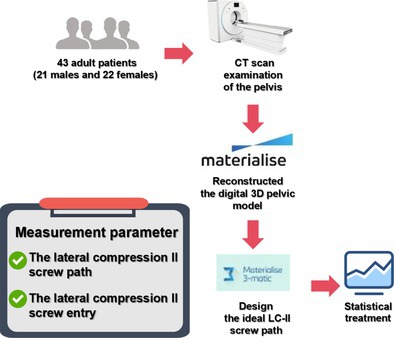
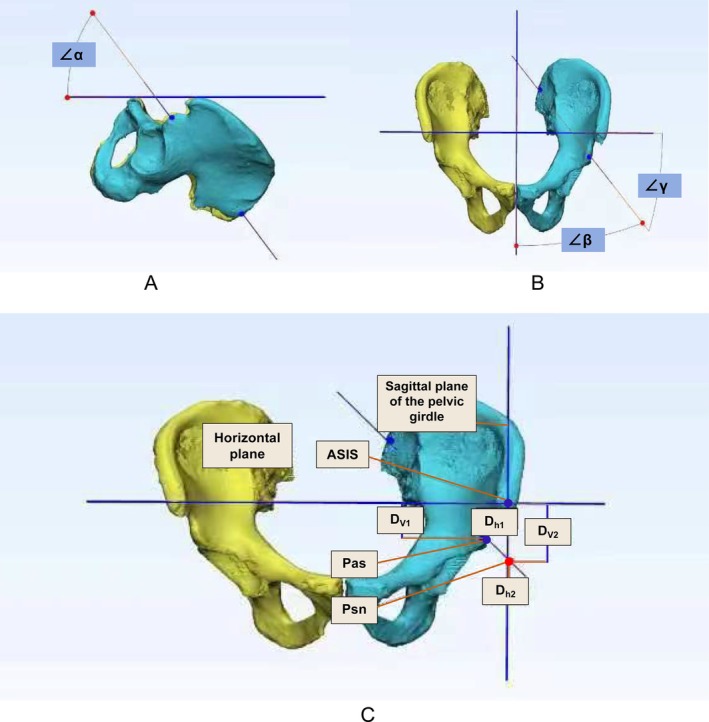
Methods: This retrospective study enrolled 43 adult patients (21 males and 22 females) who underwent a complete computed tomography (CT) scan examination from February 2017 to February 2019. The digital three-dimensional (3D) pelvic model was reconstructed, and the ideal LC-II screw path was designed by the cross-section method. The primary evaluation parameters included the screw path length (D AP), maximum diameter (D max), distances at narrow points (D1 and D2), bone thickness parameters (OW1 and IW1; OW2 and IW2), and screw entry angles (∠α, ∠β, ∠γ).
Results: Of 43 patients, 42 successfully completed LC-II screw path construction. Among 21 female patients, 5 (23.8%) could accommodate screws with a maximum diameter of < 6.5 mm. Compared with female patients, male patients exhibited significantly higher D AP, D max, D 2, OW1, IW1, IW1/OW1, and IW2/OW2 (p < 0.05). The ∠γ was significantly lower in male patients. Furthermore, digital 3D pelvic model observations revealed that LC-II screws bone entry points in the anterior iliac region were all located posterior to the anterior inferior iliac spine (AIIS). The angles between the LC-II screw and coronal plane were 48.06° in males and 45.10° in females, while the angles between the LC-II screw and sagittal plane were 27.14° and 25.60°, respectively.
Conclusion: This study utilized digital medical software to construct the LC-II screw path and analyze sex-based differences, highlighting the importance of individualized preoperative path planning and providing essential anatomical evidence for the precise and safe percutaneous insertion of LC-II screws.
期刊介绍:
Orthopaedic Surgery (OS) is the official journal of the Chinese Orthopaedic Association, focusing on all aspects of orthopaedic technique and surgery.
The journal publishes peer-reviewed articles in the following categories: Original Articles, Clinical Articles, Review Articles, Guidelines, Editorials, Commentaries, Surgical Techniques, Case Reports and Meeting Reports.





 京公网安备 11010802042870号
京ICP备2023020795号-1
京公网安备 11010802042870号
京ICP备2023020795号-1

 分享
分享
 求助内容:
求助内容: 应助结果提醒方式:
 扫码关注我们
