Betul Kula, Ahmet Kula, Fatih Bagcier, Bulent Alyanak
{"title":"颞下颌关节疾病的人工智能解决方案:ChatGPT的贡献和未来潜力。","authors":"Betul Kula, Ahmet Kula, Fatih Bagcier, Bulent Alyanak","doi":"10.4041/kjod24.106","DOIUrl":null,"url":null,"abstract":"<p><strong>Objective: </strong>This study aimed to evaluate the reliability and usefulness of information generated by Chat Generative Pre-Trained Transformer (ChatGPT) on temporomandibular joint disorders (TMD).</p><p><strong>Methods: </strong>We asked ChatGPT about the diseases specified in the TMD classification and scored the responses using Likert reliability and usefulness scales, the modified DISCERN (mDISCERN) scale, and the Global Quality Scale (GQS).</p><p><strong>Results: </strong>The highest Likert scores for both reliability and usefulness were for masticatory muscle disorders (mean ± standard deviation [SD]: 6.0 ± 0), and the lowest scores were for inflammatory disorders of the temporomandibular joint (mean ± SD: 4.3 ± 0.6 for reliability, 4.0 ± 0 for usefulness). The median Likert reliability score indicates that the responses are highly reliable. The median Likert usefulness score was 5 (4-6), indicating that the responses were moderately useful. A comparative analysis was performed, and no statistically significant differences were found in any subject for either reliability or usefulness (<i>P</i> = 0.083-1.000). The median mDISCERN score was 4 (3-5) for the two raters. A statistically significant difference was observed in the mean mDISCERN scores between the two raters (<i>P</i> = 0.046). The GQS scores indicated a moderate to high quality (mean ± SD: 3.8 ± 0.8 for rater 1, 4.0 ± 0.5 for rater 2). No statistically significant correlation was found between mDISCERN and GQS scores (r = -0.006, <i>P</i> = 0.980).</p><p><strong>Conclusions: </strong>Although ChatGPT-4 has significant potential, it can be used as an additional source of information regarding TMD for patients and clinicians.</p>","PeriodicalId":51260,"journal":{"name":"Korean Journal of Orthodontics","volume":"55 2","pages":"131-141"},"PeriodicalIF":2.3000,"publicationDate":"2025-03-25","publicationTypes":"Journal Article","fieldsOfStudy":null,"isOpenAccess":false,"openAccessPdf":"https://www.ncbi.nlm.nih.gov/pmc/articles/PMC11922634/pdf/","citationCount":"0","resultStr":"{\"title\":\"Artificial intelligence solutions for temporomandibular joint disorders: Contributions and future potential of ChatGPT.\",\"authors\":\"Betul Kula, Ahmet Kula, Fatih Bagcier, Bulent Alyanak\",\"doi\":\"10.4041/kjod24.106\",\"DOIUrl\":null,\"url\":null,\"abstract\":\"<p><strong>Objective: </strong>This study aimed to evaluate the reliability and usefulness of information generated by Chat Generative Pre-Trained Transformer (ChatGPT) on temporomandibular joint disorders (TMD).</p><p><strong>Methods: </strong>We asked ChatGPT about the diseases specified in the TMD classification and scored the responses using Likert reliability and usefulness scales, the modified DISCERN (mDISCERN) scale, and the Global Quality Scale (GQS).</p><p><strong>Results: </strong>The highest Likert scores for both reliability and usefulness were for masticatory muscle disorders (mean ± standard deviation [SD]: 6.0 ± 0), and the lowest scores were for inflammatory disorders of the temporomandibular joint (mean ± SD: 4.3 ± 0.6 for reliability, 4.0 ± 0 for usefulness). The median Likert reliability score indicates that the responses are highly reliable. The median Likert usefulness score was 5 (4-6), indicating that the responses were moderately useful. A comparative analysis was performed, and no statistically significant differences were found in any subject for either reliability or usefulness (<i>P</i> = 0.083-1.000). The median mDISCERN score was 4 (3-5) for the two raters. A statistically significant difference was observed in the mean mDISCERN scores between the two raters (<i>P</i> = 0.046). The GQS scores indicated a moderate to high quality (mean ± SD: 3.8 ± 0.8 for rater 1, 4.0 ± 0.5 for rater 2). No statistically significant correlation was found between mDISCERN and GQS scores (r = -0.006, <i>P</i> = 0.980).</p><p><strong>Conclusions: </strong>Although ChatGPT-4 has significant potential, it can be used as an additional source of information regarding TMD for patients and clinicians.</p>\",\"PeriodicalId\":51260,\"journal\":{\"name\":\"Korean Journal of Orthodontics\",\"volume\":\"55 2\",\"pages\":\"131-141\"},\"PeriodicalIF\":2.3000,\"publicationDate\":\"2025-03-25\",\"publicationTypes\":\"Journal Article\",\"fieldsOfStudy\":null,\"isOpenAccess\":false,\"openAccessPdf\":\"https://www.ncbi.nlm.nih.gov/pmc/articles/PMC11922634/pdf/\",\"citationCount\":\"0\",\"resultStr\":null,\"platform\":\"Semanticscholar\",\"paperid\":null,\"PeriodicalName\":\"Korean Journal of Orthodontics\",\"FirstCategoryId\":\"3\",\"ListUrlMain\":\"https://doi.org/10.4041/kjod24.106\",\"RegionNum\":3,\"RegionCategory\":\"医学\",\"ArticlePicture\":[],\"TitleCN\":null,\"AbstractTextCN\":null,\"PMCID\":null,\"EPubDate\":\"2024/12/11 0:00:00\",\"PubModel\":\"Epub\",\"JCR\":\"Q1\",\"JCRName\":\"DENTISTRY, ORAL SURGERY & MEDICINE\",\"Score\":null,\"Total\":0}","platform":"Semanticscholar","paperid":null,"PeriodicalName":"Korean Journal of Orthodontics","FirstCategoryId":"3","ListUrlMain":"https://doi.org/10.4041/kjod24.106","RegionNum":3,"RegionCategory":"医学","ArticlePicture":[],"TitleCN":null,"AbstractTextCN":null,"PMCID":null,"EPubDate":"2024/12/11 0:00:00","PubModel":"Epub","JCR":"Q1","JCRName":"DENTISTRY, ORAL SURGERY & MEDICINE","Score":null,"Total":0}
Artificial intelligence solutions for temporomandibular joint disorders: Contributions and future potential of ChatGPT.
Objective: This study aimed to evaluate the reliability and usefulness of information generated by Chat Generative Pre-Trained Transformer (ChatGPT) on temporomandibular joint disorders (TMD).
Methods: We asked ChatGPT about the diseases specified in the TMD classification and scored the responses using Likert reliability and usefulness scales, the modified DISCERN (mDISCERN) scale, and the Global Quality Scale (GQS).
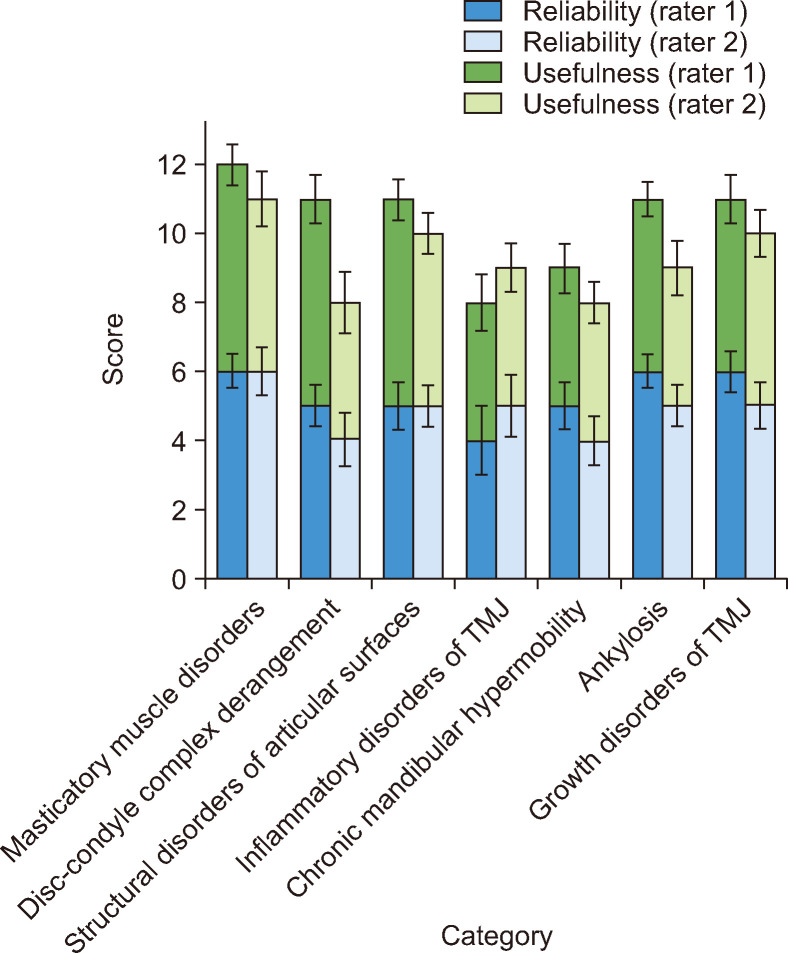
Results: The highest Likert scores for both reliability and usefulness were for masticatory muscle disorders (mean ± standard deviation [SD]: 6.0 ± 0), and the lowest scores were for inflammatory disorders of the temporomandibular joint (mean ± SD: 4.3 ± 0.6 for reliability, 4.0 ± 0 for usefulness). The median Likert reliability score indicates that the responses are highly reliable. The median Likert usefulness score was 5 (4-6), indicating that the responses were moderately useful. A comparative analysis was performed, and no statistically significant differences were found in any subject for either reliability or usefulness (P = 0.083-1.000). The median mDISCERN score was 4 (3-5) for the two raters. A statistically significant difference was observed in the mean mDISCERN scores between the two raters (P = 0.046). The GQS scores indicated a moderate to high quality (mean ± SD: 3.8 ± 0.8 for rater 1, 4.0 ± 0.5 for rater 2). No statistically significant correlation was found between mDISCERN and GQS scores (r = -0.006, P = 0.980).
Conclusions: Although ChatGPT-4 has significant potential, it can be used as an additional source of information regarding TMD for patients and clinicians.
期刊介绍:
The Korean Journal of Orthodontics (KJO) is an international, open access, peer reviewed journal published in January, March, May, July, September, and November each year. It was first launched in 1970 and, as the official scientific publication of Korean Association of Orthodontists, KJO aims to publish high quality clinical and scientific original research papers in all areas related to orthodontics and dentofacial orthopedics. Specifically, its interest focuses on evidence-based investigations of contemporary diagnostic procedures and treatment techniques, expanding to significant clinical reports of diverse treatment approaches.
The scope of KJO covers all areas of orthodontics and dentofacial orthopedics including successful diagnostic procedures and treatment planning, growth and development of the face and its clinical implications, appliance designs, biomechanics, TMJ disorders and adult treatment. Specifically, its latest interest focuses on skeletal anchorage devices, orthodontic appliance and biomaterials, 3 dimensional imaging techniques utilized for dentofacial diagnosis and treatment planning, and orthognathic surgery to correct skeletal disharmony in association of orthodontic treatment.




 京公网安备 11010802042870号
京ICP备2023020795号-1
京公网安备 11010802042870号
京ICP备2023020795号-1

 分享
分享
 求助内容:
求助内容: 应助结果提醒方式:
 扫码关注我们
