Omar Mostafa, Maymunah Malik, Kaif Qayum, Usman Ishaq, Abdul Muhaymin Khan, Abdus Samee Wasim, Zain Alsoud, Sohail Quraishi
{"title":"机器人辅助与传统全膝关节置换术:对齐精度和临床结果的系统回顾和荟萃分析。","authors":"Omar Mostafa, Maymunah Malik, Kaif Qayum, Usman Ishaq, Abdul Muhaymin Khan, Abdus Samee Wasim, Zain Alsoud, Sohail Quraishi","doi":"10.1097/MS9.0000000000002919","DOIUrl":null,"url":null,"abstract":"<p><strong>Background: </strong>Robotic-assisted total knee arthroplasty (RA-TKA) has emerged as an alternative to conventional TKA (C-TKA), aiming to improve surgical precision and patient outcomes. This systematic review and meta-analysis study compares the efficacy of RA-TKA versus C-TKA.</p><p><strong>Methods: </strong>A comprehensive search of five databases (PubMed, EMBASE, Web of Science, SCOPUS, and Cochrane Library) was conducted. We included all published randomized controlled trials (RCTs) from inception to August 2024. Meta-analysis was done using RevMan 5.4 package.</p><p><strong>Results: </strong>Twenty-one RCTs involving 2692 patients were involved. RA-TKA demonstrated significantly lower mechanical alignment outlier rates (risk ratio = 0.33, 95% confidence interval (CI)[0.19, 0.59], <i>P</i> = 0.0002) and less deviation from neutral mechanical axis (mean difference, MD = -0.93° [-1.20, -0.66], <i>P</i> < 0.00001) compared to C-TKA. No significant differences were found in WOMAC or Oxford Knee Scores at various follow-up points. RA-TKA was associated with longer operative times (MD = 19.94 minutes [9.2, 30.68], <i>P</i> = 0.0003) but showed no significant difference in intraoperative blood loss. Postoperative Knee Society Scores were slightly higher in the RA-TKA group (MD = 1.03 [0.50, 1.57], <i>P</i> = 0.0002).</p><p><strong>Conclusion: </strong>RA-TKA offers improved mechanical alignment accuracy compared to C-TKA but does not demonstrate superior short to medium-term functional outcomes. The technology is associated with longer operative times. These findings suggest that while RA-TKA may enhance surgical precision, its clinical benefits and cost-effectiveness require further evaluation, particularly in long-term studies.</p>","PeriodicalId":8025,"journal":{"name":"Annals of Medicine and Surgery","volume":"87 2","pages":"867-879"},"PeriodicalIF":1.6000,"publicationDate":"2025-01-21","publicationTypes":"Journal Article","fieldsOfStudy":null,"isOpenAccess":false,"openAccessPdf":"https://www.ncbi.nlm.nih.gov/pmc/articles/PMC11918693/pdf/","citationCount":"0","resultStr":"{\"title\":\"Robotic-assisted versus conventional total knee arthroplasty: a systematic review and meta-analysis of alignment accuracy and clinical outcomes.\",\"authors\":\"Omar Mostafa, Maymunah Malik, Kaif Qayum, Usman Ishaq, Abdul Muhaymin Khan, Abdus Samee Wasim, Zain Alsoud, Sohail Quraishi\",\"doi\":\"10.1097/MS9.0000000000002919\",\"DOIUrl\":null,\"url\":null,\"abstract\":\"<p><strong>Background: </strong>Robotic-assisted total knee arthroplasty (RA-TKA) has emerged as an alternative to conventional TKA (C-TKA), aiming to improve surgical precision and patient outcomes. This systematic review and meta-analysis study compares the efficacy of RA-TKA versus C-TKA.</p><p><strong>Methods: </strong>A comprehensive search of five databases (PubMed, EMBASE, Web of Science, SCOPUS, and Cochrane Library) was conducted. We included all published randomized controlled trials (RCTs) from inception to August 2024. Meta-analysis was done using RevMan 5.4 package.</p><p><strong>Results: </strong>Twenty-one RCTs involving 2692 patients were involved. RA-TKA demonstrated significantly lower mechanical alignment outlier rates (risk ratio = 0.33, 95% confidence interval (CI)[0.19, 0.59], <i>P</i> = 0.0002) and less deviation from neutral mechanical axis (mean difference, MD = -0.93° [-1.20, -0.66], <i>P</i> < 0.00001) compared to C-TKA. No significant differences were found in WOMAC or Oxford Knee Scores at various follow-up points. RA-TKA was associated with longer operative times (MD = 19.94 minutes [9.2, 30.68], <i>P</i> = 0.0003) but showed no significant difference in intraoperative blood loss. Postoperative Knee Society Scores were slightly higher in the RA-TKA group (MD = 1.03 [0.50, 1.57], <i>P</i> = 0.0002).</p><p><strong>Conclusion: </strong>RA-TKA offers improved mechanical alignment accuracy compared to C-TKA but does not demonstrate superior short to medium-term functional outcomes. The technology is associated with longer operative times. These findings suggest that while RA-TKA may enhance surgical precision, its clinical benefits and cost-effectiveness require further evaluation, particularly in long-term studies.</p>\",\"PeriodicalId\":8025,\"journal\":{\"name\":\"Annals of Medicine and Surgery\",\"volume\":\"87 2\",\"pages\":\"867-879\"},\"PeriodicalIF\":1.6000,\"publicationDate\":\"2025-01-21\",\"publicationTypes\":\"Journal Article\",\"fieldsOfStudy\":null,\"isOpenAccess\":false,\"openAccessPdf\":\"https://www.ncbi.nlm.nih.gov/pmc/articles/PMC11918693/pdf/\",\"citationCount\":\"0\",\"resultStr\":null,\"platform\":\"Semanticscholar\",\"paperid\":null,\"PeriodicalName\":\"Annals of Medicine and Surgery\",\"FirstCategoryId\":\"1085\",\"ListUrlMain\":\"https://doi.org/10.1097/MS9.0000000000002919\",\"RegionNum\":0,\"RegionCategory\":null,\"ArticlePicture\":[],\"TitleCN\":null,\"AbstractTextCN\":null,\"PMCID\":null,\"EPubDate\":\"2025/2/1 0:00:00\",\"PubModel\":\"eCollection\",\"JCR\":\"Q2\",\"JCRName\":\"MEDICINE, GENERAL & INTERNAL\",\"Score\":null,\"Total\":0}","platform":"Semanticscholar","paperid":null,"PeriodicalName":"Annals of Medicine and Surgery","FirstCategoryId":"1085","ListUrlMain":"https://doi.org/10.1097/MS9.0000000000002919","RegionNum":0,"RegionCategory":null,"ArticlePicture":[],"TitleCN":null,"AbstractTextCN":null,"PMCID":null,"EPubDate":"2025/2/1 0:00:00","PubModel":"eCollection","JCR":"Q2","JCRName":"MEDICINE, GENERAL & INTERNAL","Score":null,"Total":0}
引用次数: 0
摘要
背景:机器人辅助全膝关节置换术(RA-TKA)已成为传统全膝关节置换术(C-TKA)的替代方案,旨在提高手术精度和患者预后。本系统综述和荟萃分析研究比较了RA-TKA和C-TKA的疗效。方法:综合检索PubMed、EMBASE、Web of Science、SCOPUS、Cochrane Library 5个数据库。我们纳入了从开始到2024年8月所有已发表的随机对照试验(rct)。meta分析采用RevMan 5.4软件包。结果:共纳入21项随机对照试验,共2692例患者。RA-TKA与C-TKA相比,机械校准异常率显著降低(风险比= 0.33,95%可信区间(CI)[0.19, 0.59], P = 0.0002),与中性机械轴偏差较小(平均差,MD = -0.93°[-1.20,-0.66],P < 0.00001)。在各个随访点,WOMAC和牛津膝关节评分均无显著差异。RA-TKA与手术时间延长相关(MD = 19.94 min [9.2, 30.68], P = 0.0003),但术中出血量差异无统计学意义。RA-TKA组术后膝关节社会评分略高于RA-TKA组(MD = 1.03 [0.50, 1.57], P = 0.0002)。结论:与C-TKA相比,RA-TKA提供了更好的机械对准精度,但没有显示出优越的中短期功能结果。该技术与更长的手术时间有关。这些发现表明,虽然RA-TKA可以提高手术精度,但其临床效益和成本效益需要进一步评估,特别是在长期研究中。
Robotic-assisted versus conventional total knee arthroplasty: a systematic review and meta-analysis of alignment accuracy and clinical outcomes.
Background: Robotic-assisted total knee arthroplasty (RA-TKA) has emerged as an alternative to conventional TKA (C-TKA), aiming to improve surgical precision and patient outcomes. This systematic review and meta-analysis study compares the efficacy of RA-TKA versus C-TKA.
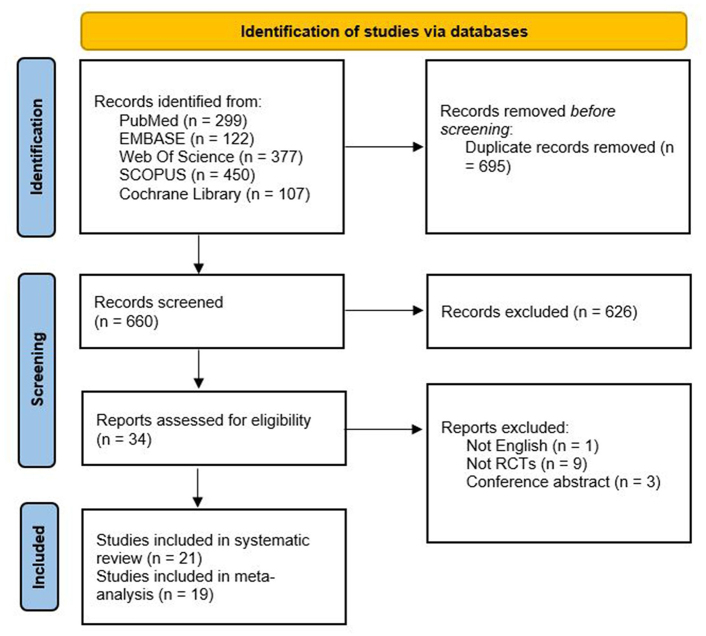
Methods: A comprehensive search of five databases (PubMed, EMBASE, Web of Science, SCOPUS, and Cochrane Library) was conducted. We included all published randomized controlled trials (RCTs) from inception to August 2024. Meta-analysis was done using RevMan 5.4 package.
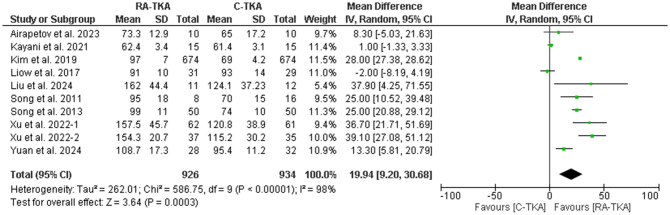
Results: Twenty-one RCTs involving 2692 patients were involved. RA-TKA demonstrated significantly lower mechanical alignment outlier rates (risk ratio = 0.33, 95% confidence interval (CI)[0.19, 0.59], P = 0.0002) and less deviation from neutral mechanical axis (mean difference, MD = -0.93° [-1.20, -0.66], P < 0.00001) compared to C-TKA. No significant differences were found in WOMAC or Oxford Knee Scores at various follow-up points. RA-TKA was associated with longer operative times (MD = 19.94 minutes [9.2, 30.68], P = 0.0003) but showed no significant difference in intraoperative blood loss. Postoperative Knee Society Scores were slightly higher in the RA-TKA group (MD = 1.03 [0.50, 1.57], P = 0.0002).
Conclusion: RA-TKA offers improved mechanical alignment accuracy compared to C-TKA but does not demonstrate superior short to medium-term functional outcomes. The technology is associated with longer operative times. These findings suggest that while RA-TKA may enhance surgical precision, its clinical benefits and cost-effectiveness require further evaluation, particularly in long-term studies.




 京公网安备 11010802042870号
京ICP备2023020795号-1
京公网安备 11010802042870号
京ICP备2023020795号-1

 分享
分享
 求助内容:
求助内容: 应助结果提醒方式:
 扫码关注我们
