Yiyuan Lang, Xin Song, Yan Chen, Han Mei, Chengyu Wu, Rui Zhang, Changao Xue
{"title":"胰岛素抵抗指标与牙周炎之间的关系:一项使用2009-2014年国家健康与营养检查调查数据的研究","authors":"Yiyuan Lang, Xin Song, Yan Chen, Han Mei, Chengyu Wu, Rui Zhang, Changao Xue","doi":"10.1186/s12903-025-05752-6","DOIUrl":null,"url":null,"abstract":"<p><strong>Background: </strong>The rising obesity rates are accompanied by an increasing prevalence of insulin resistance (IR) associated with obesity. To ascertain the best index for replacing IR, this study aimed to investigate the possible association between IR, which was assessed using the Homeostatic Model Assessment of Insulin Resistance (HOMA-IR), and the triglyceride-glucose (TyG) index and its derived indexes and periodontitis.</p><p><strong>Methods: </strong>The association between the indicators of IR and periodontitis was assessed via multivariate-adjusted logistic regression analyses using data from the National Health and Nutrition Examination Survey (NHANES) 2009-2014. In addition, subgroup analyses and receiver operating characteristic curve analyses were conducted to explore possible influencing factors.</p><p><strong>Results: </strong>Our study encompassed 1,588 participants, and 41.0% were diagnosed with periodontitis. Based on the multivariate logistic regression analysis, a higher TyG-waist-to-height ratio (WHtR) (odds ratio [OR] = 1.14, 95% confidence interval [CI]: 1.02-1.27, P = 0.0244) and HOMA-IR score (OR = 1.00, 95% CI: 1.00-1.00, P = 0.0028) were associated with an increased risk of periodontitis. Conversely, the TyG index, TyG-adjusted for body mass index, and TyG-adjusted for waist circumference (WC) were not associated with periodontitis. According to further subgroup analyses and interaction result analyses, sex affected the association between the TyG index, TyG-WC, and TyG-WHtR and periodontitis (P < 0.05 for interaction). Moreover, the influence of age regulated the association between periodontitis and both TyG and HOMA-IR score. In terms of diagnostic accuracy, the area under the receiver operating characteristic curve analysis revealed that HOMA-IR score and TyG-WHtR slightly outperformed the TyG index, TyG-body mass index, and TyG-WC. Thus, they can be robust markers for assessing IR-related periodontitis risk.</p><p><strong>Conclusion: </strong>A consistent and positive association was found between HOMA-IR score and TyG-WHtR and the odds of periodontitis prevalence. Hence, HOMA-IR score and TyG-WHtR were significantly associated with periodontitis in this cross-sectional study. However, prospective studies are needed to determine whether higher TyG-waist-to-height ratio and HOMA-IR score can predict the occurrence of periodontitis.</p>","PeriodicalId":9072,"journal":{"name":"BMC Oral Health","volume":"25 1","pages":"404"},"PeriodicalIF":3.1000,"publicationDate":"2025-03-19","publicationTypes":"Journal Article","fieldsOfStudy":null,"isOpenAccess":false,"openAccessPdf":"https://www.ncbi.nlm.nih.gov/pmc/articles/PMC11924845/pdf/","citationCount":"0","resultStr":"{\"title\":\"Association between the indicators of insulin resistance and periodontitis: a study using data from the National Health and Nutrition Examination Survey 2009-2014.\",\"authors\":\"Yiyuan Lang, Xin Song, Yan Chen, Han Mei, Chengyu Wu, Rui Zhang, Changao Xue\",\"doi\":\"10.1186/s12903-025-05752-6\",\"DOIUrl\":null,\"url\":null,\"abstract\":\"<p><strong>Background: </strong>The rising obesity rates are accompanied by an increasing prevalence of insulin resistance (IR) associated with obesity. To ascertain the best index for replacing IR, this study aimed to investigate the possible association between IR, which was assessed using the Homeostatic Model Assessment of Insulin Resistance (HOMA-IR), and the triglyceride-glucose (TyG) index and its derived indexes and periodontitis.</p><p><strong>Methods: </strong>The association between the indicators of IR and periodontitis was assessed via multivariate-adjusted logistic regression analyses using data from the National Health and Nutrition Examination Survey (NHANES) 2009-2014. In addition, subgroup analyses and receiver operating characteristic curve analyses were conducted to explore possible influencing factors.</p><p><strong>Results: </strong>Our study encompassed 1,588 participants, and 41.0% were diagnosed with periodontitis. Based on the multivariate logistic regression analysis, a higher TyG-waist-to-height ratio (WHtR) (odds ratio [OR] = 1.14, 95% confidence interval [CI]: 1.02-1.27, P = 0.0244) and HOMA-IR score (OR = 1.00, 95% CI: 1.00-1.00, P = 0.0028) were associated with an increased risk of periodontitis. Conversely, the TyG index, TyG-adjusted for body mass index, and TyG-adjusted for waist circumference (WC) were not associated with periodontitis. According to further subgroup analyses and interaction result analyses, sex affected the association between the TyG index, TyG-WC, and TyG-WHtR and periodontitis (P < 0.05 for interaction). Moreover, the influence of age regulated the association between periodontitis and both TyG and HOMA-IR score. In terms of diagnostic accuracy, the area under the receiver operating characteristic curve analysis revealed that HOMA-IR score and TyG-WHtR slightly outperformed the TyG index, TyG-body mass index, and TyG-WC. Thus, they can be robust markers for assessing IR-related periodontitis risk.</p><p><strong>Conclusion: </strong>A consistent and positive association was found between HOMA-IR score and TyG-WHtR and the odds of periodontitis prevalence. Hence, HOMA-IR score and TyG-WHtR were significantly associated with periodontitis in this cross-sectional study. However, prospective studies are needed to determine whether higher TyG-waist-to-height ratio and HOMA-IR score can predict the occurrence of periodontitis.</p>\",\"PeriodicalId\":9072,\"journal\":{\"name\":\"BMC Oral Health\",\"volume\":\"25 1\",\"pages\":\"404\"},\"PeriodicalIF\":3.1000,\"publicationDate\":\"2025-03-19\",\"publicationTypes\":\"Journal Article\",\"fieldsOfStudy\":null,\"isOpenAccess\":false,\"openAccessPdf\":\"https://www.ncbi.nlm.nih.gov/pmc/articles/PMC11924845/pdf/\",\"citationCount\":\"0\",\"resultStr\":null,\"platform\":\"Semanticscholar\",\"paperid\":null,\"PeriodicalName\":\"BMC Oral Health\",\"FirstCategoryId\":\"3\",\"ListUrlMain\":\"https://doi.org/10.1186/s12903-025-05752-6\",\"RegionNum\":2,\"RegionCategory\":\"医学\",\"ArticlePicture\":[],\"TitleCN\":null,\"AbstractTextCN\":null,\"PMCID\":null,\"EPubDate\":\"\",\"PubModel\":\"\",\"JCR\":\"Q1\",\"JCRName\":\"DENTISTRY, ORAL SURGERY & MEDICINE\",\"Score\":null,\"Total\":0}","platform":"Semanticscholar","paperid":null,"PeriodicalName":"BMC Oral Health","FirstCategoryId":"3","ListUrlMain":"https://doi.org/10.1186/s12903-025-05752-6","RegionNum":2,"RegionCategory":"医学","ArticlePicture":[],"TitleCN":null,"AbstractTextCN":null,"PMCID":null,"EPubDate":"","PubModel":"","JCR":"Q1","JCRName":"DENTISTRY, ORAL SURGERY & MEDICINE","Score":null,"Total":0}
引用次数: 0
摘要
背景:肥胖率的上升伴随着与肥胖相关的胰岛素抵抗(IR)患病率的增加。为了确定替代IR的最佳指标,本研究旨在探讨IR与甘油三酯-葡萄糖(TyG)指数及其衍生指标与牙周炎之间的可能关联,该指标采用胰岛素抵抗稳态模型评估(HOMA-IR)进行评估。方法:利用2009-2014年国家健康与营养检查调查(NHANES)的数据,通过多变量调整logistic回归分析,评估IR指标与牙周炎的相关性。并进行亚组分析和受试者工作特征曲线分析,探讨可能的影响因素。结果:我们的研究包括1588名参与者,其中41.0%被诊断患有牙周炎。基于多因素logistic回归分析,较高的tyg -腰高比(WHtR)(优势比[OR] = 1.14, 95%可信区间[CI]: 1.02-1.27, P = 0.0244)和HOMA-IR评分(OR = 1.00, 95% CI: 1.00-1.00, P = 0.0028)与牙周炎风险增加相关。相反,TyG指数、经体重指数调整的TyG和经腰围(WC)调整的TyG与牙周炎无关。根据进一步的亚组分析和交互结果分析,性别影响了TyG指数、TyG- wc和TyG- whtr与牙周炎的相关性(P结论:HOMA-IR评分和TyG- whtr与牙周炎患病率之间存在一致的正相关。因此,在本横断面研究中,HOMA-IR评分和TyG-WHtR与牙周炎显著相关。然而,更高的tyg腰高比和HOMA-IR评分是否可以预测牙周炎的发生,还需要前瞻性研究来确定。
Association between the indicators of insulin resistance and periodontitis: a study using data from the National Health and Nutrition Examination Survey 2009-2014.
Background: The rising obesity rates are accompanied by an increasing prevalence of insulin resistance (IR) associated with obesity. To ascertain the best index for replacing IR, this study aimed to investigate the possible association between IR, which was assessed using the Homeostatic Model Assessment of Insulin Resistance (HOMA-IR), and the triglyceride-glucose (TyG) index and its derived indexes and periodontitis.
Methods: The association between the indicators of IR and periodontitis was assessed via multivariate-adjusted logistic regression analyses using data from the National Health and Nutrition Examination Survey (NHANES) 2009-2014. In addition, subgroup analyses and receiver operating characteristic curve analyses were conducted to explore possible influencing factors.
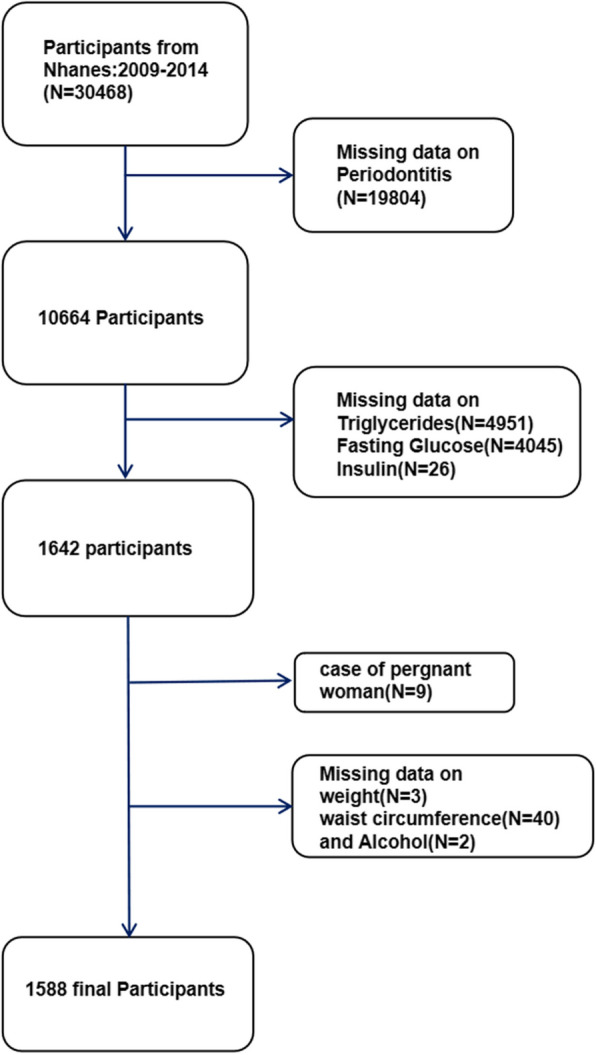
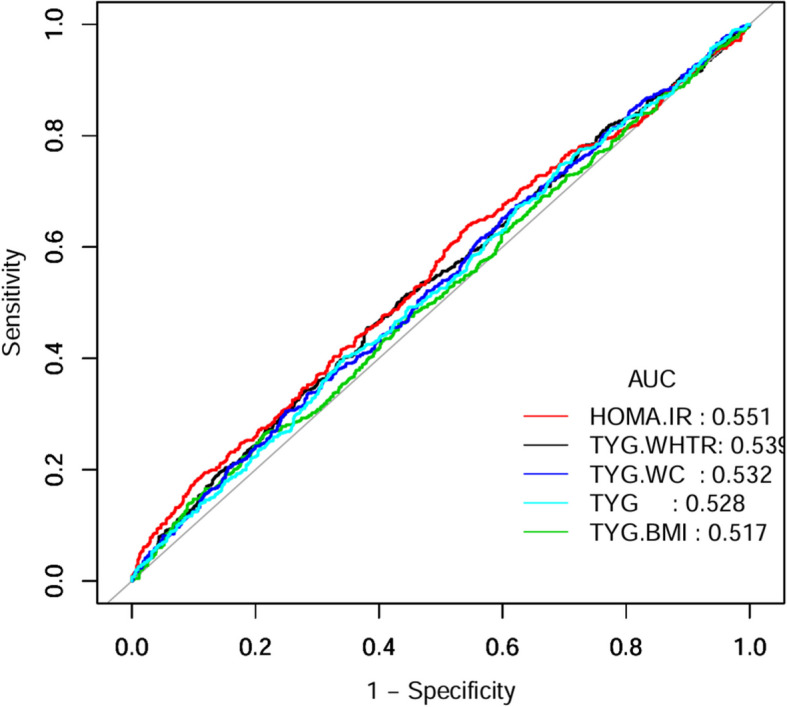
Results: Our study encompassed 1,588 participants, and 41.0% were diagnosed with periodontitis. Based on the multivariate logistic regression analysis, a higher TyG-waist-to-height ratio (WHtR) (odds ratio [OR] = 1.14, 95% confidence interval [CI]: 1.02-1.27, P = 0.0244) and HOMA-IR score (OR = 1.00, 95% CI: 1.00-1.00, P = 0.0028) were associated with an increased risk of periodontitis. Conversely, the TyG index, TyG-adjusted for body mass index, and TyG-adjusted for waist circumference (WC) were not associated with periodontitis. According to further subgroup analyses and interaction result analyses, sex affected the association between the TyG index, TyG-WC, and TyG-WHtR and periodontitis (P < 0.05 for interaction). Moreover, the influence of age regulated the association between periodontitis and both TyG and HOMA-IR score. In terms of diagnostic accuracy, the area under the receiver operating characteristic curve analysis revealed that HOMA-IR score and TyG-WHtR slightly outperformed the TyG index, TyG-body mass index, and TyG-WC. Thus, they can be robust markers for assessing IR-related periodontitis risk.
Conclusion: A consistent and positive association was found between HOMA-IR score and TyG-WHtR and the odds of periodontitis prevalence. Hence, HOMA-IR score and TyG-WHtR were significantly associated with periodontitis in this cross-sectional study. However, prospective studies are needed to determine whether higher TyG-waist-to-height ratio and HOMA-IR score can predict the occurrence of periodontitis.
期刊介绍:
BMC Oral Health is an open access, peer-reviewed journal that considers articles on all aspects of the prevention, diagnosis and management of disorders of the mouth, teeth and gums, as well as related molecular genetics, pathophysiology, and epidemiology.





 京公网安备 11010802042870号
京ICP备2023020795号-1
京公网安备 11010802042870号
京ICP备2023020795号-1

 分享
分享
 求助内容:
求助内容: 应助结果提醒方式:
 扫码关注我们
