Yafeng Guo, Shiye Cheng, Yu Du, Na Lu, Chao Li, Hanchun Bao, Xiao Zhu, Shi-Ya Tang
{"title":"等离子体增强填料床介质阻挡放电对苯的CO2重整制合成气研究。","authors":"Yafeng Guo, Shiye Cheng, Yu Du, Na Lu, Chao Li, Hanchun Bao, Xiao Zhu, Shi-Ya Tang","doi":"10.3389/fchem.2025.1532478","DOIUrl":null,"url":null,"abstract":"<p><p>Tar reforming has gained widely attention in the field of biomass gasification. Dielectric barrier discharge (DBD) presents a promising technology for the conversion of biomass gasification tar under ambient conditions. In this study, plasma-enhanced dual DBD (ED-DBD) combined with packing materials such as glass (SiO<sub>2</sub>) beads and SiC blocks was utilized to examine the CO<sub>2</sub> reforming of benzene, serving as a tar analogue, into syngas. (Introduction) First, the discharge characteristics and performance metrics for benzene and CO<sub>2</sub> conversion (Method 1) were evaluated and compared between the conventional dual dielectric barrier discharge (D-DBD) system and the ED-DBD reactor, which was augmented with SiO<sub>2</sub> beads and SiC blocks. The findings indicated that the ED-DBD reactor incorporating SiC blocks demonstrated superior performance, achieving a benzene conversion of 51.0%, a CO<sub>2</sub> conversion of 75.0%, and an energy efficiency for CO<sub>2</sub> conversion of 73.9%. The results satisfy the minimum requirements for CO<sub>2</sub> conversion and energy efficiency required for industrial application (Results and Discussion 1). Secondly, analysis via X-ray Photoelectron Spectroscopy (XPS) (Method 2) revealed that a minor proportion of carbon elements originating from the SiC blocks within the plasma region were involved in the reaction process (Results and Discussion 2). Moreover, an elevated initial concentration of CO<sub>2</sub> in the benzene system enhanced the degradation of benzene, whereas the introduction of benzene into the CO<sub>2</sub> system promoted the conversion of CO<sub>2</sub>. Emission spectroscopy (Method 3) corroborated the presence of active hydroxyl radical (·OH) particle during the discharge process. It suggests that the SiC-packed ED-DBD reactor more efficiently generates active OH particles during the discharge compared to the SiO<sub>2</sub>-packed ED-DBD reactor (Results and Discussion 3). This study not only offers an effective method for converting tar analogues into syngas under mild conditions but also presents an alternative approach for CO<sub>2</sub> utilization within a carbon-neutral strategy.</p>","PeriodicalId":12421,"journal":{"name":"Frontiers in Chemistry","volume":"13 ","pages":"1532478"},"PeriodicalIF":4.2000,"publicationDate":"2025-03-05","publicationTypes":"Journal Article","fieldsOfStudy":null,"isOpenAccess":false,"openAccessPdf":"https://www.ncbi.nlm.nih.gov/pmc/articles/PMC11921044/pdf/","citationCount":"0","resultStr":"{\"title\":\"CO<sub>2</sub> reforming of benzene into syngas by plasma-enhanced packed-bed dielectric barrier discharge with different packing materials.\",\"authors\":\"Yafeng Guo, Shiye Cheng, Yu Du, Na Lu, Chao Li, Hanchun Bao, Xiao Zhu, Shi-Ya Tang\",\"doi\":\"10.3389/fchem.2025.1532478\",\"DOIUrl\":null,\"url\":null,\"abstract\":\"<p><p>Tar reforming has gained widely attention in the field of biomass gasification. Dielectric barrier discharge (DBD) presents a promising technology for the conversion of biomass gasification tar under ambient conditions. In this study, plasma-enhanced dual DBD (ED-DBD) combined with packing materials such as glass (SiO<sub>2</sub>) beads and SiC blocks was utilized to examine the CO<sub>2</sub> reforming of benzene, serving as a tar analogue, into syngas. (Introduction) First, the discharge characteristics and performance metrics for benzene and CO<sub>2</sub> conversion (Method 1) were evaluated and compared between the conventional dual dielectric barrier discharge (D-DBD) system and the ED-DBD reactor, which was augmented with SiO<sub>2</sub> beads and SiC blocks. The findings indicated that the ED-DBD reactor incorporating SiC blocks demonstrated superior performance, achieving a benzene conversion of 51.0%, a CO<sub>2</sub> conversion of 75.0%, and an energy efficiency for CO<sub>2</sub> conversion of 73.9%. The results satisfy the minimum requirements for CO<sub>2</sub> conversion and energy efficiency required for industrial application (Results and Discussion 1). Secondly, analysis via X-ray Photoelectron Spectroscopy (XPS) (Method 2) revealed that a minor proportion of carbon elements originating from the SiC blocks within the plasma region were involved in the reaction process (Results and Discussion 2). Moreover, an elevated initial concentration of CO<sub>2</sub> in the benzene system enhanced the degradation of benzene, whereas the introduction of benzene into the CO<sub>2</sub> system promoted the conversion of CO<sub>2</sub>. Emission spectroscopy (Method 3) corroborated the presence of active hydroxyl radical (·OH) particle during the discharge process. It suggests that the SiC-packed ED-DBD reactor more efficiently generates active OH particles during the discharge compared to the SiO<sub>2</sub>-packed ED-DBD reactor (Results and Discussion 3). This study not only offers an effective method for converting tar analogues into syngas under mild conditions but also presents an alternative approach for CO<sub>2</sub> utilization within a carbon-neutral strategy.</p>\",\"PeriodicalId\":12421,\"journal\":{\"name\":\"Frontiers in Chemistry\",\"volume\":\"13 \",\"pages\":\"1532478\"},\"PeriodicalIF\":4.2000,\"publicationDate\":\"2025-03-05\",\"publicationTypes\":\"Journal Article\",\"fieldsOfStudy\":null,\"isOpenAccess\":false,\"openAccessPdf\":\"https://www.ncbi.nlm.nih.gov/pmc/articles/PMC11921044/pdf/\",\"citationCount\":\"0\",\"resultStr\":null,\"platform\":\"Semanticscholar\",\"paperid\":null,\"PeriodicalName\":\"Frontiers in Chemistry\",\"FirstCategoryId\":\"92\",\"ListUrlMain\":\"https://doi.org/10.3389/fchem.2025.1532478\",\"RegionNum\":3,\"RegionCategory\":\"化学\",\"ArticlePicture\":[],\"TitleCN\":null,\"AbstractTextCN\":null,\"PMCID\":null,\"EPubDate\":\"2025/1/1 0:00:00\",\"PubModel\":\"eCollection\",\"JCR\":\"Q2\",\"JCRName\":\"CHEMISTRY, MULTIDISCIPLINARY\",\"Score\":null,\"Total\":0}","platform":"Semanticscholar","paperid":null,"PeriodicalName":"Frontiers in Chemistry","FirstCategoryId":"92","ListUrlMain":"https://doi.org/10.3389/fchem.2025.1532478","RegionNum":3,"RegionCategory":"化学","ArticlePicture":[],"TitleCN":null,"AbstractTextCN":null,"PMCID":null,"EPubDate":"2025/1/1 0:00:00","PubModel":"eCollection","JCR":"Q2","JCRName":"CHEMISTRY, MULTIDISCIPLINARY","Score":null,"Total":0}
CO2 reforming of benzene into syngas by plasma-enhanced packed-bed dielectric barrier discharge with different packing materials.
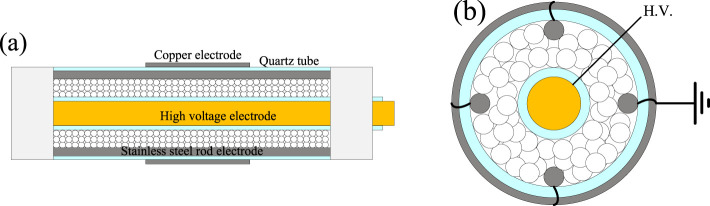
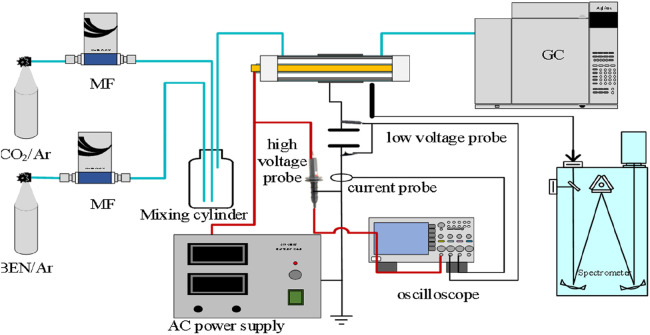
Tar reforming has gained widely attention in the field of biomass gasification. Dielectric barrier discharge (DBD) presents a promising technology for the conversion of biomass gasification tar under ambient conditions. In this study, plasma-enhanced dual DBD (ED-DBD) combined with packing materials such as glass (SiO2) beads and SiC blocks was utilized to examine the CO2 reforming of benzene, serving as a tar analogue, into syngas. (Introduction) First, the discharge characteristics and performance metrics for benzene and CO2 conversion (Method 1) were evaluated and compared between the conventional dual dielectric barrier discharge (D-DBD) system and the ED-DBD reactor, which was augmented with SiO2 beads and SiC blocks. The findings indicated that the ED-DBD reactor incorporating SiC blocks demonstrated superior performance, achieving a benzene conversion of 51.0%, a CO2 conversion of 75.0%, and an energy efficiency for CO2 conversion of 73.9%. The results satisfy the minimum requirements for CO2 conversion and energy efficiency required for industrial application (Results and Discussion 1). Secondly, analysis via X-ray Photoelectron Spectroscopy (XPS) (Method 2) revealed that a minor proportion of carbon elements originating from the SiC blocks within the plasma region were involved in the reaction process (Results and Discussion 2). Moreover, an elevated initial concentration of CO2 in the benzene system enhanced the degradation of benzene, whereas the introduction of benzene into the CO2 system promoted the conversion of CO2. Emission spectroscopy (Method 3) corroborated the presence of active hydroxyl radical (·OH) particle during the discharge process. It suggests that the SiC-packed ED-DBD reactor more efficiently generates active OH particles during the discharge compared to the SiO2-packed ED-DBD reactor (Results and Discussion 3). This study not only offers an effective method for converting tar analogues into syngas under mild conditions but also presents an alternative approach for CO2 utilization within a carbon-neutral strategy.
期刊介绍:
Frontiers in Chemistry is a high visiblity and quality journal, publishing rigorously peer-reviewed research across the chemical sciences. Field Chief Editor Steve Suib at the University of Connecticut is supported by an outstanding Editorial Board of international researchers. This multidisciplinary open-access journal is at the forefront of disseminating and communicating scientific knowledge and impactful discoveries to academics, industry leaders and the public worldwide.
Chemistry is a branch of science that is linked to all other main fields of research. The omnipresence of Chemistry is apparent in our everyday lives from the electronic devices that we all use to communicate, to foods we eat, to our health and well-being, to the different forms of energy that we use. While there are many subtopics and specialties of Chemistry, the fundamental link in all these areas is how atoms, ions, and molecules come together and come apart in what some have come to call the “dance of life”.
All specialty sections of Frontiers in Chemistry are open-access with the goal of publishing outstanding research publications, review articles, commentaries, and ideas about various aspects of Chemistry. The past forms of publication often have specific subdisciplines, most commonly of analytical, inorganic, organic and physical chemistries, but these days those lines and boxes are quite blurry and the silos of those disciplines appear to be eroding. Chemistry is important to both fundamental and applied areas of research and manufacturing, and indeed the outlines of academic versus industrial research are also often artificial. Collaborative research across all specialty areas of Chemistry is highly encouraged and supported as we move forward. These are exciting times and the field of Chemistry is an important and significant contributor to our collective knowledge.





 京公网安备 11010802042870号
京ICP备2023020795号-1
京公网安备 11010802042870号
京ICP备2023020795号-1

 分享
分享
 求助内容:
求助内容: 应助结果提醒方式:
 扫码关注我们
