Giuseppe Boriani, Jacopo F Imberti, Riccardo Asteggiano, Pietro Ameri, Davide A Mei, Michał Farkowski, Julian Chun, Josè Luis Merino, Teresa Lopez-Fernandez, Alexander R Lyon
{"title":"用于治疗活动性癌症患者的移动/可穿戴数字设备:来自ESC心血管肿瘤委员会的一项调查。","authors":"Giuseppe Boriani, Jacopo F Imberti, Riccardo Asteggiano, Pietro Ameri, Davide A Mei, Michał Farkowski, Julian Chun, Josè Luis Merino, Teresa Lopez-Fernandez, Alexander R Lyon","doi":"10.1093/ehjdh/ztae082","DOIUrl":null,"url":null,"abstract":"<p><strong>Aims: </strong>The Council of Cardio-Oncology of the European Society of Cardiology developed an on-line anonymous survey to provide an overall picture of the current practice on the use of mobile and wearable digital devices in cardio-oncology and the potential barriers to their large-scale applicability.</p><p><strong>Methods and results: </strong>Between June 2023 and January 2024, an online anonymous questionnaire was completed by 220 healthcare professionals from 55 countries. The greatest number of respondents reported that mobile/wearable digital devices have a role in all active cancer patients for measuring heart rate (33.9%), blood pressure (34.4%), body temperature (32.0%), physical activity (42.4%), and sleep (31.2%). In the setting of atrial fibrillation detection, respondents were evenly split between applying these technologies in all patients (33.0%) or only in selected patients (33.0%). Regarding QTc interval monitoring, 30.6% reported that mobile/wearable digital devices play a role only in selected patients. The decision to use the device was taken by the patient in 56.6% of cases and the physician in 43.4%. The most important barrier reported to mobile/wearable device implementation in the setting of cardiac rhythm monitoring and QTc measurement was their cost (weighted average: 3.38 and 3.39, respectively).</p><p><strong>Conclusion: </strong>Mobile/wearable digital devices are considered to play an important role in different settings of cardio-oncology, including monitoring of patients' parameters and arrhythmia detection. Their role in monitoring physical activity and QTc interval appears more nuanced. The most important perceived barrier to mobile/wearable digital device implementation is considered their high cost.</p>","PeriodicalId":72965,"journal":{"name":"European heart journal. Digital health","volume":"6 2","pages":"162-169"},"PeriodicalIF":4.4000,"publicationDate":"2025-01-21","publicationTypes":"Journal Article","fieldsOfStudy":null,"isOpenAccess":false,"openAccessPdf":"https://www.ncbi.nlm.nih.gov/pmc/articles/PMC11914721/pdf/","citationCount":"0","resultStr":"{\"title\":\"Mobile/wearable digital devices for care of active cancer patients: a survey from the ESC Council of Cardio-Oncology.\",\"authors\":\"Giuseppe Boriani, Jacopo F Imberti, Riccardo Asteggiano, Pietro Ameri, Davide A Mei, Michał Farkowski, Julian Chun, Josè Luis Merino, Teresa Lopez-Fernandez, Alexander R Lyon\",\"doi\":\"10.1093/ehjdh/ztae082\",\"DOIUrl\":null,\"url\":null,\"abstract\":\"<p><strong>Aims: </strong>The Council of Cardio-Oncology of the European Society of Cardiology developed an on-line anonymous survey to provide an overall picture of the current practice on the use of mobile and wearable digital devices in cardio-oncology and the potential barriers to their large-scale applicability.</p><p><strong>Methods and results: </strong>Between June 2023 and January 2024, an online anonymous questionnaire was completed by 220 healthcare professionals from 55 countries. The greatest number of respondents reported that mobile/wearable digital devices have a role in all active cancer patients for measuring heart rate (33.9%), blood pressure (34.4%), body temperature (32.0%), physical activity (42.4%), and sleep (31.2%). In the setting of atrial fibrillation detection, respondents were evenly split between applying these technologies in all patients (33.0%) or only in selected patients (33.0%). Regarding QTc interval monitoring, 30.6% reported that mobile/wearable digital devices play a role only in selected patients. The decision to use the device was taken by the patient in 56.6% of cases and the physician in 43.4%. The most important barrier reported to mobile/wearable device implementation in the setting of cardiac rhythm monitoring and QTc measurement was their cost (weighted average: 3.38 and 3.39, respectively).</p><p><strong>Conclusion: </strong>Mobile/wearable digital devices are considered to play an important role in different settings of cardio-oncology, including monitoring of patients' parameters and arrhythmia detection. Their role in monitoring physical activity and QTc interval appears more nuanced. The most important perceived barrier to mobile/wearable digital device implementation is considered their high cost.</p>\",\"PeriodicalId\":72965,\"journal\":{\"name\":\"European heart journal. Digital health\",\"volume\":\"6 2\",\"pages\":\"162-169\"},\"PeriodicalIF\":4.4000,\"publicationDate\":\"2025-01-21\",\"publicationTypes\":\"Journal Article\",\"fieldsOfStudy\":null,\"isOpenAccess\":false,\"openAccessPdf\":\"https://www.ncbi.nlm.nih.gov/pmc/articles/PMC11914721/pdf/\",\"citationCount\":\"0\",\"resultStr\":null,\"platform\":\"Semanticscholar\",\"paperid\":null,\"PeriodicalName\":\"European heart journal. Digital health\",\"FirstCategoryId\":\"1085\",\"ListUrlMain\":\"https://doi.org/10.1093/ehjdh/ztae082\",\"RegionNum\":0,\"RegionCategory\":null,\"ArticlePicture\":[],\"TitleCN\":null,\"AbstractTextCN\":null,\"PMCID\":null,\"EPubDate\":\"2025/3/1 0:00:00\",\"PubModel\":\"eCollection\",\"JCR\":\"Q1\",\"JCRName\":\"CARDIAC & CARDIOVASCULAR SYSTEMS\",\"Score\":null,\"Total\":0}","platform":"Semanticscholar","paperid":null,"PeriodicalName":"European heart journal. Digital health","FirstCategoryId":"1085","ListUrlMain":"https://doi.org/10.1093/ehjdh/ztae082","RegionNum":0,"RegionCategory":null,"ArticlePicture":[],"TitleCN":null,"AbstractTextCN":null,"PMCID":null,"EPubDate":"2025/3/1 0:00:00","PubModel":"eCollection","JCR":"Q1","JCRName":"CARDIAC & CARDIOVASCULAR SYSTEMS","Score":null,"Total":0}
Mobile/wearable digital devices for care of active cancer patients: a survey from the ESC Council of Cardio-Oncology.
Aims: The Council of Cardio-Oncology of the European Society of Cardiology developed an on-line anonymous survey to provide an overall picture of the current practice on the use of mobile and wearable digital devices in cardio-oncology and the potential barriers to their large-scale applicability.
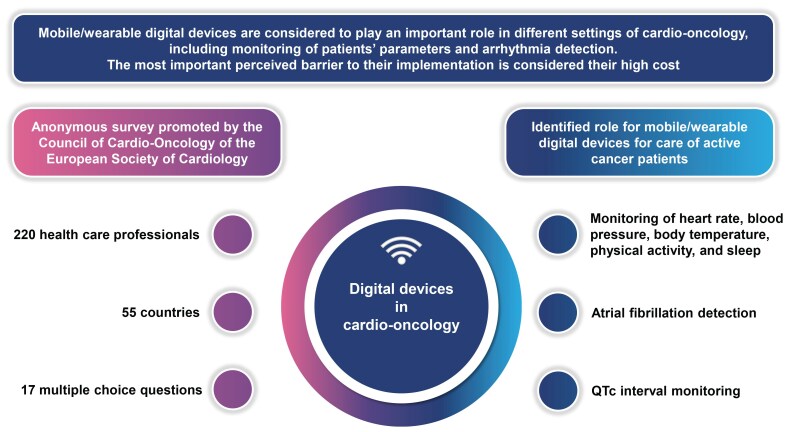
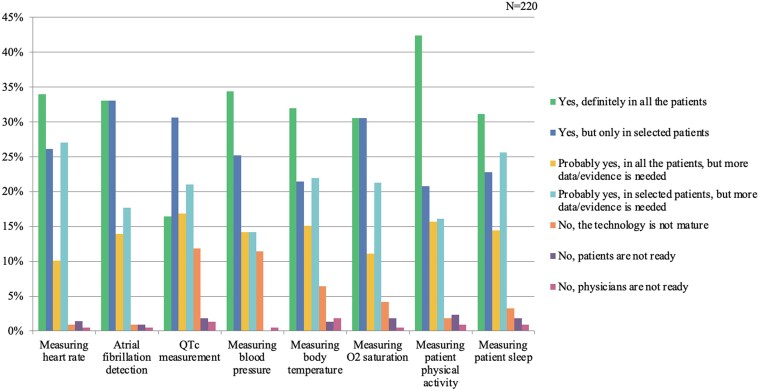
Methods and results: Between June 2023 and January 2024, an online anonymous questionnaire was completed by 220 healthcare professionals from 55 countries. The greatest number of respondents reported that mobile/wearable digital devices have a role in all active cancer patients for measuring heart rate (33.9%), blood pressure (34.4%), body temperature (32.0%), physical activity (42.4%), and sleep (31.2%). In the setting of atrial fibrillation detection, respondents were evenly split between applying these technologies in all patients (33.0%) or only in selected patients (33.0%). Regarding QTc interval monitoring, 30.6% reported that mobile/wearable digital devices play a role only in selected patients. The decision to use the device was taken by the patient in 56.6% of cases and the physician in 43.4%. The most important barrier reported to mobile/wearable device implementation in the setting of cardiac rhythm monitoring and QTc measurement was their cost (weighted average: 3.38 and 3.39, respectively).
Conclusion: Mobile/wearable digital devices are considered to play an important role in different settings of cardio-oncology, including monitoring of patients' parameters and arrhythmia detection. Their role in monitoring physical activity and QTc interval appears more nuanced. The most important perceived barrier to mobile/wearable digital device implementation is considered their high cost.



 京公网安备 11010802042870号
京ICP备2023020795号-1
京公网安备 11010802042870号
京ICP备2023020795号-1

 分享
分享

 求助内容:
求助内容: 应助结果提醒方式:
 扫码关注我们
