Marcel C. Langenbach , Thomas Mayrhofer , Isabel L. Langenbach , Michael T. Lu , Julia Karady , David Maintz , Shady Abohashem , Ahmed Tawakol , Neha J. Pagidipati , Svati H. Shah , Maros Ferencik , Alison Motsinger-Reif , Pamela S. Douglas , Borek Foldyna
{"title":"空气污染、冠状动脉疾病和心血管事件:来自PROMISE试验的见解","authors":"Marcel C. Langenbach , Thomas Mayrhofer , Isabel L. Langenbach , Michael T. Lu , Julia Karady , David Maintz , Shady Abohashem , Ahmed Tawakol , Neha J. Pagidipati , Svati H. Shah , Maros Ferencik , Alison Motsinger-Reif , Pamela S. Douglas , Borek Foldyna","doi":"10.1016/j.jcct.2025.03.001","DOIUrl":null,"url":null,"abstract":"<div><h3>Background</h3><div>Air pollution is associated with mortality and major adverse cardiovascular events (MACE) in the general population. However, little is known about the relationship between air pollution and coronary artery disease (CAD) and how this relates to MACE.</div></div><div><h3>Methods</h3><div>This study utilized data from the computed tomography (CT) arm of the PROMISE trial investigating symptomatic individuals with suspected CAD. We linked levels of air pollutants (PM<sub>2·5</sub>, PM<sub>10</sub>, NO<sub>2</sub>, and ozone) at U.S. zip codes of residence CT-derived CAD and adjudicated MACE (all-cause death, myocardial infarction, and hospitalization for unstable angina). Multivariable analyses were adjusted for the ASCVD risk score and socioeconomic determinants of health. Mediation analyses were used to test putative pathways.</div></div><div><h3>Results</h3><div>In 4343 individuals (48 % males; age: 61 ± 8 years), elevated exposures to PM<sub>2.5</sub> (≥9.4 μg/m<sup>3</sup>) and NO<sub>2</sub> (≥5.3 ppb) were independently associated with obstructive CAD (aOR = 1.23, 95%CI: 1.03–1.48, p = 0.024; aOR = 1.56, 95%CI: 1.02–2.40, p = 0.042), while there were no significant associations with PM<sub>10</sub> (≥15 μg/m<sup>3</sup>) or ozone (≥51 ppb). Increased PM<sub>2.5</sub>, PM<sub>10</sub> and ozone were independently associated with MACE (aHR = 1.56, 95%CI: 1.12–2.18, p = 0.008; aHR = 2.09, 95%CI: 1.18–3.70, p = 0.011, aHR = 1.96, 95%CI: 1.20–3.21, p = 0.008). In the mediation analysis, obstructive CAD accounted for 9 % of the total effect (p = 0.012) between PM<sub>2.5</sub> and MACE.</div></div><div><h3>Conclusion</h3><div>Exposure to air pollution, particularly PM<sub>2.5</sub>, was independently associated with obstructive CAD and MACE, with obstructive CAD mediating a small but significant portion of the association between air pollution and MACE.</div></div>","PeriodicalId":49039,"journal":{"name":"Journal of Cardiovascular Computed Tomography","volume":"19 3","pages":"Pages 306-313"},"PeriodicalIF":5.8000,"publicationDate":"2025-05-01","publicationTypes":"Journal Article","fieldsOfStudy":null,"isOpenAccess":false,"openAccessPdf":"","citationCount":"0","resultStr":"{\"title\":\"Air pollution, coronary artery disease, and cardiovascular events: Insights from the PROMISE trial\",\"authors\":\"Marcel C. Langenbach , Thomas Mayrhofer , Isabel L. Langenbach , Michael T. Lu , Julia Karady , David Maintz , Shady Abohashem , Ahmed Tawakol , Neha J. Pagidipati , Svati H. Shah , Maros Ferencik , Alison Motsinger-Reif , Pamela S. Douglas , Borek Foldyna\",\"doi\":\"10.1016/j.jcct.2025.03.001\",\"DOIUrl\":null,\"url\":null,\"abstract\":\"<div><h3>Background</h3><div>Air pollution is associated with mortality and major adverse cardiovascular events (MACE) in the general population. However, little is known about the relationship between air pollution and coronary artery disease (CAD) and how this relates to MACE.</div></div><div><h3>Methods</h3><div>This study utilized data from the computed tomography (CT) arm of the PROMISE trial investigating symptomatic individuals with suspected CAD. We linked levels of air pollutants (PM<sub>2·5</sub>, PM<sub>10</sub>, NO<sub>2</sub>, and ozone) at U.S. zip codes of residence CT-derived CAD and adjudicated MACE (all-cause death, myocardial infarction, and hospitalization for unstable angina). Multivariable analyses were adjusted for the ASCVD risk score and socioeconomic determinants of health. Mediation analyses were used to test putative pathways.</div></div><div><h3>Results</h3><div>In 4343 individuals (48 % males; age: 61 ± 8 years), elevated exposures to PM<sub>2.5</sub> (≥9.4 μg/m<sup>3</sup>) and NO<sub>2</sub> (≥5.3 ppb) were independently associated with obstructive CAD (aOR = 1.23, 95%CI: 1.03–1.48, p = 0.024; aOR = 1.56, 95%CI: 1.02–2.40, p = 0.042), while there were no significant associations with PM<sub>10</sub> (≥15 μg/m<sup>3</sup>) or ozone (≥51 ppb). Increased PM<sub>2.5</sub>, PM<sub>10</sub> and ozone were independently associated with MACE (aHR = 1.56, 95%CI: 1.12–2.18, p = 0.008; aHR = 2.09, 95%CI: 1.18–3.70, p = 0.011, aHR = 1.96, 95%CI: 1.20–3.21, p = 0.008). In the mediation analysis, obstructive CAD accounted for 9 % of the total effect (p = 0.012) between PM<sub>2.5</sub> and MACE.</div></div><div><h3>Conclusion</h3><div>Exposure to air pollution, particularly PM<sub>2.5</sub>, was independently associated with obstructive CAD and MACE, with obstructive CAD mediating a small but significant portion of the association between air pollution and MACE.</div></div>\",\"PeriodicalId\":49039,\"journal\":{\"name\":\"Journal of Cardiovascular Computed Tomography\",\"volume\":\"19 3\",\"pages\":\"Pages 306-313\"},\"PeriodicalIF\":5.8000,\"publicationDate\":\"2025-05-01\",\"publicationTypes\":\"Journal Article\",\"fieldsOfStudy\":null,\"isOpenAccess\":false,\"openAccessPdf\":\"\",\"citationCount\":\"0\",\"resultStr\":null,\"platform\":\"Semanticscholar\",\"paperid\":null,\"PeriodicalName\":\"Journal of Cardiovascular Computed Tomography\",\"FirstCategoryId\":\"3\",\"ListUrlMain\":\"https://www.sciencedirect.com/science/article/pii/S1934592525000486\",\"RegionNum\":2,\"RegionCategory\":\"医学\",\"ArticlePicture\":[],\"TitleCN\":null,\"AbstractTextCN\":null,\"PMCID\":null,\"EPubDate\":\"2025/3/19 0:00:00\",\"PubModel\":\"Epub\",\"JCR\":\"Q1\",\"JCRName\":\"CARDIAC & CARDIOVASCULAR SYSTEMS\",\"Score\":null,\"Total\":0}","platform":"Semanticscholar","paperid":null,"PeriodicalName":"Journal of Cardiovascular Computed Tomography","FirstCategoryId":"3","ListUrlMain":"https://www.sciencedirect.com/science/article/pii/S1934592525000486","RegionNum":2,"RegionCategory":"医学","ArticlePicture":[],"TitleCN":null,"AbstractTextCN":null,"PMCID":null,"EPubDate":"2025/3/19 0:00:00","PubModel":"Epub","JCR":"Q1","JCRName":"CARDIAC & CARDIOVASCULAR SYSTEMS","Score":null,"Total":0}
引用次数: 0
摘要
背景:在一般人群中,空气污染与死亡率和主要不良心血管事件(MACE)有关。然而,人们对空气污染与冠状动脉疾病(CAD)之间的关系以及这与MACE之间的关系知之甚少。方法:本研究利用PROMISE试验的计算机断层扫描(CT)组的数据,调查疑似CAD的症状个体。我们将美国邮政编码地区的空气污染物(PM2·5、PM10、NO2和臭氧)水平与ct衍生的CAD和判定的MACE(全因死亡、心肌梗死和因不稳定心绞痛住院)联系起来。多变量分析调整了ASCVD风险评分和健康的社会经济决定因素。中介分析用于测试假定的途径。结果:4343例个体(48%男性;年龄:61±8岁)、PM2.5(≥9.4 μg/m3)和NO2(≥5.3 ppb)暴露升高与阻塞性CAD独立相关(aOR = 1.23, 95%CI: 1.03-1.48, p = 0.024;aOR = 1.56, 95%CI: 1.02 ~ 2.40, p = 0.042),而与PM10(≥15 μg/m3)或臭氧(≥51 ppb)无显著相关性。PM2.5、PM10和臭氧升高与MACE独立相关(aHR = 1.56, 95%CI: 1.12-2.18, p = 0.008;aHR = 2.09, 95%置信区间ci: 1.18 - -3.70, p = 0.011, aHR = 1.96, 95%置信区间ci: 1.20 - -3.21, p = 0.008)。在中介分析中,PM2.5与MACE之间的阻塞性CAD占总效应的9% (p = 0.012)。结论:暴露于空气污染,特别是PM2.5,与阻塞性CAD和MACE独立相关,阻塞性CAD在空气污染和MACE之间的关联中起着很小但很重要的作用。
Air pollution, coronary artery disease, and cardiovascular events: Insights from the PROMISE trial
Background
Air pollution is associated with mortality and major adverse cardiovascular events (MACE) in the general population. However, little is known about the relationship between air pollution and coronary artery disease (CAD) and how this relates to MACE.
Methods
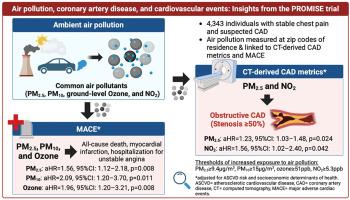
This study utilized data from the computed tomography (CT) arm of the PROMISE trial investigating symptomatic individuals with suspected CAD. We linked levels of air pollutants (PM2·5, PM10, NO2, and ozone) at U.S. zip codes of residence CT-derived CAD and adjudicated MACE (all-cause death, myocardial infarction, and hospitalization for unstable angina). Multivariable analyses were adjusted for the ASCVD risk score and socioeconomic determinants of health. Mediation analyses were used to test putative pathways.
Results
In 4343 individuals (48 % males; age: 61 ± 8 years), elevated exposures to PM2.5 (≥9.4 μg/m3) and NO2 (≥5.3 ppb) were independently associated with obstructive CAD (aOR = 1.23, 95%CI: 1.03–1.48, p = 0.024; aOR = 1.56, 95%CI: 1.02–2.40, p = 0.042), while there were no significant associations with PM10 (≥15 μg/m3) or ozone (≥51 ppb). Increased PM2.5, PM10 and ozone were independently associated with MACE (aHR = 1.56, 95%CI: 1.12–2.18, p = 0.008; aHR = 2.09, 95%CI: 1.18–3.70, p = 0.011, aHR = 1.96, 95%CI: 1.20–3.21, p = 0.008). In the mediation analysis, obstructive CAD accounted for 9 % of the total effect (p = 0.012) between PM2.5 and MACE.
Conclusion
Exposure to air pollution, particularly PM2.5, was independently associated with obstructive CAD and MACE, with obstructive CAD mediating a small but significant portion of the association between air pollution and MACE.
期刊介绍:
The Journal of Cardiovascular Computed Tomography is a unique peer-review journal that integrates the entire international cardiovascular CT community including cardiologist and radiologists, from basic to clinical academic researchers, to private practitioners, engineers, allied professionals, industry, and trainees, all of whom are vital and interdependent members of our cardiovascular imaging community across the world. The goal of the journal is to advance the field of cardiovascular CT as the leading cardiovascular CT journal, attracting seminal work in the field with rapid and timely dissemination in electronic and print media.




 京公网安备 11010802042870号
京ICP备2023020795号-1
京公网安备 11010802042870号
京ICP备2023020795号-1

 分享
分享
 求助内容:
求助内容: 应助结果提醒方式:
 扫码关注我们
