{"title":"Cl + H2 (v = 1, j = 1)→HCl + H反应共振的立体动力学控制","authors":"Xiaoxi Xu, Bayaer Buren and Maodu Chen","doi":"10.1039/D4CP04733H","DOIUrl":null,"url":null,"abstract":"<p >The stereodynamical control of resonance profoundly influences the outcomes of molecular collisions. Here, we perform time-dependent wave packet calculations for the Cl + H<small><sub>2</sub></small> (<em>v</em> = 1, <em>j</em> = 1) → HCl + H reaction to investigate how stereodynamical control influences reaction resonances. The results of the dynamical calculations indicate that the backward scattering differential cross section of the HCl (<em>v</em>′ = 2) product exhibits two pronounced peaks at collision energies of ∼0.4 eV and ∼0.5 eV. Analysis confirms that these characteristic peaks are attributable to reaction resonances. This work explores the impact of different alignment angles of the H<small><sub>2</sub></small> reactant molecule on these two reaction resonances. It is found that the parallel alignment of the H<small><sub>2</sub></small> molecule markedly amplifies the intensity of the resonance peaks, while the perpendicular alignment results in a notable suppression of these features. Furthermore, the alignment angle of the reactants significantly influences the scattering direction of the products. Products at the energies of resonances from the head-on collision tend to scatter in the backward direction. In contrast, those from the side-on collision are more likely to scatter forward and sideways.</p>","PeriodicalId":99,"journal":{"name":"Physical Chemistry Chemical Physics","volume":" 14","pages":" 7250-7257"},"PeriodicalIF":2.9000,"publicationDate":"2025-03-21","publicationTypes":"Journal Article","fieldsOfStudy":null,"isOpenAccess":false,"openAccessPdf":"","citationCount":"0","resultStr":"{\"title\":\"Stereodynamical control of resonances in the Cl + H2 (v = 1, j = 1) → HCl + H reaction\",\"authors\":\"Xiaoxi Xu, Bayaer Buren and Maodu Chen\",\"doi\":\"10.1039/D4CP04733H\",\"DOIUrl\":null,\"url\":null,\"abstract\":\"<p >The stereodynamical control of resonance profoundly influences the outcomes of molecular collisions. Here, we perform time-dependent wave packet calculations for the Cl + H<small><sub>2</sub></small> (<em>v</em> = 1, <em>j</em> = 1) → HCl + H reaction to investigate how stereodynamical control influences reaction resonances. The results of the dynamical calculations indicate that the backward scattering differential cross section of the HCl (<em>v</em>′ = 2) product exhibits two pronounced peaks at collision energies of ∼0.4 eV and ∼0.5 eV. Analysis confirms that these characteristic peaks are attributable to reaction resonances. This work explores the impact of different alignment angles of the H<small><sub>2</sub></small> reactant molecule on these two reaction resonances. It is found that the parallel alignment of the H<small><sub>2</sub></small> molecule markedly amplifies the intensity of the resonance peaks, while the perpendicular alignment results in a notable suppression of these features. Furthermore, the alignment angle of the reactants significantly influences the scattering direction of the products. Products at the energies of resonances from the head-on collision tend to scatter in the backward direction. In contrast, those from the side-on collision are more likely to scatter forward and sideways.</p>\",\"PeriodicalId\":99,\"journal\":{\"name\":\"Physical Chemistry Chemical Physics\",\"volume\":\" 14\",\"pages\":\" 7250-7257\"},\"PeriodicalIF\":2.9000,\"publicationDate\":\"2025-03-21\",\"publicationTypes\":\"Journal Article\",\"fieldsOfStudy\":null,\"isOpenAccess\":false,\"openAccessPdf\":\"\",\"citationCount\":\"0\",\"resultStr\":null,\"platform\":\"Semanticscholar\",\"paperid\":null,\"PeriodicalName\":\"Physical Chemistry Chemical Physics\",\"FirstCategoryId\":\"92\",\"ListUrlMain\":\"https://pubs.rsc.org/en/content/articlelanding/2025/cp/d4cp04733h\",\"RegionNum\":3,\"RegionCategory\":\"化学\",\"ArticlePicture\":[],\"TitleCN\":null,\"AbstractTextCN\":null,\"PMCID\":null,\"EPubDate\":\"\",\"PubModel\":\"\",\"JCR\":\"Q3\",\"JCRName\":\"CHEMISTRY, PHYSICAL\",\"Score\":null,\"Total\":0}","platform":"Semanticscholar","paperid":null,"PeriodicalName":"Physical Chemistry Chemical Physics","FirstCategoryId":"92","ListUrlMain":"https://pubs.rsc.org/en/content/articlelanding/2025/cp/d4cp04733h","RegionNum":3,"RegionCategory":"化学","ArticlePicture":[],"TitleCN":null,"AbstractTextCN":null,"PMCID":null,"EPubDate":"","PubModel":"","JCR":"Q3","JCRName":"CHEMISTRY, PHYSICAL","Score":null,"Total":0}
引用次数: 0
摘要
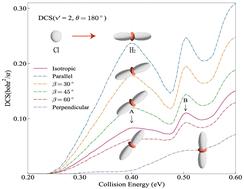
共振的立体动力学控制深刻影响着分子碰撞的结果。在此,我们对 Cl + H2 (v = 1, j = 1) → HCl + H 反应进行了随时间变化的波包计算,以研究立体动力学控制如何影响反应共振。动力学计算的结果表明,HCl (v′ = 2) 产物的后向散射差分截面在碰撞能量 ∼0.4 eV 和 ∼0.5 eV 处有两个明显的峰值。分析证实,这些特征峰是反应共振产生的。这项研究探讨了 H2 反应物分子的不同排列角度对这两个反应共振的影响。研究发现,H2 分子平行排列会明显放大共振峰的强度,而垂直排列则会明显抑制这些特征。此外,反应物的排列角度对产物的散射方向也有显著影响。正面碰撞产生的共振能量下的产物倾向于向后方向散射。相比之下,侧面碰撞产生的产物则更倾向于向前和向侧面散射。
Stereodynamical control of resonances in the Cl + H2 (v = 1, j = 1) → HCl + H reaction
The stereodynamical control of resonance profoundly influences the outcomes of molecular collisions. Here, we perform time-dependent wave packet calculations for the Cl + H2 (v = 1, j = 1) → HCl + H reaction to investigate how stereodynamical control influences reaction resonances. The results of the dynamical calculations indicate that the backward scattering differential cross section of the HCl (v′ = 2) product exhibits two pronounced peaks at collision energies of ∼0.4 eV and ∼0.5 eV. Analysis confirms that these characteristic peaks are attributable to reaction resonances. This work explores the impact of different alignment angles of the H2 reactant molecule on these two reaction resonances. It is found that the parallel alignment of the H2 molecule markedly amplifies the intensity of the resonance peaks, while the perpendicular alignment results in a notable suppression of these features. Furthermore, the alignment angle of the reactants significantly influences the scattering direction of the products. Products at the energies of resonances from the head-on collision tend to scatter in the backward direction. In contrast, those from the side-on collision are more likely to scatter forward and sideways.
期刊介绍:
Physical Chemistry Chemical Physics (PCCP) is an international journal co-owned by 19 physical chemistry and physics societies from around the world. This journal publishes original, cutting-edge research in physical chemistry, chemical physics and biophysical chemistry. To be suitable for publication in PCCP, articles must include significant innovation and/or insight into physical chemistry; this is the most important criterion that reviewers and Editors will judge against when evaluating submissions.
The journal has a broad scope and welcomes contributions spanning experiment, theory, computation and data science. Topical coverage includes spectroscopy, dynamics, kinetics, statistical mechanics, thermodynamics, electrochemistry, catalysis, surface science, quantum mechanics, quantum computing and machine learning. Interdisciplinary research areas such as polymers and soft matter, materials, nanoscience, energy, surfaces/interfaces, and biophysical chemistry are welcomed if they demonstrate significant innovation and/or insight into physical chemistry. Joined experimental/theoretical studies are particularly appreciated when complementary and based on up-to-date approaches.





 京公网安备 11010802042870号
京ICP备2023020795号-1
京公网安备 11010802042870号
京ICP备2023020795号-1

 分享
分享
 求助内容:
求助内容: 应助结果提醒方式:
 扫码关注我们
