Yanwei Wang, Guofeng Li, Jisong Hu, Ge Gao, Ying Zhang, Guangxia Shi, Xu Yang, Lei Zhang, Ling Fang and Yinwei Li
{"title":"非金属掺杂VTe2单层:增强析氢反应机理的理论见解","authors":"Yanwei Wang, Guofeng Li, Jisong Hu, Ge Gao, Ying Zhang, Guangxia Shi, Xu Yang, Lei Zhang, Ling Fang and Yinwei Li","doi":"10.1039/D5CP00670H","DOIUrl":null,"url":null,"abstract":"<p >Two-dimensional transition metal dichalcogenides (TMDCs), such as vanadium ditelluride (VTe<small><sub>2</sub></small>), have emerged as promising catalysts for the hydrogen evolution reaction (HER) due to their unique layered structures and remarkable electronic properties. However, the catalytic performance of pristine VTe<small><sub>2</sub></small> remains inferior to that of noble metals. In this study, density functional theory (DFT) calculations were employed to systematically investigate the influence of fourteen different non-metal dopants on the HER activity of VTe<small><sub>2</sub></small>. Our results disclose that N–VTe<small><sub>2</sub></small>, P–VTe<small><sub>2</sub></small> and As–VTe<small><sub>2</sub></small> possess exceptional catalytic properties for the HER with the Gibbs free energy of hydrogen adsorption (Δ<em>G</em><small><sub>H*</sub></small>) values of 0.031, −0.032 and 0.024 eV, respectively. Furthermore, analyses of the geometric and electronic structures reveal that non-metal doping induces localized geometric distortions and charge redistribution, thereby altering the electronic environment of active sites and enhancing catalytic performance. More importantly, a composite descriptor <em>φ</em>, integrating the bond length between doped non-metal atoms and neighboring V atoms (<em>L</em><small><sub>NM–M</sub></small>) and the pz band center (<em>ε</em><small><sub>pz</sub></small>) of the doped atoms, demonstrates a strong correlation with Δ<em>G</em><small><sub>H*</sub></small> and may serve as an effective predictor of HER activity. These findings shed light on non-metal doping as an effective strategy for developing efficient, non-noble metal HER catalysts based on TMDCs.</p>","PeriodicalId":99,"journal":{"name":"Physical Chemistry Chemical Physics","volume":" 19","pages":" 9970-9979"},"PeriodicalIF":2.9000,"publicationDate":"2025-03-21","publicationTypes":"Journal Article","fieldsOfStudy":null,"isOpenAccess":false,"openAccessPdf":"","citationCount":"0","resultStr":"{\"title\":\"A non-metal doped VTe2 monolayer: theoretical insights into the enhanced mechanism for the hydrogen evolution reaction†\",\"authors\":\"Yanwei Wang, Guofeng Li, Jisong Hu, Ge Gao, Ying Zhang, Guangxia Shi, Xu Yang, Lei Zhang, Ling Fang and Yinwei Li\",\"doi\":\"10.1039/D5CP00670H\",\"DOIUrl\":null,\"url\":null,\"abstract\":\"<p >Two-dimensional transition metal dichalcogenides (TMDCs), such as vanadium ditelluride (VTe<small><sub>2</sub></small>), have emerged as promising catalysts for the hydrogen evolution reaction (HER) due to their unique layered structures and remarkable electronic properties. However, the catalytic performance of pristine VTe<small><sub>2</sub></small> remains inferior to that of noble metals. In this study, density functional theory (DFT) calculations were employed to systematically investigate the influence of fourteen different non-metal dopants on the HER activity of VTe<small><sub>2</sub></small>. Our results disclose that N–VTe<small><sub>2</sub></small>, P–VTe<small><sub>2</sub></small> and As–VTe<small><sub>2</sub></small> possess exceptional catalytic properties for the HER with the Gibbs free energy of hydrogen adsorption (Δ<em>G</em><small><sub>H*</sub></small>) values of 0.031, −0.032 and 0.024 eV, respectively. Furthermore, analyses of the geometric and electronic structures reveal that non-metal doping induces localized geometric distortions and charge redistribution, thereby altering the electronic environment of active sites and enhancing catalytic performance. More importantly, a composite descriptor <em>φ</em>, integrating the bond length between doped non-metal atoms and neighboring V atoms (<em>L</em><small><sub>NM–M</sub></small>) and the pz band center (<em>ε</em><small><sub>pz</sub></small>) of the doped atoms, demonstrates a strong correlation with Δ<em>G</em><small><sub>H*</sub></small> and may serve as an effective predictor of HER activity. These findings shed light on non-metal doping as an effective strategy for developing efficient, non-noble metal HER catalysts based on TMDCs.</p>\",\"PeriodicalId\":99,\"journal\":{\"name\":\"Physical Chemistry Chemical Physics\",\"volume\":\" 19\",\"pages\":\" 9970-9979\"},\"PeriodicalIF\":2.9000,\"publicationDate\":\"2025-03-21\",\"publicationTypes\":\"Journal Article\",\"fieldsOfStudy\":null,\"isOpenAccess\":false,\"openAccessPdf\":\"\",\"citationCount\":\"0\",\"resultStr\":null,\"platform\":\"Semanticscholar\",\"paperid\":null,\"PeriodicalName\":\"Physical Chemistry Chemical Physics\",\"FirstCategoryId\":\"92\",\"ListUrlMain\":\"https://pubs.rsc.org/en/content/articlelanding/2025/cp/d5cp00670h\",\"RegionNum\":3,\"RegionCategory\":\"化学\",\"ArticlePicture\":[],\"TitleCN\":null,\"AbstractTextCN\":null,\"PMCID\":null,\"EPubDate\":\"\",\"PubModel\":\"\",\"JCR\":\"Q3\",\"JCRName\":\"CHEMISTRY, PHYSICAL\",\"Score\":null,\"Total\":0}","platform":"Semanticscholar","paperid":null,"PeriodicalName":"Physical Chemistry Chemical Physics","FirstCategoryId":"92","ListUrlMain":"https://pubs.rsc.org/en/content/articlelanding/2025/cp/d5cp00670h","RegionNum":3,"RegionCategory":"化学","ArticlePicture":[],"TitleCN":null,"AbstractTextCN":null,"PMCID":null,"EPubDate":"","PubModel":"","JCR":"Q3","JCRName":"CHEMISTRY, PHYSICAL","Score":null,"Total":0}
引用次数: 0
摘要
二维过渡金属二碲化镉(TMDCs)(如二碲化钒(VTe2))因其独特的层状结构和显著的电子特性,已成为氢进化反应(HER)中极具前景的催化剂。然而,原始 VTe2 的催化性能仍然不如贵金属。本研究采用密度泛函理论(DFT)计算方法,系统地研究了 14 种不同的非金属掺杂剂对 VTe2 的氢进化活性的影响。研究结果表明,N-VTe2、P-VTe2 和 As-VTe2 对 HER 具有优异的催化性能,其吸附氢的吉布斯自由能 (GH*) 值分别为 0.031、-0.032 和 0.024 eV。此外,对几何和电子结构的分析表明,非金属掺杂会引起局部几何畸变和电荷再分布,从而改变活性位点的电子环境并提高催化性能。更重要的是,综合了掺杂非金属原子与邻近 V 原子间的键长(LNM-M)和掺杂原子的 pz 带中心(pz)的复合描述符 与 GH* 显示出很强的相关性,可作为 HER 活性的有效预测因子。这些发现阐明了非金属掺杂是开发基于 TMDCs 的高效非贵金属 HER 催化剂的有效策略。
A non-metal doped VTe2 monolayer: theoretical insights into the enhanced mechanism for the hydrogen evolution reaction†
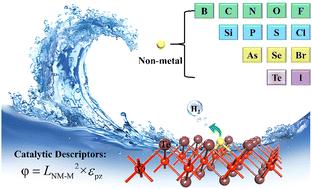
Two-dimensional transition metal dichalcogenides (TMDCs), such as vanadium ditelluride (VTe2), have emerged as promising catalysts for the hydrogen evolution reaction (HER) due to their unique layered structures and remarkable electronic properties. However, the catalytic performance of pristine VTe2 remains inferior to that of noble metals. In this study, density functional theory (DFT) calculations were employed to systematically investigate the influence of fourteen different non-metal dopants on the HER activity of VTe2. Our results disclose that N–VTe2, P–VTe2 and As–VTe2 possess exceptional catalytic properties for the HER with the Gibbs free energy of hydrogen adsorption (ΔGH*) values of 0.031, −0.032 and 0.024 eV, respectively. Furthermore, analyses of the geometric and electronic structures reveal that non-metal doping induces localized geometric distortions and charge redistribution, thereby altering the electronic environment of active sites and enhancing catalytic performance. More importantly, a composite descriptor φ, integrating the bond length between doped non-metal atoms and neighboring V atoms (LNM–M) and the pz band center (εpz) of the doped atoms, demonstrates a strong correlation with ΔGH* and may serve as an effective predictor of HER activity. These findings shed light on non-metal doping as an effective strategy for developing efficient, non-noble metal HER catalysts based on TMDCs.
期刊介绍:
Physical Chemistry Chemical Physics (PCCP) is an international journal co-owned by 19 physical chemistry and physics societies from around the world. This journal publishes original, cutting-edge research in physical chemistry, chemical physics and biophysical chemistry. To be suitable for publication in PCCP, articles must include significant innovation and/or insight into physical chemistry; this is the most important criterion that reviewers and Editors will judge against when evaluating submissions.
The journal has a broad scope and welcomes contributions spanning experiment, theory, computation and data science. Topical coverage includes spectroscopy, dynamics, kinetics, statistical mechanics, thermodynamics, electrochemistry, catalysis, surface science, quantum mechanics, quantum computing and machine learning. Interdisciplinary research areas such as polymers and soft matter, materials, nanoscience, energy, surfaces/interfaces, and biophysical chemistry are welcomed if they demonstrate significant innovation and/or insight into physical chemistry. Joined experimental/theoretical studies are particularly appreciated when complementary and based on up-to-date approaches.




 京公网安备 11010802042870号
京ICP备2023020795号-1
京公网安备 11010802042870号
京ICP备2023020795号-1

 分享
分享
 求助内容:
求助内容: 应助结果提醒方式:
 扫码关注我们
