Yuqian Wang, Xiaoyong Xiong, Shibo Fang, Hong Li, Zhulin Weng, Dahua Ren and Qiang Li
{"title":"单层α-硒p-n结光电器件光电流的第一性原理分析","authors":"Yuqian Wang, Xiaoyong Xiong, Shibo Fang, Hong Li, Zhulin Weng, Dahua Ren and Qiang Li","doi":"10.1039/D4CP04763J","DOIUrl":null,"url":null,"abstract":"<p >Two-dimensional monoelemental materials have emerged as promising candidates for use in the development of next-generation optoelectronic devices. In this work, we investigate the photovoltaic effect of monolayer (ML) α-selenium p–n junctions by using <em>ab initio</em> quantum transport simulations. Our research results indicate that the photocurrent of the ML α-selenium p–n junction optoelectronic device exhibits anisotropy. The maximum photoresponsivity (178.49 <em>a</em><small><sub>0</sub></small><small><sup>2</sup></small> per photon) in the armchair (ARM) direction is one-half that (341.72 <em>a</em><small><sub>0</sub></small><small><sup>2</sup></small> per photon) in the zigzag (ZZ) direction. When stress is applied, the most significant modulation of photoresponsivity occurs in the ZZ direction, reaching a value of 613.21 <em>a</em><small><sub>0</sub></small><small><sup>2</sup></small> per photon. When a gate voltage is applied, the most significant modulation of photoresponsivity occurs in the ARM direction, reaching a value of −684.88 <em>a</em><small><sub>0</sub></small><small><sup>2</sup></small> per photon. When a thermal difference is applied, the most significant modulation of photoresponsivity occurs in the ARM direction, reaching a value of 412.14 <em>a</em><small><sub>0</sub></small><small><sup>2</sup></small> per photon. Thus, ML α-selenium in the ZZ direction can be used for photodetection and photosensing, while ML α-selenium in the ARM direction can be used for photosensing. Both strain engineering and temperature differences cause a blueshift in the photocurrent as a function of energy. Our work paves the way for research into low-dimensional monoelemental-material optoelectronic devices.</p>","PeriodicalId":99,"journal":{"name":"Physical Chemistry Chemical Physics","volume":" 14","pages":" 7288-7295"},"PeriodicalIF":3.0000,"publicationDate":"2025-03-21","publicationTypes":"Journal Article","fieldsOfStudy":null,"isOpenAccess":false,"openAccessPdf":"","citationCount":"0","resultStr":"{\"title\":\"First-principles analysis of the photocurrent in a monolayer α-selenium p–n junction optoelectronic device†\",\"authors\":\"Yuqian Wang, Xiaoyong Xiong, Shibo Fang, Hong Li, Zhulin Weng, Dahua Ren and Qiang Li\",\"doi\":\"10.1039/D4CP04763J\",\"DOIUrl\":null,\"url\":null,\"abstract\":\"<p >Two-dimensional monoelemental materials have emerged as promising candidates for use in the development of next-generation optoelectronic devices. In this work, we investigate the photovoltaic effect of monolayer (ML) α-selenium p–n junctions by using <em>ab initio</em> quantum transport simulations. Our research results indicate that the photocurrent of the ML α-selenium p–n junction optoelectronic device exhibits anisotropy. The maximum photoresponsivity (178.49 <em>a</em><small><sub>0</sub></small><small><sup>2</sup></small> per photon) in the armchair (ARM) direction is one-half that (341.72 <em>a</em><small><sub>0</sub></small><small><sup>2</sup></small> per photon) in the zigzag (ZZ) direction. When stress is applied, the most significant modulation of photoresponsivity occurs in the ZZ direction, reaching a value of 613.21 <em>a</em><small><sub>0</sub></small><small><sup>2</sup></small> per photon. When a gate voltage is applied, the most significant modulation of photoresponsivity occurs in the ARM direction, reaching a value of −684.88 <em>a</em><small><sub>0</sub></small><small><sup>2</sup></small> per photon. When a thermal difference is applied, the most significant modulation of photoresponsivity occurs in the ARM direction, reaching a value of 412.14 <em>a</em><small><sub>0</sub></small><small><sup>2</sup></small> per photon. Thus, ML α-selenium in the ZZ direction can be used for photodetection and photosensing, while ML α-selenium in the ARM direction can be used for photosensing. Both strain engineering and temperature differences cause a blueshift in the photocurrent as a function of energy. Our work paves the way for research into low-dimensional monoelemental-material optoelectronic devices.</p>\",\"PeriodicalId\":99,\"journal\":{\"name\":\"Physical Chemistry Chemical Physics\",\"volume\":\" 14\",\"pages\":\" 7288-7295\"},\"PeriodicalIF\":3.0000,\"publicationDate\":\"2025-03-21\",\"publicationTypes\":\"Journal Article\",\"fieldsOfStudy\":null,\"isOpenAccess\":false,\"openAccessPdf\":\"\",\"citationCount\":\"0\",\"resultStr\":null,\"platform\":\"Semanticscholar\",\"paperid\":null,\"PeriodicalName\":\"Physical Chemistry Chemical Physics\",\"FirstCategoryId\":\"92\",\"ListUrlMain\":\"https://pubs.rsc.org/en/content/articlelanding/2025/cp/d4cp04763j\",\"RegionNum\":3,\"RegionCategory\":\"化学\",\"ArticlePicture\":[],\"TitleCN\":null,\"AbstractTextCN\":null,\"PMCID\":null,\"EPubDate\":\"\",\"PubModel\":\"\",\"JCR\":\"Q3\",\"JCRName\":\"CHEMISTRY, PHYSICAL\",\"Score\":null,\"Total\":0}","platform":"Semanticscholar","paperid":null,"PeriodicalName":"Physical Chemistry Chemical Physics","FirstCategoryId":"92","ListUrlMain":"https://pubs.rsc.org/en/content/articlelanding/2025/cp/d4cp04763j","RegionNum":3,"RegionCategory":"化学","ArticlePicture":[],"TitleCN":null,"AbstractTextCN":null,"PMCID":null,"EPubDate":"","PubModel":"","JCR":"Q3","JCRName":"CHEMISTRY, PHYSICAL","Score":null,"Total":0}
引用次数: 0
摘要
二维单元素材料已成为开发新一代光电器件的理想候选材料。在这项研究中,我们利用ab initio量子输运模拟研究了单层(ML)α-硒p-n结的光伏效应。研究结果表明,ML α-硒 p-n 结光电器件的光电流表现出各向异性。扶手(ARM)方向的最大光致发光率(每光子 178.49 a02)是之字形(ZZ)方向的二分之一(每光子 341.72 a02)。当施加应力时,ZZ 方向的光致发光率会发生最显著的调节,达到每光子 613.21 a02 的值。施加栅极电压时,光致发光性在 ARM 方向的调制最为显著,达到每光子 -684.88 a02 的值。当施加热差时,光致发光性的最大调制发生在 ARM 方向,达到每光子 412.14 a02 的值。因此,ZZ 方向上的 ML α 硒可用于光探测和光传感,而 ARM 方向上的 ML α 硒可用于光传感。应变工程和温度差异都会导致光电流随能量而发生蓝移。我们的工作为研究低维单元素材料光电器件铺平了道路。
First-principles analysis of the photocurrent in a monolayer α-selenium p–n junction optoelectronic device†
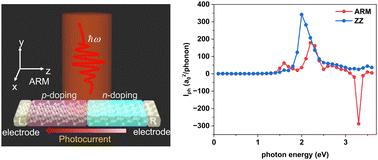
Two-dimensional monoelemental materials have emerged as promising candidates for use in the development of next-generation optoelectronic devices. In this work, we investigate the photovoltaic effect of monolayer (ML) α-selenium p–n junctions by using ab initio quantum transport simulations. Our research results indicate that the photocurrent of the ML α-selenium p–n junction optoelectronic device exhibits anisotropy. The maximum photoresponsivity (178.49 a02 per photon) in the armchair (ARM) direction is one-half that (341.72 a02 per photon) in the zigzag (ZZ) direction. When stress is applied, the most significant modulation of photoresponsivity occurs in the ZZ direction, reaching a value of 613.21 a02 per photon. When a gate voltage is applied, the most significant modulation of photoresponsivity occurs in the ARM direction, reaching a value of −684.88 a02 per photon. When a thermal difference is applied, the most significant modulation of photoresponsivity occurs in the ARM direction, reaching a value of 412.14 a02 per photon. Thus, ML α-selenium in the ZZ direction can be used for photodetection and photosensing, while ML α-selenium in the ARM direction can be used for photosensing. Both strain engineering and temperature differences cause a blueshift in the photocurrent as a function of energy. Our work paves the way for research into low-dimensional monoelemental-material optoelectronic devices.
期刊介绍:
Physical Chemistry Chemical Physics (PCCP) is an international journal co-owned by 19 physical chemistry and physics societies from around the world. This journal publishes original, cutting-edge research in physical chemistry, chemical physics and biophysical chemistry. To be suitable for publication in PCCP, articles must include significant innovation and/or insight into physical chemistry; this is the most important criterion that reviewers and Editors will judge against when evaluating submissions.
The journal has a broad scope and welcomes contributions spanning experiment, theory, computation and data science. Topical coverage includes spectroscopy, dynamics, kinetics, statistical mechanics, thermodynamics, electrochemistry, catalysis, surface science, quantum mechanics, quantum computing and machine learning. Interdisciplinary research areas such as polymers and soft matter, materials, nanoscience, energy, surfaces/interfaces, and biophysical chemistry are welcomed if they demonstrate significant innovation and/or insight into physical chemistry. Joined experimental/theoretical studies are particularly appreciated when complementary and based on up-to-date approaches.






 京公网安备 11010802042870号
京ICP备2023020795号-1
京公网安备 11010802042870号
京ICP备2023020795号-1

 分享
分享
 求助内容:
求助内容: 应助结果提醒方式:
 扫码关注我们
