{"title":"新型磺脲类NLRP3炎性小体抑制剂治疗多种炎性疾病的发现","authors":"Yiting Liu, Qinxue Wang, Jinyu Ma, Jiyuan Li, Cuina Li, Xiong Xie, Qiannan Xiao, Cen Xie, Hong Liu, Ying Hong, Jiang Wang","doi":"10.1021/acs.jmedchem.4c02813","DOIUrl":null,"url":null,"abstract":"NLRP3 inflammasome is critical in innate immunity and inflammatory responses. A series of novel sulfonylurea-based NLRP3 inflammasome inhibitors was designed and synthesized. Notably, compound <b>15</b> exhibited the potent NLRP3 inhibitory activity, effectively suppressing IL-1β secretion in THP-1 (IC<sub>50</sub> = 23 nM), demonstrating better efficacy compared to MCC950. It selectively inhibits NLRP3 activation by disrupting inflammasome assembly, with no effect on NLRC4 or AIM2 inflammasomes. Molecular docking showed that the 1-methyl-4-(methylamino)piperidine moiety forms a novel hydrogen bond with Asp662 in the hydrophilic region of NLRP3. Additionally, compound <b>15</b> displayed excellent pharmacokinetic properties with 99.6% oral bioavailability in mice. It exhibited superior efficacy in acute peritonitis and diabetic kidney disease models, surpassing MCC950. Tissue distribution studies confirmed that compound <b>15</b> specifically targeted the gut and showed efficacy in an IBD model, comparable to MCC950. These findings highlight compound <b>15</b> as a promising lead for novel oral NLRP3 inflammasome inhibitors.","PeriodicalId":46,"journal":{"name":"Journal of Medicinal Chemistry","volume":"7 1","pages":""},"PeriodicalIF":6.8000,"publicationDate":"2025-03-20","publicationTypes":"Journal Article","fieldsOfStudy":null,"isOpenAccess":false,"openAccessPdf":"","citationCount":"0","resultStr":"{\"title\":\"Discovery of Novel Sulfonylurea NLRP3 Inflammasome Inhibitor for the Treatment of Multiple Inflammatory Diseases\",\"authors\":\"Yiting Liu, Qinxue Wang, Jinyu Ma, Jiyuan Li, Cuina Li, Xiong Xie, Qiannan Xiao, Cen Xie, Hong Liu, Ying Hong, Jiang Wang\",\"doi\":\"10.1021/acs.jmedchem.4c02813\",\"DOIUrl\":null,\"url\":null,\"abstract\":\"NLRP3 inflammasome is critical in innate immunity and inflammatory responses. A series of novel sulfonylurea-based NLRP3 inflammasome inhibitors was designed and synthesized. Notably, compound <b>15</b> exhibited the potent NLRP3 inhibitory activity, effectively suppressing IL-1β secretion in THP-1 (IC<sub>50</sub> = 23 nM), demonstrating better efficacy compared to MCC950. It selectively inhibits NLRP3 activation by disrupting inflammasome assembly, with no effect on NLRC4 or AIM2 inflammasomes. Molecular docking showed that the 1-methyl-4-(methylamino)piperidine moiety forms a novel hydrogen bond with Asp662 in the hydrophilic region of NLRP3. Additionally, compound <b>15</b> displayed excellent pharmacokinetic properties with 99.6% oral bioavailability in mice. It exhibited superior efficacy in acute peritonitis and diabetic kidney disease models, surpassing MCC950. Tissue distribution studies confirmed that compound <b>15</b> specifically targeted the gut and showed efficacy in an IBD model, comparable to MCC950. These findings highlight compound <b>15</b> as a promising lead for novel oral NLRP3 inflammasome inhibitors.\",\"PeriodicalId\":46,\"journal\":{\"name\":\"Journal of Medicinal Chemistry\",\"volume\":\"7 1\",\"pages\":\"\"},\"PeriodicalIF\":6.8000,\"publicationDate\":\"2025-03-20\",\"publicationTypes\":\"Journal Article\",\"fieldsOfStudy\":null,\"isOpenAccess\":false,\"openAccessPdf\":\"\",\"citationCount\":\"0\",\"resultStr\":null,\"platform\":\"Semanticscholar\",\"paperid\":null,\"PeriodicalName\":\"Journal of Medicinal Chemistry\",\"FirstCategoryId\":\"3\",\"ListUrlMain\":\"https://doi.org/10.1021/acs.jmedchem.4c02813\",\"RegionNum\":1,\"RegionCategory\":\"医学\",\"ArticlePicture\":[],\"TitleCN\":null,\"AbstractTextCN\":null,\"PMCID\":null,\"EPubDate\":\"\",\"PubModel\":\"\",\"JCR\":\"Q1\",\"JCRName\":\"CHEMISTRY, MEDICINAL\",\"Score\":null,\"Total\":0}","platform":"Semanticscholar","paperid":null,"PeriodicalName":"Journal of Medicinal Chemistry","FirstCategoryId":"3","ListUrlMain":"https://doi.org/10.1021/acs.jmedchem.4c02813","RegionNum":1,"RegionCategory":"医学","ArticlePicture":[],"TitleCN":null,"AbstractTextCN":null,"PMCID":null,"EPubDate":"","PubModel":"","JCR":"Q1","JCRName":"CHEMISTRY, MEDICINAL","Score":null,"Total":0}
Discovery of Novel Sulfonylurea NLRP3 Inflammasome Inhibitor for the Treatment of Multiple Inflammatory Diseases
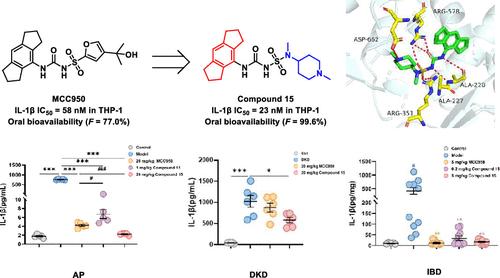
NLRP3 inflammasome is critical in innate immunity and inflammatory responses. A series of novel sulfonylurea-based NLRP3 inflammasome inhibitors was designed and synthesized. Notably, compound 15 exhibited the potent NLRP3 inhibitory activity, effectively suppressing IL-1β secretion in THP-1 (IC50 = 23 nM), demonstrating better efficacy compared to MCC950. It selectively inhibits NLRP3 activation by disrupting inflammasome assembly, with no effect on NLRC4 or AIM2 inflammasomes. Molecular docking showed that the 1-methyl-4-(methylamino)piperidine moiety forms a novel hydrogen bond with Asp662 in the hydrophilic region of NLRP3. Additionally, compound 15 displayed excellent pharmacokinetic properties with 99.6% oral bioavailability in mice. It exhibited superior efficacy in acute peritonitis and diabetic kidney disease models, surpassing MCC950. Tissue distribution studies confirmed that compound 15 specifically targeted the gut and showed efficacy in an IBD model, comparable to MCC950. These findings highlight compound 15 as a promising lead for novel oral NLRP3 inflammasome inhibitors.
期刊介绍:
The Journal of Medicinal Chemistry is a prestigious biweekly peer-reviewed publication that focuses on the multifaceted field of medicinal chemistry. Since its inception in 1959 as the Journal of Medicinal and Pharmaceutical Chemistry, it has evolved to become a cornerstone in the dissemination of research findings related to the design, synthesis, and development of therapeutic agents.
The Journal of Medicinal Chemistry is recognized for its significant impact in the scientific community, as evidenced by its 2022 impact factor of 7.3. This metric reflects the journal's influence and the importance of its content in shaping the future of drug discovery and development. The journal serves as a vital resource for chemists, pharmacologists, and other researchers interested in the molecular mechanisms of drug action and the optimization of therapeutic compounds.




 京公网安备 11010802042870号
京ICP备2023020795号-1
京公网安备 11010802042870号
京ICP备2023020795号-1

 分享
分享
 求助内容:
求助内容: 应助结果提醒方式:
 扫码关注我们
