Alva Abrahamsson, Andreas Berner, Justyna Golebiewska-Pikula, Namrata Chaudhari, Emelie Keskitalo, Cecilia Lindgren, Marcin K Chmielewski, Sjoerd Wanrooij, Erik Chorell
{"title":"利用 G4 配体共轭寡核苷酸精准靶向致癌 G-四重 DNA 的连接体设计原则。","authors":"Alva Abrahamsson, Andreas Berner, Justyna Golebiewska-Pikula, Namrata Chaudhari, Emelie Keskitalo, Cecilia Lindgren, Marcin K Chmielewski, Sjoerd Wanrooij, Erik Chorell","doi":"10.1021/acs.bioconjchem.5c00008","DOIUrl":null,"url":null,"abstract":"<p><p>G-quadruplex (G4) DNA structures are noncanonical secondary structures found in key regulatory regions of the genome, including oncogenic promoters and telomeres. Small molecules, known as G4 ligands, capable of stabilizing G4s hold promise as chemical probes and therapeutic agents. Nevertheless, achieving precise specificity for individual G4 structures within the human genome remains a significant challenge. To address this, we expand upon G4-ligand-conjugated oligonucleotides (GL-Os), a modular platform combining the stabilizing properties of G4-ligands with the sequence specificity of guide DNA oligonucleotides. Central to this strategy is the linker that bridges the G4 ligand and the guide oligonucleotide. In this study, we develop multiple conjugation strategies for the GL-Os that enabled a systematic investigation of the linker in both chemical composition and length, enabling a thorough assessment of their impact on targeting oncogenic G4 DNA. Biophysical, biochemical, and computational evaluations revealed GL-Os with optimized linkers that exhibited enhanced binding to target G4s, even under thermal or structural stress. Notably, longer linkers broadened the range of targetable sequences without introducing steric hindrance, thereby enhancing the platform's applicability across diverse genomic contexts. These findings establish GL-Os as a robust and versatile tool for the selective targeting of individual G4s. By facilitating precise investigations of G4 biology, this work provides a foundation for advancing G4-targeted therapeutic strategies and exploring their role in disease contexts.</p>","PeriodicalId":29,"journal":{"name":"Bioconjugate Chemistry","volume":" ","pages":"724-736"},"PeriodicalIF":3.9000,"publicationDate":"2025-04-16","publicationTypes":"Journal Article","fieldsOfStudy":null,"isOpenAccess":false,"openAccessPdf":"https://www.ncbi.nlm.nih.gov/pmc/articles/PMC12006964/pdf/","citationCount":"0","resultStr":"{\"title\":\"Linker Design Principles for the Precision Targeting of Oncogenic G-Quadruplex DNA with G4-Ligand-Conjugated Oligonucleotides.\",\"authors\":\"Alva Abrahamsson, Andreas Berner, Justyna Golebiewska-Pikula, Namrata Chaudhari, Emelie Keskitalo, Cecilia Lindgren, Marcin K Chmielewski, Sjoerd Wanrooij, Erik Chorell\",\"doi\":\"10.1021/acs.bioconjchem.5c00008\",\"DOIUrl\":null,\"url\":null,\"abstract\":\"<p><p>G-quadruplex (G4) DNA structures are noncanonical secondary structures found in key regulatory regions of the genome, including oncogenic promoters and telomeres. Small molecules, known as G4 ligands, capable of stabilizing G4s hold promise as chemical probes and therapeutic agents. Nevertheless, achieving precise specificity for individual G4 structures within the human genome remains a significant challenge. To address this, we expand upon G4-ligand-conjugated oligonucleotides (GL-Os), a modular platform combining the stabilizing properties of G4-ligands with the sequence specificity of guide DNA oligonucleotides. Central to this strategy is the linker that bridges the G4 ligand and the guide oligonucleotide. In this study, we develop multiple conjugation strategies for the GL-Os that enabled a systematic investigation of the linker in both chemical composition and length, enabling a thorough assessment of their impact on targeting oncogenic G4 DNA. Biophysical, biochemical, and computational evaluations revealed GL-Os with optimized linkers that exhibited enhanced binding to target G4s, even under thermal or structural stress. Notably, longer linkers broadened the range of targetable sequences without introducing steric hindrance, thereby enhancing the platform's applicability across diverse genomic contexts. These findings establish GL-Os as a robust and versatile tool for the selective targeting of individual G4s. By facilitating precise investigations of G4 biology, this work provides a foundation for advancing G4-targeted therapeutic strategies and exploring their role in disease contexts.</p>\",\"PeriodicalId\":29,\"journal\":{\"name\":\"Bioconjugate Chemistry\",\"volume\":\" \",\"pages\":\"724-736\"},\"PeriodicalIF\":3.9000,\"publicationDate\":\"2025-04-16\",\"publicationTypes\":\"Journal Article\",\"fieldsOfStudy\":null,\"isOpenAccess\":false,\"openAccessPdf\":\"https://www.ncbi.nlm.nih.gov/pmc/articles/PMC12006964/pdf/\",\"citationCount\":\"0\",\"resultStr\":null,\"platform\":\"Semanticscholar\",\"paperid\":null,\"PeriodicalName\":\"Bioconjugate Chemistry\",\"FirstCategoryId\":\"1\",\"ListUrlMain\":\"https://doi.org/10.1021/acs.bioconjchem.5c00008\",\"RegionNum\":2,\"RegionCategory\":\"化学\",\"ArticlePicture\":[],\"TitleCN\":null,\"AbstractTextCN\":null,\"PMCID\":null,\"EPubDate\":\"2025/3/20 0:00:00\",\"PubModel\":\"Epub\",\"JCR\":\"Q1\",\"JCRName\":\"BIOCHEMICAL RESEARCH METHODS\",\"Score\":null,\"Total\":0}","platform":"Semanticscholar","paperid":null,"PeriodicalName":"Bioconjugate Chemistry","FirstCategoryId":"1","ListUrlMain":"https://doi.org/10.1021/acs.bioconjchem.5c00008","RegionNum":2,"RegionCategory":"化学","ArticlePicture":[],"TitleCN":null,"AbstractTextCN":null,"PMCID":null,"EPubDate":"2025/3/20 0:00:00","PubModel":"Epub","JCR":"Q1","JCRName":"BIOCHEMICAL RESEARCH METHODS","Score":null,"Total":0}
引用次数: 0
摘要
g -四重体(G4) DNA结构是在基因组的关键调控区域发现的非规范二级结构,包括致癌启动子和端粒。被称为G4配体的小分子能够稳定G4,有望成为化学探针和治疗剂。然而,在人类基因组中实现G4结构的精确特异性仍然是一个重大挑战。为了解决这个问题,我们扩展了g4配体共轭寡核苷酸(GL-Os),这是一个模块化平台,结合了g4配体的稳定特性和引导DNA寡核苷酸的序列特异性。该策略的核心是连接G4配体和引导寡核苷酸的连接体。在本研究中,我们为gl - o开发了多种偶联策略,从而能够系统地研究其化学成分和长度,从而全面评估其对靶向致癌G4 DNA的影响。生物物理、生化和计算评估表明,即使在热应力或结构应力下,具有优化连接体的gl - o也能增强与靶g4的结合。值得注意的是,较长的连接子在不引入位阻的情况下扩大了可靶向序列的范围,从而增强了该平台在不同基因组背景下的适用性。这些发现确立了gl - o作为选择性靶向单个G4s的强大且通用的工具。通过促进G4生物学的精确研究,这项工作为推进G4靶向治疗策略和探索其在疾病环境中的作用提供了基础。
Linker Design Principles for the Precision Targeting of Oncogenic G-Quadruplex DNA with G4-Ligand-Conjugated Oligonucleotides.
G-quadruplex (G4) DNA structures are noncanonical secondary structures found in key regulatory regions of the genome, including oncogenic promoters and telomeres. Small molecules, known as G4 ligands, capable of stabilizing G4s hold promise as chemical probes and therapeutic agents. Nevertheless, achieving precise specificity for individual G4 structures within the human genome remains a significant challenge. To address this, we expand upon G4-ligand-conjugated oligonucleotides (GL-Os), a modular platform combining the stabilizing properties of G4-ligands with the sequence specificity of guide DNA oligonucleotides. Central to this strategy is the linker that bridges the G4 ligand and the guide oligonucleotide. In this study, we develop multiple conjugation strategies for the GL-Os that enabled a systematic investigation of the linker in both chemical composition and length, enabling a thorough assessment of their impact on targeting oncogenic G4 DNA. Biophysical, biochemical, and computational evaluations revealed GL-Os with optimized linkers that exhibited enhanced binding to target G4s, even under thermal or structural stress. Notably, longer linkers broadened the range of targetable sequences without introducing steric hindrance, thereby enhancing the platform's applicability across diverse genomic contexts. These findings establish GL-Os as a robust and versatile tool for the selective targeting of individual G4s. By facilitating precise investigations of G4 biology, this work provides a foundation for advancing G4-targeted therapeutic strategies and exploring their role in disease contexts.
期刊介绍:
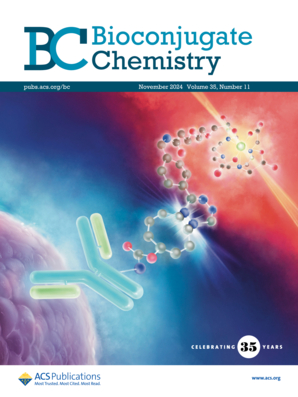
Bioconjugate Chemistry invites original contributions on all research at the interface between man-made and biological materials. The mission of the journal is to communicate to advances in fields including therapeutic delivery, imaging, bionanotechnology, and synthetic biology. Bioconjugate Chemistry is intended to provide a forum for presentation of research relevant to all aspects of bioconjugates, including the preparation, properties and applications of biomolecular conjugates.




 京公网安备 11010802042870号
京ICP备2023020795号-1
京公网安备 11010802042870号
京ICP备2023020795号-1

 分享
分享
 求助内容:
求助内容: 应助结果提醒方式:
 扫码关注我们
