番茄的可持续疾病管理:Fe3O4纳米颗粒作为传统杀菌剂控制枯萎病的环保替代品

IF 3.8 1区 农林科学 Q1 AGRONOMY Pest Management Science Pub Date : 2025-03-21 DOI:10.1002/ps.8778
Mengmeng Kong, Fuli Wang, Hairong Jing, Xiaofang Yang, Xianchao Chang, Huilian Xu, Xiaoyong Liu, Yu Shen
{"title":"番茄的可持续疾病管理:Fe3O4纳米颗粒作为传统杀菌剂控制枯萎病的环保替代品","authors":"Mengmeng Kong,&nbsp;Fuli Wang,&nbsp;Hairong Jing,&nbsp;Xiaofang Yang,&nbsp;Xianchao Chang,&nbsp;Huilian Xu,&nbsp;Xiaoyong Liu,&nbsp;Yu Shen","doi":"10.1002/ps.8778","DOIUrl":null,"url":null,"abstract":"<div>\n \n \n <section>\n \n <h3> BACKGROUND</h3>\n \n <p>Fusarium wilt disease caused by the soil pathogen <i>Fusarium oxysporum</i> f. <i>sp. lycopersici</i> significantly impacts global tomato production. While conventional fungicides remain the primary control method, their high application volumes and environmental persistence necessitate alternative approaches. We hypothesize that magnetite nanoparticles (NPs) suppress fungal growth through a tripartite mechanism that disrupts membrane integrity at the nano-bio interface, generation of reactive oxygen species through iron-mediated catalysis, and perturbation of fungal iron homeostasis pathways.</p>\n </section>\n \n <section>\n \n <h3> RESULTS</h3>\n \n <p><i>In vitro</i> studies demonstrated that 5 nm magnetite NPs exhibited superior antifungal activity with an EC₅₀ of 8.84 mg/L compared to Ningnanomycin at 84.77 mg/L. Comparative disease control efficacy under greenhouse conditions showed that magnetite NPs at 0.5 mg/L achieved 65% pathogen suppression <i>versus</i> Ningnanomycin at 71.4%, while requiring significantly lower application volumes of 180–360 g per hectare <i>versus</i> 4500–5850 mL per hectare. The NP treatment reduced disease index by 35.42%, alleviated root rot symptoms by 19.33%, and enhanced plant defense mechanisms through elevated reactive oxygen species accumulation and increased root iron content of 92.15%.</p>\n </section>\n \n <section>\n \n <h3> CONCLUSION</h3>\n \n <p>This study demonstrates that magnetite NPs provide competitive disease control efficacy against <i>Fusarium</i> wilt through multiple mechanistic pathways while reducing total chemical input. The dual functionality of direct pathogen suppression and enhanced plant defense activation, combined with lower application volumes, establishes these nanoparticles as a promising alternative to ecofriendly fungicides in tomato production systems. © 2025 Society of Chemical Industry.</p>\n </section>\n </div>","PeriodicalId":218,"journal":{"name":"Pest Management Science","volume":"81 7","pages":"4121-4134"},"PeriodicalIF":3.8000,"publicationDate":"2025-03-21","publicationTypes":"Journal Article","fieldsOfStudy":null,"isOpenAccess":false,"openAccessPdf":"","citationCount":"0","resultStr":"{\"title\":\"Sustainable disease management in tomatoes: Fe3O4 nanoparticles as an eco-friendly alternative to conventional fungicides for Fusarium wilt control\",\"authors\":\"Mengmeng Kong,&nbsp;Fuli Wang,&nbsp;Hairong Jing,&nbsp;Xiaofang Yang,&nbsp;Xianchao Chang,&nbsp;Huilian Xu,&nbsp;Xiaoyong Liu,&nbsp;Yu Shen\",\"doi\":\"10.1002/ps.8778\",\"DOIUrl\":null,\"url\":null,\"abstract\":\"<div>\\n \\n \\n <section>\\n \\n <h3> BACKGROUND</h3>\\n \\n <p>Fusarium wilt disease caused by the soil pathogen <i>Fusarium oxysporum</i> f. <i>sp. lycopersici</i> significantly impacts global tomato production. While conventional fungicides remain the primary control method, their high application volumes and environmental persistence necessitate alternative approaches. We hypothesize that magnetite nanoparticles (NPs) suppress fungal growth through a tripartite mechanism that disrupts membrane integrity at the nano-bio interface, generation of reactive oxygen species through iron-mediated catalysis, and perturbation of fungal iron homeostasis pathways.</p>\\n </section>\\n \\n <section>\\n \\n <h3> RESULTS</h3>\\n \\n <p><i>In vitro</i> studies demonstrated that 5 nm magnetite NPs exhibited superior antifungal activity with an EC₅₀ of 8.84 mg/L compared to Ningnanomycin at 84.77 mg/L. Comparative disease control efficacy under greenhouse conditions showed that magnetite NPs at 0.5 mg/L achieved 65% pathogen suppression <i>versus</i> Ningnanomycin at 71.4%, while requiring significantly lower application volumes of 180–360 g per hectare <i>versus</i> 4500–5850 mL per hectare. The NP treatment reduced disease index by 35.42%, alleviated root rot symptoms by 19.33%, and enhanced plant defense mechanisms through elevated reactive oxygen species accumulation and increased root iron content of 92.15%.</p>\\n </section>\\n \\n <section>\\n \\n <h3> CONCLUSION</h3>\\n \\n <p>This study demonstrates that magnetite NPs provide competitive disease control efficacy against <i>Fusarium</i> wilt through multiple mechanistic pathways while reducing total chemical input. The dual functionality of direct pathogen suppression and enhanced plant defense activation, combined with lower application volumes, establishes these nanoparticles as a promising alternative to ecofriendly fungicides in tomato production systems. © 2025 Society of Chemical Industry.</p>\\n </section>\\n </div>\",\"PeriodicalId\":218,\"journal\":{\"name\":\"Pest Management Science\",\"volume\":\"81 7\",\"pages\":\"4121-4134\"},\"PeriodicalIF\":3.8000,\"publicationDate\":\"2025-03-21\",\"publicationTypes\":\"Journal Article\",\"fieldsOfStudy\":null,\"isOpenAccess\":false,\"openAccessPdf\":\"\",\"citationCount\":\"0\",\"resultStr\":null,\"platform\":\"Semanticscholar\",\"paperid\":null,\"PeriodicalName\":\"Pest Management Science\",\"FirstCategoryId\":\"97\",\"ListUrlMain\":\"https://scijournals.onlinelibrary.wiley.com/doi/10.1002/ps.8778\",\"RegionNum\":1,\"RegionCategory\":\"农林科学\",\"ArticlePicture\":[],\"TitleCN\":null,\"AbstractTextCN\":null,\"PMCID\":null,\"EPubDate\":\"\",\"PubModel\":\"\",\"JCR\":\"Q1\",\"JCRName\":\"AGRONOMY\",\"Score\":null,\"Total\":0}","platform":"Semanticscholar","paperid":null,"PeriodicalName":"Pest Management Science","FirstCategoryId":"97","ListUrlMain":"https://scijournals.onlinelibrary.wiley.com/doi/10.1002/ps.8778","RegionNum":1,"RegionCategory":"农林科学","ArticlePicture":[],"TitleCN":null,"AbstractTextCN":null,"PMCID":null,"EPubDate":"","PubModel":"","JCR":"Q1","JCRName":"AGRONOMY","Score":null,"Total":0}
引用次数: 0

摘要

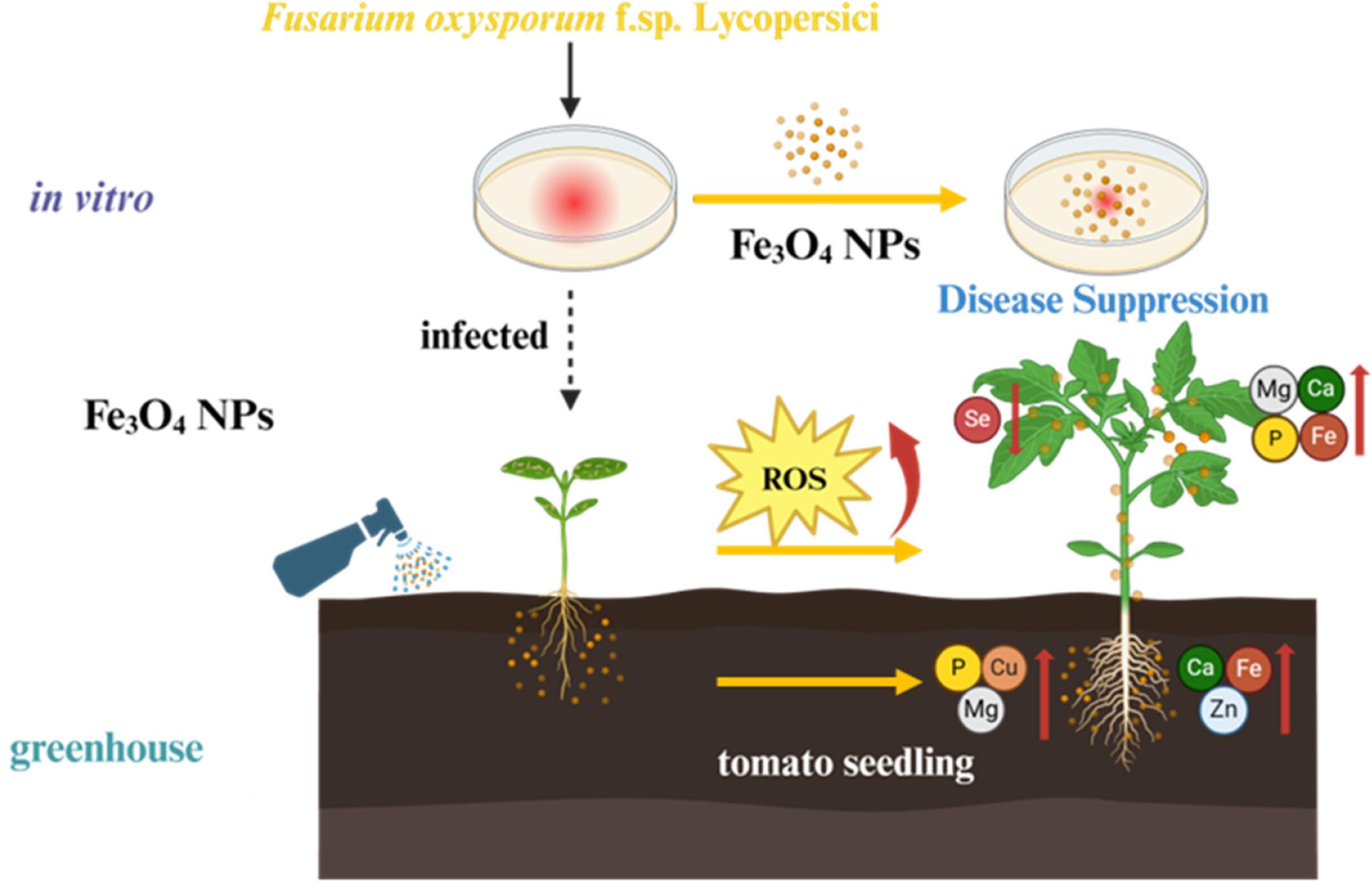
由土壤病原体 Fusarium oxysporum f. sp. lycopersici 引起的镰刀菌枯萎病严重影响着全球番茄生产。虽然传统杀菌剂仍是主要的防治方法,但由于其施用量大、环境持久性强,有必要采用其他方法。我们假设磁铁矿纳米粒子(NPs)通过三方机制抑制真菌生长,即破坏纳米生物界面的膜完整性、通过铁介导的催化作用产生活性氧以及扰乱真菌铁平衡途径。
本文章由计算机程序翻译,如有差异,请以英文原文为准。

摘要图片

摘要图片

摘要图片

摘要图片

摘要图片

查看原文
分享 分享
微信好友 朋友圈 QQ好友 复制链接
本刊更多论文
Sustainable disease management in tomatoes: Fe3O4 nanoparticles as an eco-friendly alternative to conventional fungicides for Fusarium wilt control

BACKGROUND

Fusarium wilt disease caused by the soil pathogen Fusarium oxysporum f. sp. lycopersici significantly impacts global tomato production. While conventional fungicides remain the primary control method, their high application volumes and environmental persistence necessitate alternative approaches. We hypothesize that magnetite nanoparticles (NPs) suppress fungal growth through a tripartite mechanism that disrupts membrane integrity at the nano-bio interface, generation of reactive oxygen species through iron-mediated catalysis, and perturbation of fungal iron homeostasis pathways.

RESULTS

In vitro studies demonstrated that 5 nm magnetite NPs exhibited superior antifungal activity with an EC₅₀ of 8.84 mg/L compared to Ningnanomycin at 84.77 mg/L. Comparative disease control efficacy under greenhouse conditions showed that magnetite NPs at 0.5 mg/L achieved 65% pathogen suppression versus Ningnanomycin at 71.4%, while requiring significantly lower application volumes of 180–360 g per hectare versus 4500–5850 mL per hectare. The NP treatment reduced disease index by 35.42%, alleviated root rot symptoms by 19.33%, and enhanced plant defense mechanisms through elevated reactive oxygen species accumulation and increased root iron content of 92.15%.

CONCLUSION

This study demonstrates that magnetite NPs provide competitive disease control efficacy against Fusarium wilt through multiple mechanistic pathways while reducing total chemical input. The dual functionality of direct pathogen suppression and enhanced plant defense activation, combined with lower application volumes, establishes these nanoparticles as a promising alternative to ecofriendly fungicides in tomato production systems. © 2025 Society of Chemical Industry.

求助全文
通过发布文献求助,成功后即可免费获取论文全文。 去求助
来源期刊
Pest Management Science
Pest Management Science 农林科学-昆虫学
CiteScore
7.90
自引率
9.80%
发文量
553
审稿时长
4.8 months
期刊介绍: Pest Management Science is the international journal of research and development in crop protection and pest control. Since its launch in 1970, the journal has become the premier forum for papers on the discovery, application, and impact on the environment of products and strategies designed for pest management. Published for SCI by John Wiley & Sons Ltd.
期刊最新文献
Eastward one-way nocturnal migration of insects across the China-Kazakhstan border observed with radar. Xanthotoxin-triggered HR51 suppression derepresses detoxification genes to drive metabolic adaptation in Spodoptera litura. Relationship between food quality and body size of common vole in different habitats. Widespread high-level resistance to emamectin benzoate and chlorantraniliprole and associated resistance mutations in Spodoptera exigua across China. Dual-receptors traction-based directional design of a novel anti-idiotypic insecticidal antibody for simulating Bacillus thuringiensis cry toxin against Plutella xylostella.
×
引用
GB/T 7714-2015
复制
MLA
复制
APA
复制
导出至
BibTeX EndNote RefMan NoteFirst NoteExpress
×
×
提示
您的信息不完整,为了账户安全,请先补充。
现在去补充
×
提示
您因"违规操作"
具体请查看互助需知
我知道了
×
提示
现在去查看 取消
×
提示
确定
0
微信
客服QQ
Book学术公众号 扫码关注我们
反馈
×
意见反馈
请填写您的意见或建议
请填写您的手机或邮箱
已复制链接
已复制链接
快去分享给好友吧!
我知道了
×
扫码分享
扫码分享
Book学术官方微信
Book学术官方微信
Book学术文献互助
Book学术文献互助群
群 号:604180095
Book学术
文献互助 智能选刊 最新文献 互助须知 联系我们:info@booksci.cn
Book学术提供免费学术资源搜索服务,方便国内外学者检索中英文文献。致力于提供最便捷和优质的服务体验。
Copyright © 2023 Book学术 All rights reserved.
ghs 京公网安备 11010802042870号 京ICP备2023020795号-1