{"title":"吡喹莫特3.75%乳膏与5-氟尿嘧啶4%乳膏治疗光化性角化病的疗效和耐受性比较:一项裂面研究。","authors":"Cesare Ariasi, Carola Romanò, Cesare Tomasi, Gaetano Licata, Davide Geat, PierGiacomo Calzavara-Pinton, Mariachiara Arisi","doi":"10.5826/dpc.1501a4583","DOIUrl":null,"url":null,"abstract":"<p><strong>Introduction: </strong>Actinic keratosis (AK) is a common precancerous skin lesion that arises on chronically UV-exposed skin and that can progress to keratinocyte carcinoma.</p><p><strong>Objective: </strong>The aim of this study was to compare the efficacy, safety, local skin reaction, time to wound healing, and patient preference of imiquimod (IMQ) 3.75% vs 5-fluorouracil (5-FU) 4% cream treatment for AKs.</p><p><strong>Methods: </strong>Two symmetrical contralateral areas of approximately 25 cm<sup>2</sup> harboring a similar (≥5) number of AKs were selected and randomly assigned to IMQ 3.75% or 5-FU 4% cream treatment. The total number of AKs for each patient was evaluated at baseline (T0) and 90 days after the end of treatments (T1). Local skin reaction (LSR) score was registered the day after the end of both treatments. Complete remission rate of lesions, cosmetic outcome, and patient preference of treatment were assessed after 90 days (T1).</p><p><strong>Results: </strong>The mean variation (ΔT0-T1) of AKs was not significantly different in patients treated with IMQ 3.75% vs 5-FU 4% (P = 0.35). The mean LSR was not significantly different between patients treated with IMQ 3.75% and those with 5-FU 4% (p=0.63). No difference in cosmetic outcome was observed in the two groups. Patient preference was equally distributed between the treatments. The mean time to wound healing after the end of the treatment was similar with IMQ 3.75% and with 5-FU 4% (P = 0.83).</p><p><strong>Conclusions: </strong>This study reports a non-superiority of efficacy, tolerability, wound-healing time, and cosmetic outcome of topical IMQ 3.75% treatment compared to topical 5-FU 4% treatment in AK management.</p>","PeriodicalId":11168,"journal":{"name":"Dermatology practical & conceptual","volume":"15 1","pages":""},"PeriodicalIF":2.3000,"publicationDate":"2025-01-30","publicationTypes":"Journal Article","fieldsOfStudy":null,"isOpenAccess":false,"openAccessPdf":"https://www.ncbi.nlm.nih.gov/pmc/articles/PMC11928111/pdf/","citationCount":"0","resultStr":"{\"title\":\"Comparative Efficacy and Tolerability of Imiquimod 3.75% Cream vs 5-Fluorouracil 4% cream in the Treatment of Actinic Keratosis: A Split-Face Study.\",\"authors\":\"Cesare Ariasi, Carola Romanò, Cesare Tomasi, Gaetano Licata, Davide Geat, PierGiacomo Calzavara-Pinton, Mariachiara Arisi\",\"doi\":\"10.5826/dpc.1501a4583\",\"DOIUrl\":null,\"url\":null,\"abstract\":\"<p><strong>Introduction: </strong>Actinic keratosis (AK) is a common precancerous skin lesion that arises on chronically UV-exposed skin and that can progress to keratinocyte carcinoma.</p><p><strong>Objective: </strong>The aim of this study was to compare the efficacy, safety, local skin reaction, time to wound healing, and patient preference of imiquimod (IMQ) 3.75% vs 5-fluorouracil (5-FU) 4% cream treatment for AKs.</p><p><strong>Methods: </strong>Two symmetrical contralateral areas of approximately 25 cm<sup>2</sup> harboring a similar (≥5) number of AKs were selected and randomly assigned to IMQ 3.75% or 5-FU 4% cream treatment. The total number of AKs for each patient was evaluated at baseline (T0) and 90 days after the end of treatments (T1). Local skin reaction (LSR) score was registered the day after the end of both treatments. Complete remission rate of lesions, cosmetic outcome, and patient preference of treatment were assessed after 90 days (T1).</p><p><strong>Results: </strong>The mean variation (ΔT0-T1) of AKs was not significantly different in patients treated with IMQ 3.75% vs 5-FU 4% (P = 0.35). The mean LSR was not significantly different between patients treated with IMQ 3.75% and those with 5-FU 4% (p=0.63). No difference in cosmetic outcome was observed in the two groups. Patient preference was equally distributed between the treatments. The mean time to wound healing after the end of the treatment was similar with IMQ 3.75% and with 5-FU 4% (P = 0.83).</p><p><strong>Conclusions: </strong>This study reports a non-superiority of efficacy, tolerability, wound-healing time, and cosmetic outcome of topical IMQ 3.75% treatment compared to topical 5-FU 4% treatment in AK management.</p>\",\"PeriodicalId\":11168,\"journal\":{\"name\":\"Dermatology practical & conceptual\",\"volume\":\"15 1\",\"pages\":\"\"},\"PeriodicalIF\":2.3000,\"publicationDate\":\"2025-01-30\",\"publicationTypes\":\"Journal Article\",\"fieldsOfStudy\":null,\"isOpenAccess\":false,\"openAccessPdf\":\"https://www.ncbi.nlm.nih.gov/pmc/articles/PMC11928111/pdf/\",\"citationCount\":\"0\",\"resultStr\":null,\"platform\":\"Semanticscholar\",\"paperid\":null,\"PeriodicalName\":\"Dermatology practical & conceptual\",\"FirstCategoryId\":\"3\",\"ListUrlMain\":\"https://doi.org/10.5826/dpc.1501a4583\",\"RegionNum\":4,\"RegionCategory\":\"医学\",\"ArticlePicture\":[],\"TitleCN\":null,\"AbstractTextCN\":null,\"PMCID\":null,\"EPubDate\":\"\",\"PubModel\":\"\",\"JCR\":\"Q2\",\"JCRName\":\"DERMATOLOGY\",\"Score\":null,\"Total\":0}","platform":"Semanticscholar","paperid":null,"PeriodicalName":"Dermatology practical & conceptual","FirstCategoryId":"3","ListUrlMain":"https://doi.org/10.5826/dpc.1501a4583","RegionNum":4,"RegionCategory":"医学","ArticlePicture":[],"TitleCN":null,"AbstractTextCN":null,"PMCID":null,"EPubDate":"","PubModel":"","JCR":"Q2","JCRName":"DERMATOLOGY","Score":null,"Total":0}
引用次数: 0
摘要
简介:光化性角化病(AK)是一种常见的癌前皮肤病变,发生在长期暴露在紫外线下的皮肤上,并可发展为角化细胞癌。目的:比较3.75%咪喹莫特(IMQ)与4% 5-氟尿嘧啶(5-FU)乳膏治疗AKs的疗效、安全性、局部皮肤反应、伤口愈合时间及患者偏好。方法:选择两个对称的约25 cm2的对侧区域,其中ak数量相似(≥5),随机分配至imq3.75%或5- fu 4%乳膏治疗。在基线(T0)和治疗结束后90天(T1)评估每位患者的ak总数。局部皮肤反应(LSR)评分记录在两种治疗结束后的第二天。90天后(T1)评估病变完全缓解率、美容结果和患者对治疗的偏好。结果:imq3.75% vs 5-FU 4%组AKs的平均变异(ΔT0-T1)无显著差异(P = 0.35)。IMQ为3.75%的患者与5-FU为4%的患者的平均LSR无显著差异(p=0.63)。两组患者的美容效果无差异。患者的偏好在治疗之间均匀分布。治疗结束后伤口愈合的平均时间IMQ为3.75%,5-FU为4% (P = 0.83)。结论:本研究报道,在AK治疗中,外用imq3.75%治疗与外用5-FU 4%治疗相比,在疗效、耐受性、伤口愈合时间和美容效果方面没有优势。
Comparative Efficacy and Tolerability of Imiquimod 3.75% Cream vs 5-Fluorouracil 4% cream in the Treatment of Actinic Keratosis: A Split-Face Study.
Introduction: Actinic keratosis (AK) is a common precancerous skin lesion that arises on chronically UV-exposed skin and that can progress to keratinocyte carcinoma.
Objective: The aim of this study was to compare the efficacy, safety, local skin reaction, time to wound healing, and patient preference of imiquimod (IMQ) 3.75% vs 5-fluorouracil (5-FU) 4% cream treatment for AKs.
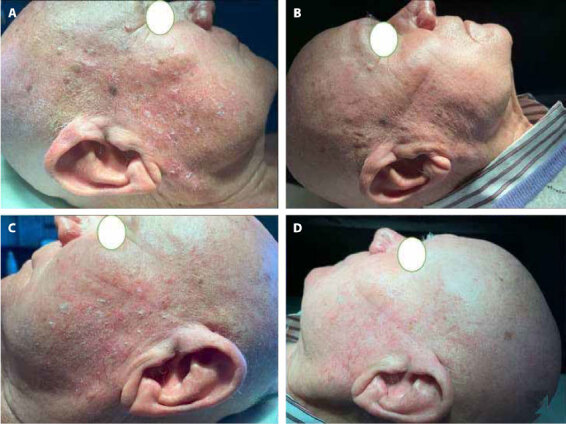
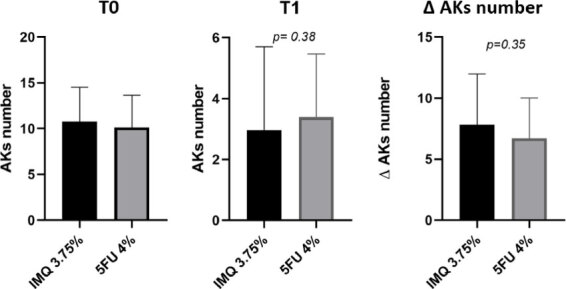
Methods: Two symmetrical contralateral areas of approximately 25 cm2 harboring a similar (≥5) number of AKs were selected and randomly assigned to IMQ 3.75% or 5-FU 4% cream treatment. The total number of AKs for each patient was evaluated at baseline (T0) and 90 days after the end of treatments (T1). Local skin reaction (LSR) score was registered the day after the end of both treatments. Complete remission rate of lesions, cosmetic outcome, and patient preference of treatment were assessed after 90 days (T1).
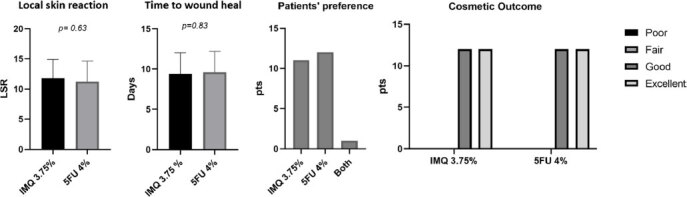
Results: The mean variation (ΔT0-T1) of AKs was not significantly different in patients treated with IMQ 3.75% vs 5-FU 4% (P = 0.35). The mean LSR was not significantly different between patients treated with IMQ 3.75% and those with 5-FU 4% (p=0.63). No difference in cosmetic outcome was observed in the two groups. Patient preference was equally distributed between the treatments. The mean time to wound healing after the end of the treatment was similar with IMQ 3.75% and with 5-FU 4% (P = 0.83).
Conclusions: This study reports a non-superiority of efficacy, tolerability, wound-healing time, and cosmetic outcome of topical IMQ 3.75% treatment compared to topical 5-FU 4% treatment in AK management.



 京公网安备 11010802042870号
京ICP备2023020795号-1
京公网安备 11010802042870号
京ICP备2023020795号-1

 分享
分享
 求助内容:
求助内容: 应助结果提醒方式:
 扫码关注我们
