Sheng Wan, Hanbo Wang, Yan Wang, Rui Wang, Dongyu Pei, Ziming Wang, Yumei Tian, Zhan Shi, Kechang Li and Haiyan Lu
{"title":"高性能超级电容器中mxene复合镍钴双氢氧化物的界面协同调节","authors":"Sheng Wan, Hanbo Wang, Yan Wang, Rui Wang, Dongyu Pei, Ziming Wang, Yumei Tian, Zhan Shi, Kechang Li and Haiyan Lu","doi":"10.1039/D4QI02825B","DOIUrl":null,"url":null,"abstract":"<p >Nickel–cobalt double hydroxide is gaining significant interest due to its high theoretical specific capacitance. However, its tendency to agglomerate and low electrical conductivity present major challenges for its application. This study employed a one-step hydrothermal method to integrate exfoliated few-layer MXene materials with NiCo-LDH, facilitating the uniform vertical growth of NiCo-LDH nanosheets on the surface of the MXene, effectively minimizing agglomeration. Additionally, the interfacial synergy between MXene and NiCo-LDH enhances the transfer of electrons from NiCo-LDH to MXene, resulting in an electron-rich MXene and an oxygen vacancy-rich NiCo-LDH. Together, these characteristics significantly improve the electrochemical performance of the material at high current densities, achieving 7776 W kg<small><sup>−1</sup></small> and 66.96 W h kg<small><sup>−1</sup></small> at 15 A g<small><sup>−1</sup></small>. After cycling 40 000 times, it retains an impressive capacity retention rate of 89.5%. These findings demonstrate that MXene materials effectively tackle the main challenges associated with NiCo-LDH, opening new possibilities for their application in electrode materials.</p>","PeriodicalId":79,"journal":{"name":"Inorganic Chemistry Frontiers","volume":" 18","pages":" 5459-5467"},"PeriodicalIF":6.2000,"publicationDate":"2025-03-24","publicationTypes":"Journal Article","fieldsOfStudy":null,"isOpenAccess":false,"openAccessPdf":"","citationCount":"0","resultStr":"{\"title\":\"Interfacial synergistic regulation of MXene-composited nickel–cobalt double hydroxide for high-performance supercapacitors†\",\"authors\":\"Sheng Wan, Hanbo Wang, Yan Wang, Rui Wang, Dongyu Pei, Ziming Wang, Yumei Tian, Zhan Shi, Kechang Li and Haiyan Lu\",\"doi\":\"10.1039/D4QI02825B\",\"DOIUrl\":null,\"url\":null,\"abstract\":\"<p >Nickel–cobalt double hydroxide is gaining significant interest due to its high theoretical specific capacitance. However, its tendency to agglomerate and low electrical conductivity present major challenges for its application. This study employed a one-step hydrothermal method to integrate exfoliated few-layer MXene materials with NiCo-LDH, facilitating the uniform vertical growth of NiCo-LDH nanosheets on the surface of the MXene, effectively minimizing agglomeration. Additionally, the interfacial synergy between MXene and NiCo-LDH enhances the transfer of electrons from NiCo-LDH to MXene, resulting in an electron-rich MXene and an oxygen vacancy-rich NiCo-LDH. Together, these characteristics significantly improve the electrochemical performance of the material at high current densities, achieving 7776 W kg<small><sup>−1</sup></small> and 66.96 W h kg<small><sup>−1</sup></small> at 15 A g<small><sup>−1</sup></small>. After cycling 40 000 times, it retains an impressive capacity retention rate of 89.5%. These findings demonstrate that MXene materials effectively tackle the main challenges associated with NiCo-LDH, opening new possibilities for their application in electrode materials.</p>\",\"PeriodicalId\":79,\"journal\":{\"name\":\"Inorganic Chemistry Frontiers\",\"volume\":\" 18\",\"pages\":\" 5459-5467\"},\"PeriodicalIF\":6.2000,\"publicationDate\":\"2025-03-24\",\"publicationTypes\":\"Journal Article\",\"fieldsOfStudy\":null,\"isOpenAccess\":false,\"openAccessPdf\":\"\",\"citationCount\":\"0\",\"resultStr\":null,\"platform\":\"Semanticscholar\",\"paperid\":null,\"PeriodicalName\":\"Inorganic Chemistry Frontiers\",\"FirstCategoryId\":\"92\",\"ListUrlMain\":\"https://pubs.rsc.org/en/content/articlelanding/2025/qi/d4qi02825b\",\"RegionNum\":1,\"RegionCategory\":\"化学\",\"ArticlePicture\":[],\"TitleCN\":null,\"AbstractTextCN\":null,\"PMCID\":null,\"EPubDate\":\"\",\"PubModel\":\"\",\"JCR\":\"Q1\",\"JCRName\":\"CHEMISTRY, INORGANIC & NUCLEAR\",\"Score\":null,\"Total\":0}","platform":"Semanticscholar","paperid":null,"PeriodicalName":"Inorganic Chemistry Frontiers","FirstCategoryId":"92","ListUrlMain":"https://pubs.rsc.org/en/content/articlelanding/2025/qi/d4qi02825b","RegionNum":1,"RegionCategory":"化学","ArticlePicture":[],"TitleCN":null,"AbstractTextCN":null,"PMCID":null,"EPubDate":"","PubModel":"","JCR":"Q1","JCRName":"CHEMISTRY, INORGANIC & NUCLEAR","Score":null,"Total":0}
引用次数: 0
摘要
镍钴双氢氧化物由于其较高的理论比电容而引起了人们的极大兴趣。然而,它的团聚性和低导电性是其应用的主要挑战。本研究采用一步水热法将脱落的少层MXene材料与NiCo-LDH整合,促进NiCo-LDH纳米片在MXene表面均匀垂直生长,有效地减少团聚。此外,MXene和NiCo-LDH之间的界面协同作用增强了电子从NiCo-LDH向MXene的转移,从而形成富电子的MXene和富氧空位的NiCo-LDH。总之,这些特性显著提高了材料在高电流密度下的电化学性能,在15 A g−1时达到7776 Wh kg−1和66.96 Wh kg−1。在循环4万次之后,它仍然保持着令人印象深刻的89.5%的容量保留率。这些发现表明,MXene材料有效地解决了与NiCo-LDH相关的主要挑战,为其在电极材料中的应用开辟了新的可能性。
Interfacial synergistic regulation of MXene-composited nickel–cobalt double hydroxide for high-performance supercapacitors†
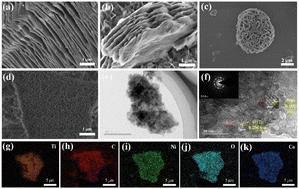
Nickel–cobalt double hydroxide is gaining significant interest due to its high theoretical specific capacitance. However, its tendency to agglomerate and low electrical conductivity present major challenges for its application. This study employed a one-step hydrothermal method to integrate exfoliated few-layer MXene materials with NiCo-LDH, facilitating the uniform vertical growth of NiCo-LDH nanosheets on the surface of the MXene, effectively minimizing agglomeration. Additionally, the interfacial synergy between MXene and NiCo-LDH enhances the transfer of electrons from NiCo-LDH to MXene, resulting in an electron-rich MXene and an oxygen vacancy-rich NiCo-LDH. Together, these characteristics significantly improve the electrochemical performance of the material at high current densities, achieving 7776 W kg−1 and 66.96 W h kg−1 at 15 A g−1. After cycling 40 000 times, it retains an impressive capacity retention rate of 89.5%. These findings demonstrate that MXene materials effectively tackle the main challenges associated with NiCo-LDH, opening new possibilities for their application in electrode materials.




 京公网安备 11010802042870号
京ICP备2023020795号-1
京公网安备 11010802042870号
京ICP备2023020795号-1

 分享
分享
 求助内容:
求助内容: 应助结果提醒方式:
 扫码关注我们
