Jianyu Li, Junjie Yang, Xiaoqi Peng, Shuwei Sheng, Haolin Wang, Yuehao Gu, Tao Chen, Hong Wang
{"title":"水热沉积用于光电化学水分解的金属硫化物异质结薄膜。","authors":"Jianyu Li, Junjie Yang, Xiaoqi Peng, Shuwei Sheng, Haolin Wang, Yuehao Gu, Tao Chen, Hong Wang","doi":"10.1002/cssc.202500039","DOIUrl":null,"url":null,"abstract":"<p>Metal sulfides represent a broad class of materials with considerable potential for applications in photovoltaic devices and energy technologies. However, the low-temperature synthesis of high-quality metal sulfide thin films remains a formidable challenge. Hydrothermal deposition, known for its versatility and cost-efficiency, has been successfully employed to synthesize a variety of materials, yet its application in the preparation of metal sulfide thin films has not been extensively explored. In this study, we develop a hydrothermal deposition method to synthesize five distinct types of metal sulfide thin films, each with well-defined phases and compositions. As a case study, CdS/Bi<sub>2</sub>S<sub>3</sub> thin film was selected and evaluated as photoanode for photoelectrochemical water splitting. Through O-doping and the modification of an ultrathin MoO<sub>3</sub> overlayer, the photocurrent density was significantly enhanced from 1.52 mA cm<sup>−2</sup> (CdS/Bi<sub>2</sub>S<sub>3</sub>) to 2.27 mA cm<sup>−2</sup> (CdS/O-Bi<sub>2</sub>S<sub>3</sub>), and further to 2.84 mA cm<sup>−2</sup> (CdS/O-Bi<sub>2</sub>S<sub>3</sub>/MoO<sub>3</sub>) at 1.23 V vs. reversible hydrogen electrode under AM 1.5G illumination. This methodology is expected to advance both fundamental and applied research on metal sulfides.</p>","PeriodicalId":149,"journal":{"name":"ChemSusChem","volume":"18 11","pages":""},"PeriodicalIF":6.6000,"publicationDate":"2025-03-23","publicationTypes":"Journal Article","fieldsOfStudy":null,"isOpenAccess":false,"openAccessPdf":"","citationCount":"0","resultStr":"{\"title\":\"Hydrothermal Deposition of Metal Sulfide Heterojunction Thin Films for Photoelectrochemical Water Splitting\",\"authors\":\"Jianyu Li, Junjie Yang, Xiaoqi Peng, Shuwei Sheng, Haolin Wang, Yuehao Gu, Tao Chen, Hong Wang\",\"doi\":\"10.1002/cssc.202500039\",\"DOIUrl\":null,\"url\":null,\"abstract\":\"<p>Metal sulfides represent a broad class of materials with considerable potential for applications in photovoltaic devices and energy technologies. However, the low-temperature synthesis of high-quality metal sulfide thin films remains a formidable challenge. Hydrothermal deposition, known for its versatility and cost-efficiency, has been successfully employed to synthesize a variety of materials, yet its application in the preparation of metal sulfide thin films has not been extensively explored. In this study, we develop a hydrothermal deposition method to synthesize five distinct types of metal sulfide thin films, each with well-defined phases and compositions. As a case study, CdS/Bi<sub>2</sub>S<sub>3</sub> thin film was selected and evaluated as photoanode for photoelectrochemical water splitting. Through O-doping and the modification of an ultrathin MoO<sub>3</sub> overlayer, the photocurrent density was significantly enhanced from 1.52 mA cm<sup>−2</sup> (CdS/Bi<sub>2</sub>S<sub>3</sub>) to 2.27 mA cm<sup>−2</sup> (CdS/O-Bi<sub>2</sub>S<sub>3</sub>), and further to 2.84 mA cm<sup>−2</sup> (CdS/O-Bi<sub>2</sub>S<sub>3</sub>/MoO<sub>3</sub>) at 1.23 V vs. reversible hydrogen electrode under AM 1.5G illumination. This methodology is expected to advance both fundamental and applied research on metal sulfides.</p>\",\"PeriodicalId\":149,\"journal\":{\"name\":\"ChemSusChem\",\"volume\":\"18 11\",\"pages\":\"\"},\"PeriodicalIF\":6.6000,\"publicationDate\":\"2025-03-23\",\"publicationTypes\":\"Journal Article\",\"fieldsOfStudy\":null,\"isOpenAccess\":false,\"openAccessPdf\":\"\",\"citationCount\":\"0\",\"resultStr\":null,\"platform\":\"Semanticscholar\",\"paperid\":null,\"PeriodicalName\":\"ChemSusChem\",\"FirstCategoryId\":\"92\",\"ListUrlMain\":\"https://chemistry-europe.onlinelibrary.wiley.com/doi/10.1002/cssc.202500039\",\"RegionNum\":2,\"RegionCategory\":\"化学\",\"ArticlePicture\":[],\"TitleCN\":null,\"AbstractTextCN\":null,\"PMCID\":null,\"EPubDate\":\"\",\"PubModel\":\"\",\"JCR\":\"Q1\",\"JCRName\":\"CHEMISTRY, MULTIDISCIPLINARY\",\"Score\":null,\"Total\":0}","platform":"Semanticscholar","paperid":null,"PeriodicalName":"ChemSusChem","FirstCategoryId":"92","ListUrlMain":"https://chemistry-europe.onlinelibrary.wiley.com/doi/10.1002/cssc.202500039","RegionNum":2,"RegionCategory":"化学","ArticlePicture":[],"TitleCN":null,"AbstractTextCN":null,"PMCID":null,"EPubDate":"","PubModel":"","JCR":"Q1","JCRName":"CHEMISTRY, MULTIDISCIPLINARY","Score":null,"Total":0}
引用次数: 0
摘要
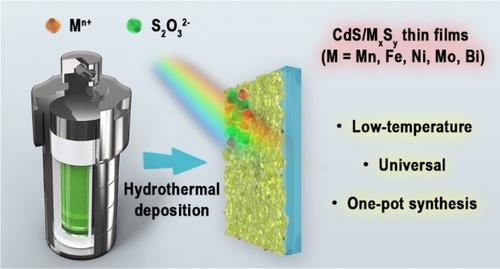
金属硫化物代表了一类广泛的材料,在光伏器件和能源技术中具有相当大的应用潜力。然而,低温合成高质量的金属硫化物薄膜仍然是一个艰巨的挑战。水热沉积以其通用性和成本效益而闻名,已成功地用于合成多种材料,但其在金属硫化物薄膜制备中的应用尚未得到广泛的探索。在这项研究中,我们开发了一种热液沉积方法来合成五种不同类型的金属硫化物薄膜,每种薄膜都具有明确的相和成分。选择CdS/Bi2S3薄膜作为光电化学水分解的光阳极,并对其性能进行了评价。通过o掺杂和超薄MoO3涂层的修饰,光电流密度从1.52 mA cm-2 (CdS/Bi2S3)显著提高到2.27 mA cm-2 (CdS/O-Bi2S3),在1.23 V的AM 1.5G照明下,与可逆氢电极相比,光电流密度进一步提高到2.84 mA cm-2 (CdS/O-Bi2S3/MoO3)。这种方法有望推进金属硫化物的基础和应用研究。
Hydrothermal Deposition of Metal Sulfide Heterojunction Thin Films for Photoelectrochemical Water Splitting
Metal sulfides represent a broad class of materials with considerable potential for applications in photovoltaic devices and energy technologies. However, the low-temperature synthesis of high-quality metal sulfide thin films remains a formidable challenge. Hydrothermal deposition, known for its versatility and cost-efficiency, has been successfully employed to synthesize a variety of materials, yet its application in the preparation of metal sulfide thin films has not been extensively explored. In this study, we develop a hydrothermal deposition method to synthesize five distinct types of metal sulfide thin films, each with well-defined phases and compositions. As a case study, CdS/Bi2S3 thin film was selected and evaluated as photoanode for photoelectrochemical water splitting. Through O-doping and the modification of an ultrathin MoO3 overlayer, the photocurrent density was significantly enhanced from 1.52 mA cm−2 (CdS/Bi2S3) to 2.27 mA cm−2 (CdS/O-Bi2S3), and further to 2.84 mA cm−2 (CdS/O-Bi2S3/MoO3) at 1.23 V vs. reversible hydrogen electrode under AM 1.5G illumination. This methodology is expected to advance both fundamental and applied research on metal sulfides.
期刊介绍:
ChemSusChem
Impact Factor (2016): 7.226
Scope:
Interdisciplinary journal
Focuses on research at the interface of chemistry and sustainability
Features the best research on sustainability and energy
Areas Covered:
Chemistry
Materials Science
Chemical Engineering
Biotechnology





 京公网安备 11010802042870号
京ICP备2023020795号-1
京公网安备 11010802042870号
京ICP备2023020795号-1

 分享
分享
 求助内容:
求助内容: 应助结果提醒方式:
 扫码关注我们
