Nicole Sciberras, Lara Miruzzi, Luke Bugeja, Adrienne Gatt, Suzanne Cauchi, Zane Attard, Pierre Ellul, Stefania Chetcuti Zammit
{"title":"炎症性肠病的发病年龄是恶性肿瘤发生的最大风险因素。","authors":"Nicole Sciberras, Lara Miruzzi, Luke Bugeja, Adrienne Gatt, Suzanne Cauchi, Zane Attard, Pierre Ellul, Stefania Chetcuti Zammit","doi":"10.20524/aog.2025.0952","DOIUrl":null,"url":null,"abstract":"<p><strong>Background: </strong>Inflammatory bowel disease (IBD), which includes Crohn's disease and ulcerative colitis, is a multifactorial inflammatory disorder of the gastrointestinal system that impairs the patient's quality of life. Its presentation includes a spectrum of symptoms that may also be secondary to IBD complications, such as malignancy. On the other hand, immunosuppressive treatment to maintain remission also carries a risk of malignancy, which can cause patients distress due to the risk/benefit balance of IBD control and malignancy.</p><p><strong>Methods: </strong>In this nationwide retrospective study, we aimed to elucidate which patient and treatment factors have the greatest impact on the development of malignancy in IBD patients. Statistical analysis was performed on patient factors, including treatment types, and nominal regression analysis was carried out to assess the effects of multiple risk factors on the incidence of malignancy in patients with IBD.</p><p><strong>Results: </strong>Age at diagnosis of IBD correlated significantly with malignancy development, as did the diagnosis of ulcerative colitis. IBD patients diagnosed with malignancy had an older age of onset of IBD than those who did not develop malignancy. Sex, treatment type, treatment duration, and extent or location of disease did not correlate significantly with malignancy development.</p><p><strong>Conclusion: </strong>We conclude that age of onset of IBD plays the greatest role in malignancy development, whilst immunosuppressive treatment is not a significant risk factor.</p>","PeriodicalId":7978,"journal":{"name":"Annals of Gastroenterology","volume":"38 2","pages":"182-186"},"PeriodicalIF":2.2000,"publicationDate":"2025-03-01","publicationTypes":"Journal Article","fieldsOfStudy":null,"isOpenAccess":false,"openAccessPdf":"https://www.ncbi.nlm.nih.gov/pmc/articles/PMC11928892/pdf/","citationCount":"0","resultStr":"{\"title\":\"Age of onset of inflammatory bowel disease is the strongest risk factor for the development of malignancy.\",\"authors\":\"Nicole Sciberras, Lara Miruzzi, Luke Bugeja, Adrienne Gatt, Suzanne Cauchi, Zane Attard, Pierre Ellul, Stefania Chetcuti Zammit\",\"doi\":\"10.20524/aog.2025.0952\",\"DOIUrl\":null,\"url\":null,\"abstract\":\"<p><strong>Background: </strong>Inflammatory bowel disease (IBD), which includes Crohn's disease and ulcerative colitis, is a multifactorial inflammatory disorder of the gastrointestinal system that impairs the patient's quality of life. Its presentation includes a spectrum of symptoms that may also be secondary to IBD complications, such as malignancy. On the other hand, immunosuppressive treatment to maintain remission also carries a risk of malignancy, which can cause patients distress due to the risk/benefit balance of IBD control and malignancy.</p><p><strong>Methods: </strong>In this nationwide retrospective study, we aimed to elucidate which patient and treatment factors have the greatest impact on the development of malignancy in IBD patients. Statistical analysis was performed on patient factors, including treatment types, and nominal regression analysis was carried out to assess the effects of multiple risk factors on the incidence of malignancy in patients with IBD.</p><p><strong>Results: </strong>Age at diagnosis of IBD correlated significantly with malignancy development, as did the diagnosis of ulcerative colitis. IBD patients diagnosed with malignancy had an older age of onset of IBD than those who did not develop malignancy. Sex, treatment type, treatment duration, and extent or location of disease did not correlate significantly with malignancy development.</p><p><strong>Conclusion: </strong>We conclude that age of onset of IBD plays the greatest role in malignancy development, whilst immunosuppressive treatment is not a significant risk factor.</p>\",\"PeriodicalId\":7978,\"journal\":{\"name\":\"Annals of Gastroenterology\",\"volume\":\"38 2\",\"pages\":\"182-186\"},\"PeriodicalIF\":2.2000,\"publicationDate\":\"2025-03-01\",\"publicationTypes\":\"Journal Article\",\"fieldsOfStudy\":null,\"isOpenAccess\":false,\"openAccessPdf\":\"https://www.ncbi.nlm.nih.gov/pmc/articles/PMC11928892/pdf/\",\"citationCount\":\"0\",\"resultStr\":null,\"platform\":\"Semanticscholar\",\"paperid\":null,\"PeriodicalName\":\"Annals of Gastroenterology\",\"FirstCategoryId\":\"1085\",\"ListUrlMain\":\"https://doi.org/10.20524/aog.2025.0952\",\"RegionNum\":0,\"RegionCategory\":null,\"ArticlePicture\":[],\"TitleCN\":null,\"AbstractTextCN\":null,\"PMCID\":null,\"EPubDate\":\"2025/2/28 0:00:00\",\"PubModel\":\"Epub\",\"JCR\":\"Q3\",\"JCRName\":\"GASTROENTEROLOGY & HEPATOLOGY\",\"Score\":null,\"Total\":0}","platform":"Semanticscholar","paperid":null,"PeriodicalName":"Annals of Gastroenterology","FirstCategoryId":"1085","ListUrlMain":"https://doi.org/10.20524/aog.2025.0952","RegionNum":0,"RegionCategory":null,"ArticlePicture":[],"TitleCN":null,"AbstractTextCN":null,"PMCID":null,"EPubDate":"2025/2/28 0:00:00","PubModel":"Epub","JCR":"Q3","JCRName":"GASTROENTEROLOGY & HEPATOLOGY","Score":null,"Total":0}
Age of onset of inflammatory bowel disease is the strongest risk factor for the development of malignancy.
Background: Inflammatory bowel disease (IBD), which includes Crohn's disease and ulcerative colitis, is a multifactorial inflammatory disorder of the gastrointestinal system that impairs the patient's quality of life. Its presentation includes a spectrum of symptoms that may also be secondary to IBD complications, such as malignancy. On the other hand, immunosuppressive treatment to maintain remission also carries a risk of malignancy, which can cause patients distress due to the risk/benefit balance of IBD control and malignancy.
Methods: In this nationwide retrospective study, we aimed to elucidate which patient and treatment factors have the greatest impact on the development of malignancy in IBD patients. Statistical analysis was performed on patient factors, including treatment types, and nominal regression analysis was carried out to assess the effects of multiple risk factors on the incidence of malignancy in patients with IBD.
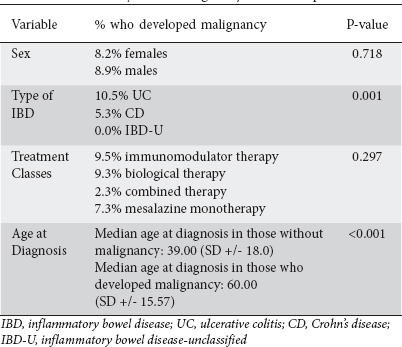
Results: Age at diagnosis of IBD correlated significantly with malignancy development, as did the diagnosis of ulcerative colitis. IBD patients diagnosed with malignancy had an older age of onset of IBD than those who did not develop malignancy. Sex, treatment type, treatment duration, and extent or location of disease did not correlate significantly with malignancy development.
Conclusion: We conclude that age of onset of IBD plays the greatest role in malignancy development, whilst immunosuppressive treatment is not a significant risk factor.





 京公网安备 11010802042870号
京ICP备2023020795号-1
京公网安备 11010802042870号
京ICP备2023020795号-1

 分享
分享
 求助内容:
求助内容: 应助结果提醒方式:
 扫码关注我们
