{"title":"根据脓毒症-3的定义,诱饵受体3作为脓毒症和脓毒性休克的预后生物标志物。","authors":"Long Chen, Xiao Lin, Xing Yu, Chunxia Yang, Rui Li, Qingqing Guo, Jingshi Shi, Xiuyu Liao, Xiaoli Chen, Zengyi Ma, Jiandong Lin","doi":"10.3389/fcimb.2025.1529917","DOIUrl":null,"url":null,"abstract":"<p><strong>Objectives: </strong>The present study was conducted to reappraise the prognostic value of decoy receptor 3 (DcR3) for patients with sepsis and septic shock according to the latest Sepsis-3 definitions.</p><p><strong>Methods: </strong>Subjects suffering from sepsis or septic shock were enrolled within 6 h of admission. The Sequential Organ Failure Assessment (SOFA) score and the plasma levels of DcR3, C-reactive protein, procalcitonin, and interleukin-6 were measured. Group comparisons were made based on the survival status on day 28 after onset. Predictors of mortality were assessed using the Cox proportional hazard models, and survival curves were plotted with the Kaplan-Meier method. Discriminative performances of single and combined indicators were evaluated via the areas under receiver operating characteristic curves.</p><p><strong>Results: </strong>Among 143 eligible sepsis cases, 77 developed septic shock, and the 28-day mortality rates were 32.2% and 45.5%, respectively. Regardless of the population (all sepsis or septic shock), non-survivors exhibited significantly higher DcR3 levels compared to survivors (median 4.19 vs. 2.64 ng/mL and 4.37 vs. 3.18 ng/mL, respectively; <i>p</i> < 0.001 and p = 0.002, respectively). DcR3 levels were most correlated with organ dysfunction presented by SOFA scores (correlation coefficient = 0.347 and 0.308, respectively; p = 0.001 and 0.016, respectively) but did not differ among the various pathogenic microbes of infection. Multivariate Cox regression identified DcR3 as an independent predictor of mortality [hazard ratio (95% confidence interval): 1.570 (1.048-2.352) and 1.828 (1.047-3.194), respectively; p = 0.029 and 0.034, respectively]. Kaplan-Meier analysis showed that elevated DcR3 concentrations were associated with significantly lower survival rates (p = 0.001 and 0.013, respectively). The areas under receiver operating characteristic curves of DcR3 alone for predicting outcome were superior to that of the other three biomarkers (0.731 and 0.711, respectively) and could be further improved when coupled with SOFA scores (0.803 and 0.784, respectively).</p><p><strong>Conclusions: </strong>DcR3 is a valuable prognostic biomarker for sepsis and septic shock, offering the potential to predict 28-day mortality in clinical settings.</p>","PeriodicalId":12458,"journal":{"name":"Frontiers in Cellular and Infection Microbiology","volume":"15 ","pages":"1529917"},"PeriodicalIF":4.8000,"publicationDate":"2025-03-07","publicationTypes":"Journal Article","fieldsOfStudy":null,"isOpenAccess":false,"openAccessPdf":"https://www.ncbi.nlm.nih.gov/pmc/articles/PMC11925903/pdf/","citationCount":"0","resultStr":"{\"title\":\"Decoy receptor 3 as a prognostic biomarker for sepsis and septic shock according to the Sepsis-3 definitions.\",\"authors\":\"Long Chen, Xiao Lin, Xing Yu, Chunxia Yang, Rui Li, Qingqing Guo, Jingshi Shi, Xiuyu Liao, Xiaoli Chen, Zengyi Ma, Jiandong Lin\",\"doi\":\"10.3389/fcimb.2025.1529917\",\"DOIUrl\":null,\"url\":null,\"abstract\":\"<p><strong>Objectives: </strong>The present study was conducted to reappraise the prognostic value of decoy receptor 3 (DcR3) for patients with sepsis and septic shock according to the latest Sepsis-3 definitions.</p><p><strong>Methods: </strong>Subjects suffering from sepsis or septic shock were enrolled within 6 h of admission. The Sequential Organ Failure Assessment (SOFA) score and the plasma levels of DcR3, C-reactive protein, procalcitonin, and interleukin-6 were measured. Group comparisons were made based on the survival status on day 28 after onset. Predictors of mortality were assessed using the Cox proportional hazard models, and survival curves were plotted with the Kaplan-Meier method. Discriminative performances of single and combined indicators were evaluated via the areas under receiver operating characteristic curves.</p><p><strong>Results: </strong>Among 143 eligible sepsis cases, 77 developed septic shock, and the 28-day mortality rates were 32.2% and 45.5%, respectively. Regardless of the population (all sepsis or septic shock), non-survivors exhibited significantly higher DcR3 levels compared to survivors (median 4.19 vs. 2.64 ng/mL and 4.37 vs. 3.18 ng/mL, respectively; <i>p</i> < 0.001 and p = 0.002, respectively). DcR3 levels were most correlated with organ dysfunction presented by SOFA scores (correlation coefficient = 0.347 and 0.308, respectively; p = 0.001 and 0.016, respectively) but did not differ among the various pathogenic microbes of infection. Multivariate Cox regression identified DcR3 as an independent predictor of mortality [hazard ratio (95% confidence interval): 1.570 (1.048-2.352) and 1.828 (1.047-3.194), respectively; p = 0.029 and 0.034, respectively]. Kaplan-Meier analysis showed that elevated DcR3 concentrations were associated with significantly lower survival rates (p = 0.001 and 0.013, respectively). The areas under receiver operating characteristic curves of DcR3 alone for predicting outcome were superior to that of the other three biomarkers (0.731 and 0.711, respectively) and could be further improved when coupled with SOFA scores (0.803 and 0.784, respectively).</p><p><strong>Conclusions: </strong>DcR3 is a valuable prognostic biomarker for sepsis and septic shock, offering the potential to predict 28-day mortality in clinical settings.</p>\",\"PeriodicalId\":12458,\"journal\":{\"name\":\"Frontiers in Cellular and Infection Microbiology\",\"volume\":\"15 \",\"pages\":\"1529917\"},\"PeriodicalIF\":4.8000,\"publicationDate\":\"2025-03-07\",\"publicationTypes\":\"Journal Article\",\"fieldsOfStudy\":null,\"isOpenAccess\":false,\"openAccessPdf\":\"https://www.ncbi.nlm.nih.gov/pmc/articles/PMC11925903/pdf/\",\"citationCount\":\"0\",\"resultStr\":null,\"platform\":\"Semanticscholar\",\"paperid\":null,\"PeriodicalName\":\"Frontiers in Cellular and Infection Microbiology\",\"FirstCategoryId\":\"3\",\"ListUrlMain\":\"https://doi.org/10.3389/fcimb.2025.1529917\",\"RegionNum\":2,\"RegionCategory\":\"医学\",\"ArticlePicture\":[],\"TitleCN\":null,\"AbstractTextCN\":null,\"PMCID\":null,\"EPubDate\":\"2025/1/1 0:00:00\",\"PubModel\":\"eCollection\",\"JCR\":\"Q2\",\"JCRName\":\"IMMUNOLOGY\",\"Score\":null,\"Total\":0}","platform":"Semanticscholar","paperid":null,"PeriodicalName":"Frontiers in Cellular and Infection Microbiology","FirstCategoryId":"3","ListUrlMain":"https://doi.org/10.3389/fcimb.2025.1529917","RegionNum":2,"RegionCategory":"医学","ArticlePicture":[],"TitleCN":null,"AbstractTextCN":null,"PMCID":null,"EPubDate":"2025/1/1 0:00:00","PubModel":"eCollection","JCR":"Q2","JCRName":"IMMUNOLOGY","Score":null,"Total":0}
引用次数: 0
摘要
目的:本研究根据最新的脓毒症-3定义,重新评估诱饵受体3 (DcR3)对脓毒症和脓毒症休克患者的预后价值。方法:脓毒症或感染性休克患者在入院后6小时内入组。测定顺序器官衰竭评估(SOFA)评分及血浆DcR3、c反应蛋白、降钙素原、白细胞介素-6水平。根据发病后第28天的生存状况进行组间比较。死亡率预测因子采用Cox比例风险模型进行评估,生存曲线采用Kaplan-Meier法绘制。通过受试者工作特征曲线下面积评价单一指标和组合指标的判别性能。结果:143例符合条件的脓毒症患者中,77例发生脓毒症休克,28天死亡率分别为32.2%和45.5%。无论人群如何(所有败血症或感染性休克),非幸存者的DcR3水平明显高于幸存者(中位数分别为4.19 vs. 2.64 ng/mL和4.37 vs. 3.18 ng/mL;P < 0.001和P = 0.002)。DcR3水平与SOFA评分表现的器官功能障碍相关性最大(相关系数分别为0.347和0.308);P值分别为0.001和0.016),但不同病原菌间无差异。多因素Cox回归发现DcR3是死亡率的独立预测因子[风险比(95%置信区间)分别为1.570(1.048-2.352)和1.828 (1.047-3.194);P分别= 0.029和0.034]。Kaplan-Meier分析显示,DcR3浓度升高与生存率显著降低相关(p分别为0.001和0.013)。单独使用DcR3预测预后的受试者工作特征曲线下面积优于其他3种生物标志物(分别为0.731和0.711),与SOFA评分联合使用(分别为0.803和0.784)可进一步改善预后。结论:DcR3是一种有价值的脓毒症和脓毒性休克预后生物标志物,在临床环境中具有预测28天死亡率的潜力。
Decoy receptor 3 as a prognostic biomarker for sepsis and septic shock according to the Sepsis-3 definitions.
Objectives: The present study was conducted to reappraise the prognostic value of decoy receptor 3 (DcR3) for patients with sepsis and septic shock according to the latest Sepsis-3 definitions.
Methods: Subjects suffering from sepsis or septic shock were enrolled within 6 h of admission. The Sequential Organ Failure Assessment (SOFA) score and the plasma levels of DcR3, C-reactive protein, procalcitonin, and interleukin-6 were measured. Group comparisons were made based on the survival status on day 28 after onset. Predictors of mortality were assessed using the Cox proportional hazard models, and survival curves were plotted with the Kaplan-Meier method. Discriminative performances of single and combined indicators were evaluated via the areas under receiver operating characteristic curves.
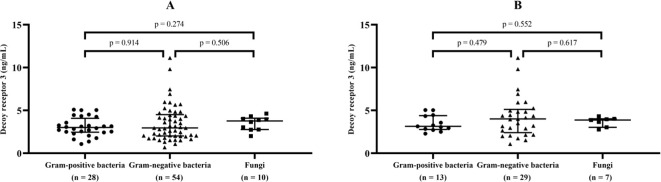
Results: Among 143 eligible sepsis cases, 77 developed septic shock, and the 28-day mortality rates were 32.2% and 45.5%, respectively. Regardless of the population (all sepsis or septic shock), non-survivors exhibited significantly higher DcR3 levels compared to survivors (median 4.19 vs. 2.64 ng/mL and 4.37 vs. 3.18 ng/mL, respectively; p < 0.001 and p = 0.002, respectively). DcR3 levels were most correlated with organ dysfunction presented by SOFA scores (correlation coefficient = 0.347 and 0.308, respectively; p = 0.001 and 0.016, respectively) but did not differ among the various pathogenic microbes of infection. Multivariate Cox regression identified DcR3 as an independent predictor of mortality [hazard ratio (95% confidence interval): 1.570 (1.048-2.352) and 1.828 (1.047-3.194), respectively; p = 0.029 and 0.034, respectively]. Kaplan-Meier analysis showed that elevated DcR3 concentrations were associated with significantly lower survival rates (p = 0.001 and 0.013, respectively). The areas under receiver operating characteristic curves of DcR3 alone for predicting outcome were superior to that of the other three biomarkers (0.731 and 0.711, respectively) and could be further improved when coupled with SOFA scores (0.803 and 0.784, respectively).
Conclusions: DcR3 is a valuable prognostic biomarker for sepsis and septic shock, offering the potential to predict 28-day mortality in clinical settings.
期刊介绍:
Frontiers in Cellular and Infection Microbiology is a leading specialty journal, publishing rigorously peer-reviewed research across all pathogenic microorganisms and their interaction with their hosts. Chief Editor Yousef Abu Kwaik, University of Louisville is supported by an outstanding Editorial Board of international experts. This multidisciplinary open-access journal is at the forefront of disseminating and communicating scientific knowledge and impactful discoveries to researchers, academics, clinicians and the public worldwide.
Frontiers in Cellular and Infection Microbiology includes research on bacteria, fungi, parasites, viruses, endosymbionts, prions and all microbial pathogens as well as the microbiota and its effect on health and disease in various hosts. The research approaches include molecular microbiology, cellular microbiology, gene regulation, proteomics, signal transduction, pathogenic evolution, genomics, structural biology, and virulence factors as well as model hosts. Areas of research to counteract infectious agents by the host include the host innate and adaptive immune responses as well as metabolic restrictions to various pathogenic microorganisms, vaccine design and development against various pathogenic microorganisms, and the mechanisms of antibiotic resistance and its countermeasures.







 京公网安备 11010802042870号
京ICP备2023020795号-1
京公网安备 11010802042870号
京ICP备2023020795号-1

 分享
分享
 求助内容:
求助内容: 应助结果提醒方式:
 扫码关注我们
