Sang Nam Lee, Young-Il Kim, Jaemoo Kim, D. K. Haluwana, Ryounho Eun, Sei Hyun Park, Janghun Heo, Juryeon Gil, Yebin Seong, Min-Ho Lee, Young-Woock Noh, Jong-Soo Lee, Young Ki Choi, Yong Taik Lim
{"title":"模仿自然感染多维免疫调节的动力学活化纳米疫苗,在动物模型中广泛保护机体免受异源病毒感染","authors":"Sang Nam Lee, Young-Il Kim, Jaemoo Kim, D. K. Haluwana, Ryounho Eun, Sei Hyun Park, Janghun Heo, Juryeon Gil, Yebin Seong, Min-Ho Lee, Young-Woock Noh, Jong-Soo Lee, Young Ki Choi, Yong Taik Lim","doi":"10.1038/s41467-025-58006-y","DOIUrl":null,"url":null,"abstract":"<p>Immunity by vaccination can protect human against heterologous viruses. However, protective abilities of artificial vaccines are still weaker than natural infections. Here we develop a kinetically engineered vaccine (KE-VAC) that mimics the multidimensional immunomodulation in natural infections via dynamic activation of antigen presenting cells with masked TLR7/8 agonist and sustained supplies of antigens and adjuvants to lymph nodes, leading to follicular helper T and germinal centre B cell activation in vaccinated mice. KE-VAC demonstrates superior efficacy than traditional alum and mRNA vaccines, achieving a 100% survival rate with increased neutralizing antibodies titers and polyfunctional CD8<sup>+</sup> T cells, recognizing heterologous SARS-CoV-2 variants, and inducing broad and long-term protection against multiple strains of influenza viruses. Prime/boost vaccination with KE-VAC also protect aged ferrets from severe fever with thrombocytopenia syndrome virus infection, with no virus detected in any organs at day 6 p.i. The efficacy of KE-VAC across various pathogens thus highlights its potential as an effective vaccine against emerging infectious risks.</p>","PeriodicalId":19066,"journal":{"name":"Nature Communications","volume":"96 1","pages":""},"PeriodicalIF":15.7000,"publicationDate":"2025-03-25","publicationTypes":"Journal Article","fieldsOfStudy":null,"isOpenAccess":false,"openAccessPdf":"","citationCount":"0","resultStr":"{\"title\":\"Kinetically activating nanovaccine mimicking multidimensional immunomodulation of natural infection for broad protection against heterologous viruses in animal models\",\"authors\":\"Sang Nam Lee, Young-Il Kim, Jaemoo Kim, D. K. Haluwana, Ryounho Eun, Sei Hyun Park, Janghun Heo, Juryeon Gil, Yebin Seong, Min-Ho Lee, Young-Woock Noh, Jong-Soo Lee, Young Ki Choi, Yong Taik Lim\",\"doi\":\"10.1038/s41467-025-58006-y\",\"DOIUrl\":null,\"url\":null,\"abstract\":\"<p>Immunity by vaccination can protect human against heterologous viruses. However, protective abilities of artificial vaccines are still weaker than natural infections. Here we develop a kinetically engineered vaccine (KE-VAC) that mimics the multidimensional immunomodulation in natural infections via dynamic activation of antigen presenting cells with masked TLR7/8 agonist and sustained supplies of antigens and adjuvants to lymph nodes, leading to follicular helper T and germinal centre B cell activation in vaccinated mice. KE-VAC demonstrates superior efficacy than traditional alum and mRNA vaccines, achieving a 100% survival rate with increased neutralizing antibodies titers and polyfunctional CD8<sup>+</sup> T cells, recognizing heterologous SARS-CoV-2 variants, and inducing broad and long-term protection against multiple strains of influenza viruses. Prime/boost vaccination with KE-VAC also protect aged ferrets from severe fever with thrombocytopenia syndrome virus infection, with no virus detected in any organs at day 6 p.i. The efficacy of KE-VAC across various pathogens thus highlights its potential as an effective vaccine against emerging infectious risks.</p>\",\"PeriodicalId\":19066,\"journal\":{\"name\":\"Nature Communications\",\"volume\":\"96 1\",\"pages\":\"\"},\"PeriodicalIF\":15.7000,\"publicationDate\":\"2025-03-25\",\"publicationTypes\":\"Journal Article\",\"fieldsOfStudy\":null,\"isOpenAccess\":false,\"openAccessPdf\":\"\",\"citationCount\":\"0\",\"resultStr\":null,\"platform\":\"Semanticscholar\",\"paperid\":null,\"PeriodicalName\":\"Nature Communications\",\"FirstCategoryId\":\"103\",\"ListUrlMain\":\"https://doi.org/10.1038/s41467-025-58006-y\",\"RegionNum\":1,\"RegionCategory\":\"综合性期刊\",\"ArticlePicture\":[],\"TitleCN\":null,\"AbstractTextCN\":null,\"PMCID\":null,\"EPubDate\":\"\",\"PubModel\":\"\",\"JCR\":\"Q1\",\"JCRName\":\"MULTIDISCIPLINARY SCIENCES\",\"Score\":null,\"Total\":0}","platform":"Semanticscholar","paperid":null,"PeriodicalName":"Nature Communications","FirstCategoryId":"103","ListUrlMain":"https://doi.org/10.1038/s41467-025-58006-y","RegionNum":1,"RegionCategory":"综合性期刊","ArticlePicture":[],"TitleCN":null,"AbstractTextCN":null,"PMCID":null,"EPubDate":"","PubModel":"","JCR":"Q1","JCRName":"MULTIDISCIPLINARY SCIENCES","Score":null,"Total":0}
Kinetically activating nanovaccine mimicking multidimensional immunomodulation of natural infection for broad protection against heterologous viruses in animal models
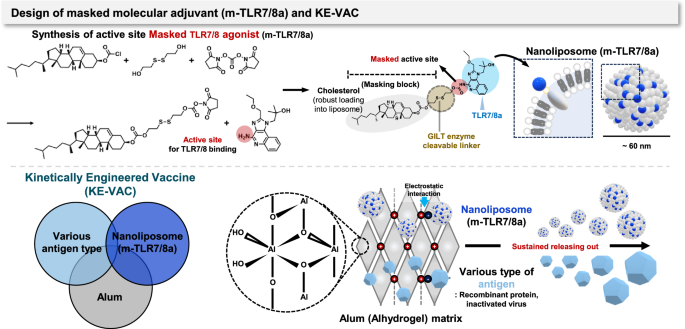
Immunity by vaccination can protect human against heterologous viruses. However, protective abilities of artificial vaccines are still weaker than natural infections. Here we develop a kinetically engineered vaccine (KE-VAC) that mimics the multidimensional immunomodulation in natural infections via dynamic activation of antigen presenting cells with masked TLR7/8 agonist and sustained supplies of antigens and adjuvants to lymph nodes, leading to follicular helper T and germinal centre B cell activation in vaccinated mice. KE-VAC demonstrates superior efficacy than traditional alum and mRNA vaccines, achieving a 100% survival rate with increased neutralizing antibodies titers and polyfunctional CD8+ T cells, recognizing heterologous SARS-CoV-2 variants, and inducing broad and long-term protection against multiple strains of influenza viruses. Prime/boost vaccination with KE-VAC also protect aged ferrets from severe fever with thrombocytopenia syndrome virus infection, with no virus detected in any organs at day 6 p.i. The efficacy of KE-VAC across various pathogens thus highlights its potential as an effective vaccine against emerging infectious risks.
期刊介绍:
Nature Communications, an open-access journal, publishes high-quality research spanning all areas of the natural sciences. Papers featured in the journal showcase significant advances relevant to specialists in each respective field. With a 2-year impact factor of 16.6 (2022) and a median time of 8 days from submission to the first editorial decision, Nature Communications is committed to rapid dissemination of research findings. As a multidisciplinary journal, it welcomes contributions from biological, health, physical, chemical, Earth, social, mathematical, applied, and engineering sciences, aiming to highlight important breakthroughs within each domain.




 京公网安备 11010802042870号
京ICP备2023020795号-1
京公网安备 11010802042870号
京ICP备2023020795号-1

 分享
分享
 求助内容:
求助内容: 应助结果提醒方式:
 扫码关注我们
