Zhicui Song, Jing Xue, Chaohui Wei, Donghuang Wang, Yingchun Ding, Aijun Zhou and Jingze Li
{"title":"异质种子促进双相锂存储的自亲锂寄主,以获得稳定的锂金属阳极","authors":"Zhicui Song, Jing Xue, Chaohui Wei, Donghuang Wang, Yingchun Ding, Aijun Zhou and Jingze Li","doi":"10.1039/D5QI00286A","DOIUrl":null,"url":null,"abstract":"<p >Lithium (Li)-metal anode holds great promise for high-energy-density battery applications. However, the issue of uncontrollable Li dendrite growth, which is associated with large volume expansion during cycling, remains a significant hurdle. It is well known that the uniform Li<small><sup>+</sup></small> flux, rich lithiophilic nucleation sites, and low local current density are of significant importance for inducing even Li deposition. Herein, a three-dimensional (3D) composite host was constructed by decorating an ultrafine Pt-nanoparticle layer on a carbon fiber framework (CF@Pt) <em>via</em> sputtering. CF with a high graphitic degree was <em>in situ</em> transformed into a lithiophilic LiC<small><sub>6</sub></small> phase upon charging, endowing self-lithiophilicity with a low Li nucleation energy barrier. A reversible “dual-phase” Li storage behavior (lithiation and metallization) was spontaneously realized in this 3D host with low local current density. Highly dispersed Pt heterogeneous nano-seeds further served as the lithiophilicity and Li nucleation boosters, consequently leading to even Li<small><sup>+</sup></small> flux distribution and boosting the dense and smooth Li nucleation/growth. Additionally, the as-obtained CF@Pt host shows remarkably improved electrochemical performances in half-cells, symmetrical cells and full-cells.</p>","PeriodicalId":79,"journal":{"name":"Inorganic Chemistry Frontiers","volume":" 10","pages":" 3611-3619"},"PeriodicalIF":6.4000,"publicationDate":"2025-03-25","publicationTypes":"Journal Article","fieldsOfStudy":null,"isOpenAccess":false,"openAccessPdf":"","citationCount":"0","resultStr":"{\"title\":\"Heterogeneous seeds boosting the self-lithiophilic host with dual-phase lithium storage for a stable lithium-metal anode†\",\"authors\":\"Zhicui Song, Jing Xue, Chaohui Wei, Donghuang Wang, Yingchun Ding, Aijun Zhou and Jingze Li\",\"doi\":\"10.1039/D5QI00286A\",\"DOIUrl\":null,\"url\":null,\"abstract\":\"<p >Lithium (Li)-metal anode holds great promise for high-energy-density battery applications. However, the issue of uncontrollable Li dendrite growth, which is associated with large volume expansion during cycling, remains a significant hurdle. It is well known that the uniform Li<small><sup>+</sup></small> flux, rich lithiophilic nucleation sites, and low local current density are of significant importance for inducing even Li deposition. Herein, a three-dimensional (3D) composite host was constructed by decorating an ultrafine Pt-nanoparticle layer on a carbon fiber framework (CF@Pt) <em>via</em> sputtering. CF with a high graphitic degree was <em>in situ</em> transformed into a lithiophilic LiC<small><sub>6</sub></small> phase upon charging, endowing self-lithiophilicity with a low Li nucleation energy barrier. A reversible “dual-phase” Li storage behavior (lithiation and metallization) was spontaneously realized in this 3D host with low local current density. Highly dispersed Pt heterogeneous nano-seeds further served as the lithiophilicity and Li nucleation boosters, consequently leading to even Li<small><sup>+</sup></small> flux distribution and boosting the dense and smooth Li nucleation/growth. Additionally, the as-obtained CF@Pt host shows remarkably improved electrochemical performances in half-cells, symmetrical cells and full-cells.</p>\",\"PeriodicalId\":79,\"journal\":{\"name\":\"Inorganic Chemistry Frontiers\",\"volume\":\" 10\",\"pages\":\" 3611-3619\"},\"PeriodicalIF\":6.4000,\"publicationDate\":\"2025-03-25\",\"publicationTypes\":\"Journal Article\",\"fieldsOfStudy\":null,\"isOpenAccess\":false,\"openAccessPdf\":\"\",\"citationCount\":\"0\",\"resultStr\":null,\"platform\":\"Semanticscholar\",\"paperid\":null,\"PeriodicalName\":\"Inorganic Chemistry Frontiers\",\"FirstCategoryId\":\"92\",\"ListUrlMain\":\"https://pubs.rsc.org/en/content/articlelanding/2025/qi/d5qi00286a\",\"RegionNum\":1,\"RegionCategory\":\"化学\",\"ArticlePicture\":[],\"TitleCN\":null,\"AbstractTextCN\":null,\"PMCID\":null,\"EPubDate\":\"\",\"PubModel\":\"\",\"JCR\":\"Q1\",\"JCRName\":\"CHEMISTRY, INORGANIC & NUCLEAR\",\"Score\":null,\"Total\":0}","platform":"Semanticscholar","paperid":null,"PeriodicalName":"Inorganic Chemistry Frontiers","FirstCategoryId":"92","ListUrlMain":"https://pubs.rsc.org/en/content/articlelanding/2025/qi/d5qi00286a","RegionNum":1,"RegionCategory":"化学","ArticlePicture":[],"TitleCN":null,"AbstractTextCN":null,"PMCID":null,"EPubDate":"","PubModel":"","JCR":"Q1","JCRName":"CHEMISTRY, INORGANIC & NUCLEAR","Score":null,"Total":0}
Heterogeneous seeds boosting the self-lithiophilic host with dual-phase lithium storage for a stable lithium-metal anode†
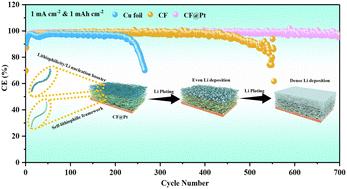
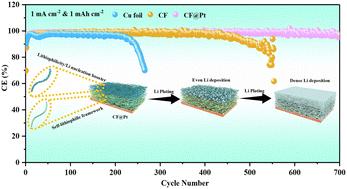
Lithium (Li)-metal anode holds great promise for high-energy-density battery applications. However, the issue of uncontrollable Li dendrite growth, which is associated with large volume expansion during cycling, remains a significant hurdle. It is well known that the uniform Li+ flux, rich lithiophilic nucleation sites, and low local current density are of significant importance for inducing even Li deposition. Herein, a three-dimensional (3D) composite host was constructed by decorating an ultrafine Pt-nanoparticle layer on a carbon fiber framework (CF@Pt) via sputtering. CF with a high graphitic degree was in situ transformed into a lithiophilic LiC6 phase upon charging, endowing self-lithiophilicity with a low Li nucleation energy barrier. A reversible “dual-phase” Li storage behavior (lithiation and metallization) was spontaneously realized in this 3D host with low local current density. Highly dispersed Pt heterogeneous nano-seeds further served as the lithiophilicity and Li nucleation boosters, consequently leading to even Li+ flux distribution and boosting the dense and smooth Li nucleation/growth. Additionally, the as-obtained CF@Pt host shows remarkably improved electrochemical performances in half-cells, symmetrical cells and full-cells.




 京公网安备 11010802042870号
京ICP备2023020795号-1
京公网安备 11010802042870号
京ICP备2023020795号-1

 分享
分享
 求助内容:
求助内容: 应助结果提醒方式:
 扫码关注我们
