{"title":"基于分子模拟多模态优化的锌水电池电解质筛选与设计","authors":"Wei Feng, Luyan Zhang, Yaobo Cheng, Jin Wu, Chunguang Wei, Junwei Zhang, Kuang Yu","doi":"10.1021/acs.jpclett.5c00341","DOIUrl":null,"url":null,"abstract":"Aqueous batteries, such as aqueous zinc-ion batteries (AZIB), have garnered significant attention because of their advantages in intrinsic safety, low cost, and eco-friendliness. However, aqueous electrolytes tend to freeze at low temperatures, which limits their potential industrial applications. Thus, one of the core challenges in aqueous electrolyte design is optimizing the formula to prevent freezing while maintaining good ion conductivity. However, the experimental trial-and-error approach is inefficient for this purpose, and existing simulation tools are either inaccurate or too expensive for high-throughput phase transition predictions. In this work, we employ a small amount of experimental data and differentiable simulation techniques to develop a multimodal optimization workflow. With minimal human intervention, this workflow significantly enhances the prediction power of classical force fields for electrical conductivity. Most importantly, the simulated electrical conductivity can serve as an effective predictor of electrolyte freezing at low temperatures. Generally, the workflow developed in this work introduces a new paradigm for electrolyte design. This paradigm leverages both easily measurable experimental data and fast simulation techniques to predict properties that are challenging to access by using either approach alone.","PeriodicalId":62,"journal":{"name":"The Journal of Physical Chemistry Letters","volume":"47 1","pages":""},"PeriodicalIF":4.6000,"publicationDate":"2025-03-25","publicationTypes":"Journal Article","fieldsOfStudy":null,"isOpenAccess":false,"openAccessPdf":"","citationCount":"0","resultStr":"{\"title\":\"Screening and Design of Aqueous Zinc Battery Electrolytes Based on the Multimodal Optimization of Molecular Simulation\",\"authors\":\"Wei Feng, Luyan Zhang, Yaobo Cheng, Jin Wu, Chunguang Wei, Junwei Zhang, Kuang Yu\",\"doi\":\"10.1021/acs.jpclett.5c00341\",\"DOIUrl\":null,\"url\":null,\"abstract\":\"Aqueous batteries, such as aqueous zinc-ion batteries (AZIB), have garnered significant attention because of their advantages in intrinsic safety, low cost, and eco-friendliness. However, aqueous electrolytes tend to freeze at low temperatures, which limits their potential industrial applications. Thus, one of the core challenges in aqueous electrolyte design is optimizing the formula to prevent freezing while maintaining good ion conductivity. However, the experimental trial-and-error approach is inefficient for this purpose, and existing simulation tools are either inaccurate or too expensive for high-throughput phase transition predictions. In this work, we employ a small amount of experimental data and differentiable simulation techniques to develop a multimodal optimization workflow. With minimal human intervention, this workflow significantly enhances the prediction power of classical force fields for electrical conductivity. Most importantly, the simulated electrical conductivity can serve as an effective predictor of electrolyte freezing at low temperatures. Generally, the workflow developed in this work introduces a new paradigm for electrolyte design. This paradigm leverages both easily measurable experimental data and fast simulation techniques to predict properties that are challenging to access by using either approach alone.\",\"PeriodicalId\":62,\"journal\":{\"name\":\"The Journal of Physical Chemistry Letters\",\"volume\":\"47 1\",\"pages\":\"\"},\"PeriodicalIF\":4.6000,\"publicationDate\":\"2025-03-25\",\"publicationTypes\":\"Journal Article\",\"fieldsOfStudy\":null,\"isOpenAccess\":false,\"openAccessPdf\":\"\",\"citationCount\":\"0\",\"resultStr\":null,\"platform\":\"Semanticscholar\",\"paperid\":null,\"PeriodicalName\":\"The Journal of Physical Chemistry Letters\",\"FirstCategoryId\":\"1\",\"ListUrlMain\":\"https://doi.org/10.1021/acs.jpclett.5c00341\",\"RegionNum\":2,\"RegionCategory\":\"化学\",\"ArticlePicture\":[],\"TitleCN\":null,\"AbstractTextCN\":null,\"PMCID\":null,\"EPubDate\":\"\",\"PubModel\":\"\",\"JCR\":\"Q2\",\"JCRName\":\"CHEMISTRY, PHYSICAL\",\"Score\":null,\"Total\":0}","platform":"Semanticscholar","paperid":null,"PeriodicalName":"The Journal of Physical Chemistry Letters","FirstCategoryId":"1","ListUrlMain":"https://doi.org/10.1021/acs.jpclett.5c00341","RegionNum":2,"RegionCategory":"化学","ArticlePicture":[],"TitleCN":null,"AbstractTextCN":null,"PMCID":null,"EPubDate":"","PubModel":"","JCR":"Q2","JCRName":"CHEMISTRY, PHYSICAL","Score":null,"Total":0}
Screening and Design of Aqueous Zinc Battery Electrolytes Based on the Multimodal Optimization of Molecular Simulation
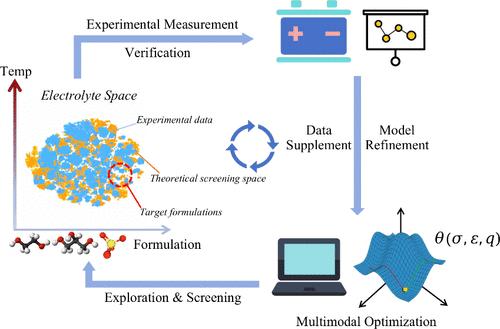
Aqueous batteries, such as aqueous zinc-ion batteries (AZIB), have garnered significant attention because of their advantages in intrinsic safety, low cost, and eco-friendliness. However, aqueous electrolytes tend to freeze at low temperatures, which limits their potential industrial applications. Thus, one of the core challenges in aqueous electrolyte design is optimizing the formula to prevent freezing while maintaining good ion conductivity. However, the experimental trial-and-error approach is inefficient for this purpose, and existing simulation tools are either inaccurate or too expensive for high-throughput phase transition predictions. In this work, we employ a small amount of experimental data and differentiable simulation techniques to develop a multimodal optimization workflow. With minimal human intervention, this workflow significantly enhances the prediction power of classical force fields for electrical conductivity. Most importantly, the simulated electrical conductivity can serve as an effective predictor of electrolyte freezing at low temperatures. Generally, the workflow developed in this work introduces a new paradigm for electrolyte design. This paradigm leverages both easily measurable experimental data and fast simulation techniques to predict properties that are challenging to access by using either approach alone.
期刊介绍:
The Journal of Physical Chemistry (JPC) Letters is devoted to reporting new and original experimental and theoretical basic research of interest to physical chemists, biophysical chemists, chemical physicists, physicists, material scientists, and engineers. An important criterion for acceptance is that the paper reports a significant scientific advance and/or physical insight such that rapid publication is essential. Two issues of JPC Letters are published each month.



 京公网安备 11010802042870号
京ICP备2023020795号-1
京公网安备 11010802042870号
京ICP备2023020795号-1

 分享
分享
 求助内容:
求助内容: 应助结果提醒方式:
 扫码关注我们
