Killian Malosse , Marie Ben Doula , Béatrice Josselin , Thomas Robert , Fabrice Anizon , Sandrine Ruchaud , Francis Giraud , Pascale Moreau
{"title":"h -吡咯[3,2-g]异喹啉类Haspin激酶抑制剂的合成及生物活性研究","authors":"Killian Malosse , Marie Ben Doula , Béatrice Josselin , Thomas Robert , Fabrice Anizon , Sandrine Ruchaud , Francis Giraud , Pascale Moreau","doi":"10.1016/j.bmc.2025.118157","DOIUrl":null,"url":null,"abstract":"<div><div>Based on previous results, new 1<em>H</em>-pyrrolo[3,2-<em>g</em>]isoquinolines were synthesized and evaluated for their ability to inhibit Haspin. Considering that analogues methylated at the indole nitrogen could retain their Haspin inhibitory potency, conjugates that could be suitable for a use in a PROTAC approach were prepared by <em>N</em>-alkylation. In addition, based on the Haspin inhibitory potency of 1<em>H</em>-pyrrolo[3,2-<em>g</em>]isoquinoline-3-carbaldehyde analogue, an additional PROTAC candidate was synthesized by carbonylation at the 3-position. Unfortunately, none of these conjugates exhibited Haspin inhibitory potency. Nevertheless, <em>N</em>-methylated derivative <strong>10</strong> bearing a pyridin-4-yl substituent at the 3-position is the best selective Haspin inhibitor identified to date in these series, with an IC<sub>50</sub> value of 23.6 nM and a selectivity index superior to 14 compared to other protein kinases tested. Additionally, this compound showed both interesting effects on cell viability of various human cell lines and significant inhibitory properties on cellular Haspin kinase.</div></div>","PeriodicalId":255,"journal":{"name":"Bioorganic & Medicinal Chemistry","volume":"123 ","pages":"Article 118157"},"PeriodicalIF":3.5000,"publicationDate":"2025-06-01","publicationTypes":"Journal Article","fieldsOfStudy":null,"isOpenAccess":false,"openAccessPdf":"","citationCount":"0","resultStr":"{\"title\":\"Synthesis and biological activity of 1H-pyrrolo[3,2-g]isoquinolines as Haspin kinase inhibitors\",\"authors\":\"Killian Malosse , Marie Ben Doula , Béatrice Josselin , Thomas Robert , Fabrice Anizon , Sandrine Ruchaud , Francis Giraud , Pascale Moreau\",\"doi\":\"10.1016/j.bmc.2025.118157\",\"DOIUrl\":null,\"url\":null,\"abstract\":\"<div><div>Based on previous results, new 1<em>H</em>-pyrrolo[3,2-<em>g</em>]isoquinolines were synthesized and evaluated for their ability to inhibit Haspin. Considering that analogues methylated at the indole nitrogen could retain their Haspin inhibitory potency, conjugates that could be suitable for a use in a PROTAC approach were prepared by <em>N</em>-alkylation. In addition, based on the Haspin inhibitory potency of 1<em>H</em>-pyrrolo[3,2-<em>g</em>]isoquinoline-3-carbaldehyde analogue, an additional PROTAC candidate was synthesized by carbonylation at the 3-position. Unfortunately, none of these conjugates exhibited Haspin inhibitory potency. Nevertheless, <em>N</em>-methylated derivative <strong>10</strong> bearing a pyridin-4-yl substituent at the 3-position is the best selective Haspin inhibitor identified to date in these series, with an IC<sub>50</sub> value of 23.6 nM and a selectivity index superior to 14 compared to other protein kinases tested. Additionally, this compound showed both interesting effects on cell viability of various human cell lines and significant inhibitory properties on cellular Haspin kinase.</div></div>\",\"PeriodicalId\":255,\"journal\":{\"name\":\"Bioorganic & Medicinal Chemistry\",\"volume\":\"123 \",\"pages\":\"Article 118157\"},\"PeriodicalIF\":3.5000,\"publicationDate\":\"2025-06-01\",\"publicationTypes\":\"Journal Article\",\"fieldsOfStudy\":null,\"isOpenAccess\":false,\"openAccessPdf\":\"\",\"citationCount\":\"0\",\"resultStr\":null,\"platform\":\"Semanticscholar\",\"paperid\":null,\"PeriodicalName\":\"Bioorganic & Medicinal Chemistry\",\"FirstCategoryId\":\"3\",\"ListUrlMain\":\"https://www.sciencedirect.com/science/article/pii/S0968089625000987\",\"RegionNum\":3,\"RegionCategory\":\"医学\",\"ArticlePicture\":[],\"TitleCN\":null,\"AbstractTextCN\":null,\"PMCID\":null,\"EPubDate\":\"2025/3/11 0:00:00\",\"PubModel\":\"Epub\",\"JCR\":\"Q2\",\"JCRName\":\"BIOCHEMISTRY & MOLECULAR BIOLOGY\",\"Score\":null,\"Total\":0}","platform":"Semanticscholar","paperid":null,"PeriodicalName":"Bioorganic & Medicinal Chemistry","FirstCategoryId":"3","ListUrlMain":"https://www.sciencedirect.com/science/article/pii/S0968089625000987","RegionNum":3,"RegionCategory":"医学","ArticlePicture":[],"TitleCN":null,"AbstractTextCN":null,"PMCID":null,"EPubDate":"2025/3/11 0:00:00","PubModel":"Epub","JCR":"Q2","JCRName":"BIOCHEMISTRY & MOLECULAR BIOLOGY","Score":null,"Total":0}
Synthesis and biological activity of 1H-pyrrolo[3,2-g]isoquinolines as Haspin kinase inhibitors
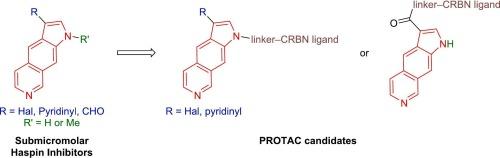
Based on previous results, new 1H-pyrrolo[3,2-g]isoquinolines were synthesized and evaluated for their ability to inhibit Haspin. Considering that analogues methylated at the indole nitrogen could retain their Haspin inhibitory potency, conjugates that could be suitable for a use in a PROTAC approach were prepared by N-alkylation. In addition, based on the Haspin inhibitory potency of 1H-pyrrolo[3,2-g]isoquinoline-3-carbaldehyde analogue, an additional PROTAC candidate was synthesized by carbonylation at the 3-position. Unfortunately, none of these conjugates exhibited Haspin inhibitory potency. Nevertheless, N-methylated derivative 10 bearing a pyridin-4-yl substituent at the 3-position is the best selective Haspin inhibitor identified to date in these series, with an IC50 value of 23.6 nM and a selectivity index superior to 14 compared to other protein kinases tested. Additionally, this compound showed both interesting effects on cell viability of various human cell lines and significant inhibitory properties on cellular Haspin kinase.
期刊介绍:
Bioorganic & Medicinal Chemistry provides an international forum for the publication of full original research papers and critical reviews on molecular interactions in key biological targets such as receptors, channels, enzymes, nucleotides, lipids and saccharides.
The aim of the journal is to promote a better understanding at the molecular level of life processes, and living organisms, as well as the interaction of these with chemical agents. A special feature will be that colour illustrations will be reproduced at no charge to the author, provided that the Editor agrees that colour is essential to the information content of the illustration in question.




 京公网安备 11010802042870号
京ICP备2023020795号-1
京公网安备 11010802042870号
京ICP备2023020795号-1

 分享
分享
 求助内容:
求助内容: 应助结果提醒方式:
 扫码关注我们
