Alp C. Karacakol, Yunus Alapan, Sinan O. Demir, Metin Sitti
{"title":"形状可编程磁性软材料的数据驱动设计","authors":"Alp C. Karacakol, Yunus Alapan, Sinan O. Demir, Metin Sitti","doi":"10.1038/s41467-025-58091-z","DOIUrl":null,"url":null,"abstract":"<p>Magnetically responsive soft materials with spatially-encoded magnetic and material properties enable versatile shape morphing for applications ranging from soft medical robots to biointerfaces. Although high-resolution encoding of 3D magnetic and material properties create a vast design space, their intrinsic coupling makes trial-and-error based design exploration infeasible. Here, we introduce a data-driven strategy that uses stochastic design alterations guided by a predictive neural network, combined with cost-efficient simulations, to optimize distributed magnetization profile and morphology of magnetic soft materials for desired shape-morphing and robotic behaviors. Our approach uncovers non-intuitive 2D designs that morph into complex 2D/3D structures and optimizes morphological behaviors, such as maximizing rotation or minimizing volume. We further demonstrate enhanced jumping performance over an intuitive reference design and showcase fabrication- and scale-agnostic, inherently 3D, multi-material soft structures for robotic tasks including traversing and jumping. This generic, data-driven framework enables efficient exploration of design space of stimuli-responsive soft materials, providing functional shape morphing and behavior for the next generation of soft robots and devices.</p>","PeriodicalId":19066,"journal":{"name":"Nature Communications","volume":"24 1","pages":""},"PeriodicalIF":15.7000,"publicationDate":"2025-03-26","publicationTypes":"Journal Article","fieldsOfStudy":null,"isOpenAccess":false,"openAccessPdf":"","citationCount":"0","resultStr":"{\"title\":\"Data-driven design of shape-programmable magnetic soft materials\",\"authors\":\"Alp C. Karacakol, Yunus Alapan, Sinan O. Demir, Metin Sitti\",\"doi\":\"10.1038/s41467-025-58091-z\",\"DOIUrl\":null,\"url\":null,\"abstract\":\"<p>Magnetically responsive soft materials with spatially-encoded magnetic and material properties enable versatile shape morphing for applications ranging from soft medical robots to biointerfaces. Although high-resolution encoding of 3D magnetic and material properties create a vast design space, their intrinsic coupling makes trial-and-error based design exploration infeasible. Here, we introduce a data-driven strategy that uses stochastic design alterations guided by a predictive neural network, combined with cost-efficient simulations, to optimize distributed magnetization profile and morphology of magnetic soft materials for desired shape-morphing and robotic behaviors. Our approach uncovers non-intuitive 2D designs that morph into complex 2D/3D structures and optimizes morphological behaviors, such as maximizing rotation or minimizing volume. We further demonstrate enhanced jumping performance over an intuitive reference design and showcase fabrication- and scale-agnostic, inherently 3D, multi-material soft structures for robotic tasks including traversing and jumping. This generic, data-driven framework enables efficient exploration of design space of stimuli-responsive soft materials, providing functional shape morphing and behavior for the next generation of soft robots and devices.</p>\",\"PeriodicalId\":19066,\"journal\":{\"name\":\"Nature Communications\",\"volume\":\"24 1\",\"pages\":\"\"},\"PeriodicalIF\":15.7000,\"publicationDate\":\"2025-03-26\",\"publicationTypes\":\"Journal Article\",\"fieldsOfStudy\":null,\"isOpenAccess\":false,\"openAccessPdf\":\"\",\"citationCount\":\"0\",\"resultStr\":null,\"platform\":\"Semanticscholar\",\"paperid\":null,\"PeriodicalName\":\"Nature Communications\",\"FirstCategoryId\":\"103\",\"ListUrlMain\":\"https://doi.org/10.1038/s41467-025-58091-z\",\"RegionNum\":1,\"RegionCategory\":\"综合性期刊\",\"ArticlePicture\":[],\"TitleCN\":null,\"AbstractTextCN\":null,\"PMCID\":null,\"EPubDate\":\"\",\"PubModel\":\"\",\"JCR\":\"Q1\",\"JCRName\":\"MULTIDISCIPLINARY SCIENCES\",\"Score\":null,\"Total\":0}","platform":"Semanticscholar","paperid":null,"PeriodicalName":"Nature Communications","FirstCategoryId":"103","ListUrlMain":"https://doi.org/10.1038/s41467-025-58091-z","RegionNum":1,"RegionCategory":"综合性期刊","ArticlePicture":[],"TitleCN":null,"AbstractTextCN":null,"PMCID":null,"EPubDate":"","PubModel":"","JCR":"Q1","JCRName":"MULTIDISCIPLINARY SCIENCES","Score":null,"Total":0}
Data-driven design of shape-programmable magnetic soft materials
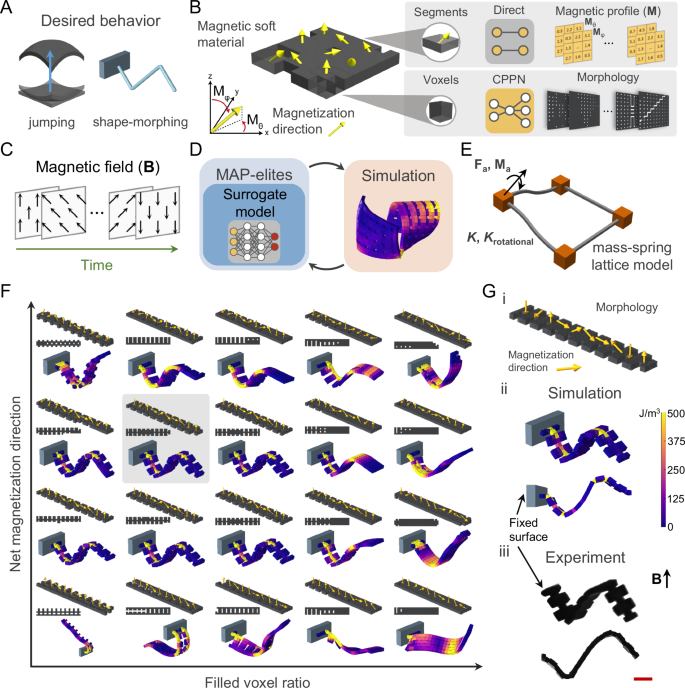
Magnetically responsive soft materials with spatially-encoded magnetic and material properties enable versatile shape morphing for applications ranging from soft medical robots to biointerfaces. Although high-resolution encoding of 3D magnetic and material properties create a vast design space, their intrinsic coupling makes trial-and-error based design exploration infeasible. Here, we introduce a data-driven strategy that uses stochastic design alterations guided by a predictive neural network, combined with cost-efficient simulations, to optimize distributed magnetization profile and morphology of magnetic soft materials for desired shape-morphing and robotic behaviors. Our approach uncovers non-intuitive 2D designs that morph into complex 2D/3D structures and optimizes morphological behaviors, such as maximizing rotation or minimizing volume. We further demonstrate enhanced jumping performance over an intuitive reference design and showcase fabrication- and scale-agnostic, inherently 3D, multi-material soft structures for robotic tasks including traversing and jumping. This generic, data-driven framework enables efficient exploration of design space of stimuli-responsive soft materials, providing functional shape morphing and behavior for the next generation of soft robots and devices.
期刊介绍:
Nature Communications, an open-access journal, publishes high-quality research spanning all areas of the natural sciences. Papers featured in the journal showcase significant advances relevant to specialists in each respective field. With a 2-year impact factor of 16.6 (2022) and a median time of 8 days from submission to the first editorial decision, Nature Communications is committed to rapid dissemination of research findings. As a multidisciplinary journal, it welcomes contributions from biological, health, physical, chemical, Earth, social, mathematical, applied, and engineering sciences, aiming to highlight important breakthroughs within each domain.




 京公网安备 11010802042870号
京ICP备2023020795号-1
京公网安备 11010802042870号
京ICP备2023020795号-1

 分享
分享
 求助内容:
求助内容: 应助结果提醒方式:
 扫码关注我们
