Maximilian J. Klingsiek, Julian Buth, Pia C. Trapp, Andreas Mix, Jan-Hendrik Lamm, Beate Neumann, Hans-Georg Stammler and Norbert W. Mitzel
{"title":"基于二苯并环四烯的聚刘易斯酸:多齿客体的拍打宿主","authors":"Maximilian J. Klingsiek, Julian Buth, Pia C. Trapp, Andreas Mix, Jan-Hendrik Lamm, Beate Neumann, Hans-Georg Stammler and Norbert W. Mitzel","doi":"10.1039/D5QI00823A","DOIUrl":null,"url":null,"abstract":"<p >A synthetic route to flapping poly-Lewis acids (PLAs) based on dibenzocyclooctatetraene was developed. The reactivity of tetradentate boron and aluminium containing PLAs towards various Lewis bases (LB) including drugs was investigated in detail. By using different monodentate LBs, the different effective Lewis acidities (<em>eLA</em>) of the respective pairings were determined and compared with each other. The reaction with multidentate LBs yielded a range of adducts, which were analysed in solution by NMR methods, including DOSY NMR spectroscopy, and in the solid state by X-ray diffraction. The adducts include specific oligomers, and coordination polymers constructed <em>via</em> B–P, Al–P and Al–N interactions. The solid-state structures of these coordination polymers have been determined. The results of complexation of bidentate LB by the tetradentate PLA show that LB is preferentially chelated in the binding pockets, which does not impede the flapping movement during chelating complexation. This phenomenon can be attributed to a reduction in entropy when this flapping motion is lost. The aluminium containing PLAs were observed to form a complex with two caffeine molecules, exhibiting remarkable preference for oxygen functions. In contrast, the reaction with theobromine resulted in the degradation of the PLAs due to the presence of acidic protons in theobromine, leading to the formation of a dimeric aluminium containing theobromine derivative. These findings demonstrate the interaction of PLAs with drugs. They provide a foundation for the advancement of PLAs with a tuneable orientation of Lewis acidic functions.</p>","PeriodicalId":79,"journal":{"name":"Inorganic Chemistry Frontiers","volume":" 12","pages":" 4091-4105"},"PeriodicalIF":6.4000,"publicationDate":"2025-03-26","publicationTypes":"Journal Article","fieldsOfStudy":null,"isOpenAccess":false,"openAccessPdf":"https://pubs.rsc.org/en/content/articlepdf/2025/qi/d5qi00823a?page=search","citationCount":"0","resultStr":"{\"title\":\"Dibenzocyclooctatetraene based poly-Lewis-acids: flapping hosts for multidentate guests†\",\"authors\":\"Maximilian J. Klingsiek, Julian Buth, Pia C. Trapp, Andreas Mix, Jan-Hendrik Lamm, Beate Neumann, Hans-Georg Stammler and Norbert W. Mitzel\",\"doi\":\"10.1039/D5QI00823A\",\"DOIUrl\":null,\"url\":null,\"abstract\":\"<p >A synthetic route to flapping poly-Lewis acids (PLAs) based on dibenzocyclooctatetraene was developed. The reactivity of tetradentate boron and aluminium containing PLAs towards various Lewis bases (LB) including drugs was investigated in detail. By using different monodentate LBs, the different effective Lewis acidities (<em>eLA</em>) of the respective pairings were determined and compared with each other. The reaction with multidentate LBs yielded a range of adducts, which were analysed in solution by NMR methods, including DOSY NMR spectroscopy, and in the solid state by X-ray diffraction. The adducts include specific oligomers, and coordination polymers constructed <em>via</em> B–P, Al–P and Al–N interactions. The solid-state structures of these coordination polymers have been determined. The results of complexation of bidentate LB by the tetradentate PLA show that LB is preferentially chelated in the binding pockets, which does not impede the flapping movement during chelating complexation. This phenomenon can be attributed to a reduction in entropy when this flapping motion is lost. The aluminium containing PLAs were observed to form a complex with two caffeine molecules, exhibiting remarkable preference for oxygen functions. In contrast, the reaction with theobromine resulted in the degradation of the PLAs due to the presence of acidic protons in theobromine, leading to the formation of a dimeric aluminium containing theobromine derivative. These findings demonstrate the interaction of PLAs with drugs. They provide a foundation for the advancement of PLAs with a tuneable orientation of Lewis acidic functions.</p>\",\"PeriodicalId\":79,\"journal\":{\"name\":\"Inorganic Chemistry Frontiers\",\"volume\":\" 12\",\"pages\":\" 4091-4105\"},\"PeriodicalIF\":6.4000,\"publicationDate\":\"2025-03-26\",\"publicationTypes\":\"Journal Article\",\"fieldsOfStudy\":null,\"isOpenAccess\":false,\"openAccessPdf\":\"https://pubs.rsc.org/en/content/articlepdf/2025/qi/d5qi00823a?page=search\",\"citationCount\":\"0\",\"resultStr\":null,\"platform\":\"Semanticscholar\",\"paperid\":null,\"PeriodicalName\":\"Inorganic Chemistry Frontiers\",\"FirstCategoryId\":\"92\",\"ListUrlMain\":\"https://pubs.rsc.org/en/content/articlelanding/2025/qi/d5qi00823a\",\"RegionNum\":1,\"RegionCategory\":\"化学\",\"ArticlePicture\":[],\"TitleCN\":null,\"AbstractTextCN\":null,\"PMCID\":null,\"EPubDate\":\"\",\"PubModel\":\"\",\"JCR\":\"Q1\",\"JCRName\":\"CHEMISTRY, INORGANIC & NUCLEAR\",\"Score\":null,\"Total\":0}","platform":"Semanticscholar","paperid":null,"PeriodicalName":"Inorganic Chemistry Frontiers","FirstCategoryId":"92","ListUrlMain":"https://pubs.rsc.org/en/content/articlelanding/2025/qi/d5qi00823a","RegionNum":1,"RegionCategory":"化学","ArticlePicture":[],"TitleCN":null,"AbstractTextCN":null,"PMCID":null,"EPubDate":"","PubModel":"","JCR":"Q1","JCRName":"CHEMISTRY, INORGANIC & NUCLEAR","Score":null,"Total":0}
引用次数: 0
摘要
我们开发了一种基于二苯并环辛四烯的拍打聚路易斯酸(PLA)的合成路线。详细研究了含硼和铝的四价聚乳酸对各种路易斯碱(LB)(包括药物)的反应性。通过使用不同的单齿路易斯碱,确定了各自配对的不同有效路易斯酸度(eLA),并进行了相互比较。通过核磁共振方法(包括 DOSY 核磁共振谱)和 X 射线衍射方法分析了溶液中和固态中的加合物。这些加合物包括特定的低聚物,以及通过 B-P、Al-P 和 Al-N 相互作用形成的配位聚合物。这些配位聚合物的固态结构已经确定。四价聚乳酸与双价枸橼酸的络合结果表明,枸橼酸优先被螯合在结合袋中,这并不妨碍螯合络合过程中的拍打运动。这一现象可归因于失去拍打运动后熵的减少。据观察,含铝聚乳酸能与两个咖啡因分子形成络合物,表现出明显的氧功能偏好。相反,由于可可碱中存在酸性质子,与可可碱反应会导致聚乳酸降解,形成含可可碱衍生物的二聚铝。这些发现证明了聚乳酸与药物的相互作用。它们为开发具有可调路易斯酸性功能取向的聚乳酸奠定了基础。
Dibenzocyclooctatetraene based poly-Lewis-acids: flapping hosts for multidentate guests†
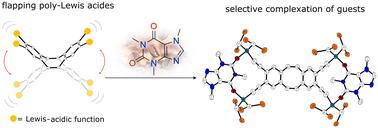
A synthetic route to flapping poly-Lewis acids (PLAs) based on dibenzocyclooctatetraene was developed. The reactivity of tetradentate boron and aluminium containing PLAs towards various Lewis bases (LB) including drugs was investigated in detail. By using different monodentate LBs, the different effective Lewis acidities (eLA) of the respective pairings were determined and compared with each other. The reaction with multidentate LBs yielded a range of adducts, which were analysed in solution by NMR methods, including DOSY NMR spectroscopy, and in the solid state by X-ray diffraction. The adducts include specific oligomers, and coordination polymers constructed via B–P, Al–P and Al–N interactions. The solid-state structures of these coordination polymers have been determined. The results of complexation of bidentate LB by the tetradentate PLA show that LB is preferentially chelated in the binding pockets, which does not impede the flapping movement during chelating complexation. This phenomenon can be attributed to a reduction in entropy when this flapping motion is lost. The aluminium containing PLAs were observed to form a complex with two caffeine molecules, exhibiting remarkable preference for oxygen functions. In contrast, the reaction with theobromine resulted in the degradation of the PLAs due to the presence of acidic protons in theobromine, leading to the formation of a dimeric aluminium containing theobromine derivative. These findings demonstrate the interaction of PLAs with drugs. They provide a foundation for the advancement of PLAs with a tuneable orientation of Lewis acidic functions.




 京公网安备 11010802042870号
京ICP备2023020795号-1
京公网安备 11010802042870号
京ICP备2023020795号-1

 分享
分享
 求助内容:
求助内容: 应助结果提醒方式:
 扫码关注我们
