{"title":"用于时间分辨和多阶段信息加密防伪的杂化氯化锑的逐步结构变换","authors":"Zeping Wang and Xiaoying Huang","doi":"10.1039/D5QI00256G","DOIUrl":null,"url":null,"abstract":"<p >The growing issue of counterfeiting has driven an increasing demand for advanced anti-counterfeiting technologies. Stepwise structural transformations among numerous compounds offer a promising approach to achieving high-level anti-counterfeiting methods, such as multi-step and time-resolved techniques. However, research in this area is still in its early stages. In this work, we report the first example of the stepwise structural transformation from <em>A</em>Sb<em>X</em><small><sub>4</sub></small> (<em>A</em> = cation, <em>X</em> = halide) to <em>A</em><small><sub>2</sub></small>Sb<em>X</em><small><sub>5</sub></small> and further to <em>A</em><small><sub>3</sub></small>Sb<em>X</em><small><sub>6</sub></small>. The compounds are [Bzmim]<small><sub>4</sub></small>[Sb<small><sub>4</sub></small>Cl<small><sub>16</sub></small>] (<strong>1</strong>, Bzmim = 1-benzyl-3-methylimidazolium), [Bzmim]<small><sub>2</sub></small>SbCl<small><sub>5</sub></small> (<strong>2</strong>) and [Bzmim]<small><sub>3</sub></small>SbCl<small><sub>6</sub></small> (<strong>3</strong>). <strong>1</strong>, <strong>2</strong>, and <strong>3</strong> exhibit distinct photoluminescent properties: non-emission, red emission peaking at 600 nm, and green emission peaking at 525 nm, respectively. Consequently, stepwise structural transformations enable stepwise luminescent switching from an “<em>off</em>” to multi-“<em>on</em>” states. Moreover, the switching mode can be adjusted from “<em>off-on</em>” to “<em>off-on</em><small><sup>1</sup></small>-<em>on</em><small><sup>2</sup></small>” by simply changing the reactant ratio. Using SbCl<small><sub>3</sub></small> ethanol solutions as invisible ink, multi-step and time-resolved information encryption and anti-counterfeiting were demonstrated by combining [Bzmim]Cl solution, UV light, time, and temperature as developers. The tunable composition and photoluminescent response modes of these IOMHs position them as excellent candidates for high-level information encryption and anti-counterfeiting applications. This work sheds light on the potential for developing advanced informational encryption technologies.</p>","PeriodicalId":79,"journal":{"name":"Inorganic Chemistry Frontiers","volume":" 12","pages":" 3997-4006"},"PeriodicalIF":6.4000,"publicationDate":"2025-03-26","publicationTypes":"Journal Article","fieldsOfStudy":null,"isOpenAccess":false,"openAccessPdf":"","citationCount":"0","resultStr":"{\"title\":\"Stepwise structural transformation in hybrid antimony chloride for time-resolved and multi-stage informational encryption and anti-counterfeiting†\",\"authors\":\"Zeping Wang and Xiaoying Huang\",\"doi\":\"10.1039/D5QI00256G\",\"DOIUrl\":null,\"url\":null,\"abstract\":\"<p >The growing issue of counterfeiting has driven an increasing demand for advanced anti-counterfeiting technologies. Stepwise structural transformations among numerous compounds offer a promising approach to achieving high-level anti-counterfeiting methods, such as multi-step and time-resolved techniques. However, research in this area is still in its early stages. In this work, we report the first example of the stepwise structural transformation from <em>A</em>Sb<em>X</em><small><sub>4</sub></small> (<em>A</em> = cation, <em>X</em> = halide) to <em>A</em><small><sub>2</sub></small>Sb<em>X</em><small><sub>5</sub></small> and further to <em>A</em><small><sub>3</sub></small>Sb<em>X</em><small><sub>6</sub></small>. The compounds are [Bzmim]<small><sub>4</sub></small>[Sb<small><sub>4</sub></small>Cl<small><sub>16</sub></small>] (<strong>1</strong>, Bzmim = 1-benzyl-3-methylimidazolium), [Bzmim]<small><sub>2</sub></small>SbCl<small><sub>5</sub></small> (<strong>2</strong>) and [Bzmim]<small><sub>3</sub></small>SbCl<small><sub>6</sub></small> (<strong>3</strong>). <strong>1</strong>, <strong>2</strong>, and <strong>3</strong> exhibit distinct photoluminescent properties: non-emission, red emission peaking at 600 nm, and green emission peaking at 525 nm, respectively. Consequently, stepwise structural transformations enable stepwise luminescent switching from an “<em>off</em>” to multi-“<em>on</em>” states. Moreover, the switching mode can be adjusted from “<em>off-on</em>” to “<em>off-on</em><small><sup>1</sup></small>-<em>on</em><small><sup>2</sup></small>” by simply changing the reactant ratio. Using SbCl<small><sub>3</sub></small> ethanol solutions as invisible ink, multi-step and time-resolved information encryption and anti-counterfeiting were demonstrated by combining [Bzmim]Cl solution, UV light, time, and temperature as developers. The tunable composition and photoluminescent response modes of these IOMHs position them as excellent candidates for high-level information encryption and anti-counterfeiting applications. This work sheds light on the potential for developing advanced informational encryption technologies.</p>\",\"PeriodicalId\":79,\"journal\":{\"name\":\"Inorganic Chemistry Frontiers\",\"volume\":\" 12\",\"pages\":\" 3997-4006\"},\"PeriodicalIF\":6.4000,\"publicationDate\":\"2025-03-26\",\"publicationTypes\":\"Journal Article\",\"fieldsOfStudy\":null,\"isOpenAccess\":false,\"openAccessPdf\":\"\",\"citationCount\":\"0\",\"resultStr\":null,\"platform\":\"Semanticscholar\",\"paperid\":null,\"PeriodicalName\":\"Inorganic Chemistry Frontiers\",\"FirstCategoryId\":\"92\",\"ListUrlMain\":\"https://pubs.rsc.org/en/content/articlelanding/2025/qi/d5qi00256g\",\"RegionNum\":1,\"RegionCategory\":\"化学\",\"ArticlePicture\":[],\"TitleCN\":null,\"AbstractTextCN\":null,\"PMCID\":null,\"EPubDate\":\"\",\"PubModel\":\"\",\"JCR\":\"Q1\",\"JCRName\":\"CHEMISTRY, INORGANIC & NUCLEAR\",\"Score\":null,\"Total\":0}","platform":"Semanticscholar","paperid":null,"PeriodicalName":"Inorganic Chemistry Frontiers","FirstCategoryId":"92","ListUrlMain":"https://pubs.rsc.org/en/content/articlelanding/2025/qi/d5qi00256g","RegionNum":1,"RegionCategory":"化学","ArticlePicture":[],"TitleCN":null,"AbstractTextCN":null,"PMCID":null,"EPubDate":"","PubModel":"","JCR":"Q1","JCRName":"CHEMISTRY, INORGANIC & NUCLEAR","Score":null,"Total":0}
Stepwise structural transformation in hybrid antimony chloride for time-resolved and multi-stage informational encryption and anti-counterfeiting†
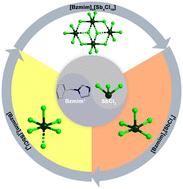
The growing issue of counterfeiting has driven an increasing demand for advanced anti-counterfeiting technologies. Stepwise structural transformations among numerous compounds offer a promising approach to achieving high-level anti-counterfeiting methods, such as multi-step and time-resolved techniques. However, research in this area is still in its early stages. In this work, we report the first example of the stepwise structural transformation from ASbX4 (A = cation, X = halide) to A2SbX5 and further to A3SbX6. The compounds are [Bzmim]4[Sb4Cl16] (1, Bzmim = 1-benzyl-3-methylimidazolium), [Bzmim]2SbCl5 (2) and [Bzmim]3SbCl6 (3). 1, 2, and 3 exhibit distinct photoluminescent properties: non-emission, red emission peaking at 600 nm, and green emission peaking at 525 nm, respectively. Consequently, stepwise structural transformations enable stepwise luminescent switching from an “off” to multi-“on” states. Moreover, the switching mode can be adjusted from “off-on” to “off-on1-on2” by simply changing the reactant ratio. Using SbCl3 ethanol solutions as invisible ink, multi-step and time-resolved information encryption and anti-counterfeiting were demonstrated by combining [Bzmim]Cl solution, UV light, time, and temperature as developers. The tunable composition and photoluminescent response modes of these IOMHs position them as excellent candidates for high-level information encryption and anti-counterfeiting applications. This work sheds light on the potential for developing advanced informational encryption technologies.





 京公网安备 11010802042870号
京ICP备2023020795号-1
京公网安备 11010802042870号
京ICP备2023020795号-1

 分享
分享
 求助内容:
求助内容: 应助结果提醒方式:
 扫码关注我们
