Hongda Zhu, Timothy A. Jackson, Aaron J. Teator, Bala Subramaniam
{"title":"溶剂预处理聚乙烯臭氧氧化功能化研究","authors":"Hongda Zhu, Timothy A. Jackson, Aaron J. Teator, Bala Subramaniam","doi":"10.1021/acssuschemeng.4c09279","DOIUrl":null,"url":null,"abstract":"Recently, there has been much interest in editing polymers to either endow them with improved properties or facilitate their deconstruction post-use. Such editing often requires the addition of functional groups, which can be especially challenging in the case of highly crystalline and recalcitrant polymers. Herein, we introduce a relatively simple dual-step technique for functionalizing high-density polyethylene (HDPE) using ozone. The method involves first treating the polymer in either supercritical carbon dioxide or paraffinic solvents such as isobutane or <i>n</i>-hexane at 110–120 °C to enhance ozone’s accessibility to the C–H bonds. This step is then followed by exposing the pretreated polymer to ozone either in a gaseous form or dissolved in liquid carbon dioxide at ambient temperature. Nitrogen sorption results and scanning electron micrographs confirmed increased porosity in the solvent-pretreated HDPE samples. Infrared and NMR spectroscopic analyses reveal the formation of carbonyl groups in the pretreated polymer samples upon ozonation. Further, high-temperature GPC analyses indicate that ozonation reduced the molecular weights of the pretreated HDPE samples, suggesting that ozone also induces C–C scission. This method uses benign reagents to induce porosity in the polymer and its functionalization. Our results demonstrate the need to improve ozone utilization to maximize resource efficiency.","PeriodicalId":25,"journal":{"name":"ACS Sustainable Chemistry & Engineering","volume":"11 1","pages":""},"PeriodicalIF":7.3000,"publicationDate":"2025-03-25","publicationTypes":"Journal Article","fieldsOfStudy":null,"isOpenAccess":false,"openAccessPdf":"","citationCount":"0","resultStr":"{\"title\":\"Oxidative Functionalization of Solvent-Pretreated Polyethylene by Ozone\",\"authors\":\"Hongda Zhu, Timothy A. Jackson, Aaron J. Teator, Bala Subramaniam\",\"doi\":\"10.1021/acssuschemeng.4c09279\",\"DOIUrl\":null,\"url\":null,\"abstract\":\"Recently, there has been much interest in editing polymers to either endow them with improved properties or facilitate their deconstruction post-use. Such editing often requires the addition of functional groups, which can be especially challenging in the case of highly crystalline and recalcitrant polymers. Herein, we introduce a relatively simple dual-step technique for functionalizing high-density polyethylene (HDPE) using ozone. The method involves first treating the polymer in either supercritical carbon dioxide or paraffinic solvents such as isobutane or <i>n</i>-hexane at 110–120 °C to enhance ozone’s accessibility to the C–H bonds. This step is then followed by exposing the pretreated polymer to ozone either in a gaseous form or dissolved in liquid carbon dioxide at ambient temperature. Nitrogen sorption results and scanning electron micrographs confirmed increased porosity in the solvent-pretreated HDPE samples. Infrared and NMR spectroscopic analyses reveal the formation of carbonyl groups in the pretreated polymer samples upon ozonation. Further, high-temperature GPC analyses indicate that ozonation reduced the molecular weights of the pretreated HDPE samples, suggesting that ozone also induces C–C scission. This method uses benign reagents to induce porosity in the polymer and its functionalization. Our results demonstrate the need to improve ozone utilization to maximize resource efficiency.\",\"PeriodicalId\":25,\"journal\":{\"name\":\"ACS Sustainable Chemistry & Engineering\",\"volume\":\"11 1\",\"pages\":\"\"},\"PeriodicalIF\":7.3000,\"publicationDate\":\"2025-03-25\",\"publicationTypes\":\"Journal Article\",\"fieldsOfStudy\":null,\"isOpenAccess\":false,\"openAccessPdf\":\"\",\"citationCount\":\"0\",\"resultStr\":null,\"platform\":\"Semanticscholar\",\"paperid\":null,\"PeriodicalName\":\"ACS Sustainable Chemistry & Engineering\",\"FirstCategoryId\":\"92\",\"ListUrlMain\":\"https://doi.org/10.1021/acssuschemeng.4c09279\",\"RegionNum\":1,\"RegionCategory\":\"化学\",\"ArticlePicture\":[],\"TitleCN\":null,\"AbstractTextCN\":null,\"PMCID\":null,\"EPubDate\":\"\",\"PubModel\":\"\",\"JCR\":\"Q1\",\"JCRName\":\"CHEMISTRY, MULTIDISCIPLINARY\",\"Score\":null,\"Total\":0}","platform":"Semanticscholar","paperid":null,"PeriodicalName":"ACS Sustainable Chemistry & Engineering","FirstCategoryId":"92","ListUrlMain":"https://doi.org/10.1021/acssuschemeng.4c09279","RegionNum":1,"RegionCategory":"化学","ArticlePicture":[],"TitleCN":null,"AbstractTextCN":null,"PMCID":null,"EPubDate":"","PubModel":"","JCR":"Q1","JCRName":"CHEMISTRY, MULTIDISCIPLINARY","Score":null,"Total":0}
引用次数: 0
摘要
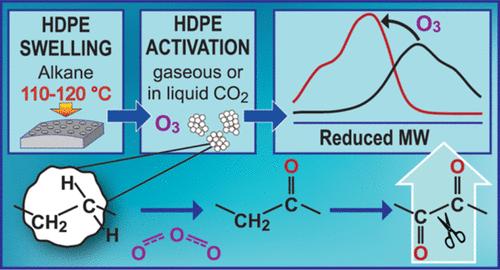
最近,人们对编辑聚合物以改善其性能或促进其使用后的解构产生了浓厚的兴趣。这种编辑通常需要添加官能团,这对于高结晶性和难降解聚合物来说尤其具有挑战性。在此,我们介绍一种相对简单的两步法技术,利用臭氧对高密度聚乙烯(HDPE)进行功能化。该方法首先在 110-120 °C 的温度下,用超临界二氧化碳或石蜡溶剂(如异丁烷或正己烷)处理聚合物,以提高臭氧与 C-H 键的接触性。然后,在环境温度下将预处理过的聚合物置于气态臭氧或溶解在液态二氧化碳中的臭氧中。氮吸附结果和扫描电子显微照片证实,经过溶剂预处理的高密度聚乙烯样品的孔隙率有所增加。红外光谱和核磁共振光谱分析显示,经过臭氧处理的聚合物样品中形成了羰基。此外,高温 GPC 分析表明,臭氧处理降低了预处理高密度聚乙烯样品的分子量,这表明臭氧还能诱导 C-C 裂解。这种方法使用良性试剂诱导聚合物的多孔性及其功能化。我们的研究结果表明,有必要提高臭氧利用率,以最大限度地提高资源效率。
Oxidative Functionalization of Solvent-Pretreated Polyethylene by Ozone
Recently, there has been much interest in editing polymers to either endow them with improved properties or facilitate their deconstruction post-use. Such editing often requires the addition of functional groups, which can be especially challenging in the case of highly crystalline and recalcitrant polymers. Herein, we introduce a relatively simple dual-step technique for functionalizing high-density polyethylene (HDPE) using ozone. The method involves first treating the polymer in either supercritical carbon dioxide or paraffinic solvents such as isobutane or n-hexane at 110–120 °C to enhance ozone’s accessibility to the C–H bonds. This step is then followed by exposing the pretreated polymer to ozone either in a gaseous form or dissolved in liquid carbon dioxide at ambient temperature. Nitrogen sorption results and scanning electron micrographs confirmed increased porosity in the solvent-pretreated HDPE samples. Infrared and NMR spectroscopic analyses reveal the formation of carbonyl groups in the pretreated polymer samples upon ozonation. Further, high-temperature GPC analyses indicate that ozonation reduced the molecular weights of the pretreated HDPE samples, suggesting that ozone also induces C–C scission. This method uses benign reagents to induce porosity in the polymer and its functionalization. Our results demonstrate the need to improve ozone utilization to maximize resource efficiency.
期刊介绍:
ACS Sustainable Chemistry & Engineering is a prestigious weekly peer-reviewed scientific journal published by the American Chemical Society. Dedicated to advancing the principles of green chemistry and green engineering, it covers a wide array of research topics including green chemistry, green engineering, biomass, alternative energy, and life cycle assessment.
The journal welcomes submissions in various formats, including Letters, Articles, Features, and Perspectives (Reviews), that address the challenges of sustainability in the chemical enterprise and contribute to the advancement of sustainable practices. Join us in shaping the future of sustainable chemistry and engineering.




 京公网安备 11010802042870号
京ICP备2023020795号-1
京公网安备 11010802042870号
京ICP备2023020795号-1

 分享
分享
 求助内容:
求助内容: 应助结果提醒方式:
 扫码关注我们
