{"title":"htFuncLib:设计用于蛋白质优化的活性位点多点突变体文库。","authors":"Rosalie Lipsh-Sokolik , Sarel J. Fleishman","doi":"10.1016/j.jmb.2025.169011","DOIUrl":null,"url":null,"abstract":"<div><div>Protein function relies on accurate and densely packed constellations of amino acids within the active site. The high density in the active site optimizes activity but reduces tolerance to mutations, thereby frustrating efforts to engineer or design new or dramatically improved activity. Introducing new activities may therefore require simultaneous multipoint mutations. Still, in a phenomenon known as epistasis, the outcome of combinations of mutations can differ significantly—and even reverse—the impact of the individual mutations, limiting predictability. To address these challenges we previously developed FuncLib, a method for the computational design of multipoint mutants in active sites. We recently extended FuncLib to enable the design of large combinatorial mutation libraries for high-throughput screening in a method called htFuncLib that generates compatible sets of mutations likely to yield functional multipoint mutants. htFuncLib enables scalable library design and experimental screening of hundreds and up to millions of active-site variants. This approach has generated thousands of active enzymes and fluorescent proteins with diverse functional properties. We have updated the FuncLib web server (<span><span>https://FuncLib.weizmann.ac.il/</span><svg><path></path></svg></span>) to support htFuncLib and introduced an electronic notebook (<span><span>https://github.com/Fleishman-Lab/htFuncLib-web-server</span><svg><path></path></svg></span>) for customizable library design, making those tools easily accessible for protein engineering and design. The new FuncLib web server enables reliable and scalable design of function for low-, medium- and high-throughput experiments through a single computational platform. We envision that this server will accelerate the optimization and discovery of function in enzymes, antibodies, and other proteins.</div></div>","PeriodicalId":369,"journal":{"name":"Journal of Molecular Biology","volume":"437 15","pages":"Article 169011"},"PeriodicalIF":4.5000,"publicationDate":"2025-08-01","publicationTypes":"Journal Article","fieldsOfStudy":null,"isOpenAccess":false,"openAccessPdf":"","citationCount":"0","resultStr":"{\"title\":\"htFuncLib: Designing Libraries of Active-site Multipoint Mutants for Protein Optimization\",\"authors\":\"Rosalie Lipsh-Sokolik , Sarel J. Fleishman\",\"doi\":\"10.1016/j.jmb.2025.169011\",\"DOIUrl\":null,\"url\":null,\"abstract\":\"<div><div>Protein function relies on accurate and densely packed constellations of amino acids within the active site. The high density in the active site optimizes activity but reduces tolerance to mutations, thereby frustrating efforts to engineer or design new or dramatically improved activity. Introducing new activities may therefore require simultaneous multipoint mutations. Still, in a phenomenon known as epistasis, the outcome of combinations of mutations can differ significantly—and even reverse—the impact of the individual mutations, limiting predictability. To address these challenges we previously developed FuncLib, a method for the computational design of multipoint mutants in active sites. We recently extended FuncLib to enable the design of large combinatorial mutation libraries for high-throughput screening in a method called htFuncLib that generates compatible sets of mutations likely to yield functional multipoint mutants. htFuncLib enables scalable library design and experimental screening of hundreds and up to millions of active-site variants. This approach has generated thousands of active enzymes and fluorescent proteins with diverse functional properties. We have updated the FuncLib web server (<span><span>https://FuncLib.weizmann.ac.il/</span><svg><path></path></svg></span>) to support htFuncLib and introduced an electronic notebook (<span><span>https://github.com/Fleishman-Lab/htFuncLib-web-server</span><svg><path></path></svg></span>) for customizable library design, making those tools easily accessible for protein engineering and design. The new FuncLib web server enables reliable and scalable design of function for low-, medium- and high-throughput experiments through a single computational platform. We envision that this server will accelerate the optimization and discovery of function in enzymes, antibodies, and other proteins.</div></div>\",\"PeriodicalId\":369,\"journal\":{\"name\":\"Journal of Molecular Biology\",\"volume\":\"437 15\",\"pages\":\"Article 169011\"},\"PeriodicalIF\":4.5000,\"publicationDate\":\"2025-08-01\",\"publicationTypes\":\"Journal Article\",\"fieldsOfStudy\":null,\"isOpenAccess\":false,\"openAccessPdf\":\"\",\"citationCount\":\"0\",\"resultStr\":null,\"platform\":\"Semanticscholar\",\"paperid\":null,\"PeriodicalName\":\"Journal of Molecular Biology\",\"FirstCategoryId\":\"99\",\"ListUrlMain\":\"https://www.sciencedirect.com/science/article/pii/S0022283625000774\",\"RegionNum\":2,\"RegionCategory\":\"生物学\",\"ArticlePicture\":[],\"TitleCN\":null,\"AbstractTextCN\":null,\"PMCID\":null,\"EPubDate\":\"2025/2/15 0:00:00\",\"PubModel\":\"Epub\",\"JCR\":\"Q1\",\"JCRName\":\"BIOCHEMISTRY & MOLECULAR BIOLOGY\",\"Score\":null,\"Total\":0}","platform":"Semanticscholar","paperid":null,"PeriodicalName":"Journal of Molecular Biology","FirstCategoryId":"99","ListUrlMain":"https://www.sciencedirect.com/science/article/pii/S0022283625000774","RegionNum":2,"RegionCategory":"生物学","ArticlePicture":[],"TitleCN":null,"AbstractTextCN":null,"PMCID":null,"EPubDate":"2025/2/15 0:00:00","PubModel":"Epub","JCR":"Q1","JCRName":"BIOCHEMISTRY & MOLECULAR BIOLOGY","Score":null,"Total":0}
htFuncLib: Designing Libraries of Active-site Multipoint Mutants for Protein Optimization
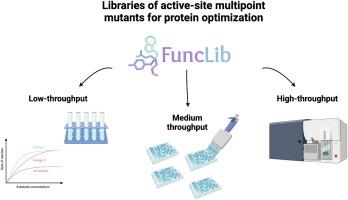
Protein function relies on accurate and densely packed constellations of amino acids within the active site. The high density in the active site optimizes activity but reduces tolerance to mutations, thereby frustrating efforts to engineer or design new or dramatically improved activity. Introducing new activities may therefore require simultaneous multipoint mutations. Still, in a phenomenon known as epistasis, the outcome of combinations of mutations can differ significantly—and even reverse—the impact of the individual mutations, limiting predictability. To address these challenges we previously developed FuncLib, a method for the computational design of multipoint mutants in active sites. We recently extended FuncLib to enable the design of large combinatorial mutation libraries for high-throughput screening in a method called htFuncLib that generates compatible sets of mutations likely to yield functional multipoint mutants. htFuncLib enables scalable library design and experimental screening of hundreds and up to millions of active-site variants. This approach has generated thousands of active enzymes and fluorescent proteins with diverse functional properties. We have updated the FuncLib web server (https://FuncLib.weizmann.ac.il/) to support htFuncLib and introduced an electronic notebook (https://github.com/Fleishman-Lab/htFuncLib-web-server) for customizable library design, making those tools easily accessible for protein engineering and design. The new FuncLib web server enables reliable and scalable design of function for low-, medium- and high-throughput experiments through a single computational platform. We envision that this server will accelerate the optimization and discovery of function in enzymes, antibodies, and other proteins.
期刊介绍:
Journal of Molecular Biology (JMB) provides high quality, comprehensive and broad coverage in all areas of molecular biology. The journal publishes original scientific research papers that provide mechanistic and functional insights and report a significant advance to the field. The journal encourages the submission of multidisciplinary studies that use complementary experimental and computational approaches to address challenging biological questions.
Research areas include but are not limited to: Biomolecular interactions, signaling networks, systems biology; Cell cycle, cell growth, cell differentiation; Cell death, autophagy; Cell signaling and regulation; Chemical biology; Computational biology, in combination with experimental studies; DNA replication, repair, and recombination; Development, regenerative biology, mechanistic and functional studies of stem cells; Epigenetics, chromatin structure and function; Gene expression; Membrane processes, cell surface proteins and cell-cell interactions; Methodological advances, both experimental and theoretical, including databases; Microbiology, virology, and interactions with the host or environment; Microbiota mechanistic and functional studies; Nuclear organization; Post-translational modifications, proteomics; Processing and function of biologically important macromolecules and complexes; Molecular basis of disease; RNA processing, structure and functions of non-coding RNAs, transcription; Sorting, spatiotemporal organization, trafficking; Structural biology; Synthetic biology; Translation, protein folding, chaperones, protein degradation and quality control.




 京公网安备 11010802042870号
京ICP备2023020795号-1
京公网安备 11010802042870号
京ICP备2023020795号-1

 分享
分享
 求助内容:
求助内容: 应助结果提醒方式:
 扫码关注我们
