Cherumannil Femina, Toshiya Yamagami, Norifumi Yamamoto, Reji Thomas and Pookkottu K. Sajith
{"title":"双(氰苯基)吡咯衍生物聚集诱导发射的理论见解","authors":"Cherumannil Femina, Toshiya Yamagami, Norifumi Yamamoto, Reji Thomas and Pookkottu K. Sajith","doi":"10.1039/D4CP01291G","DOIUrl":null,"url":null,"abstract":"<p >The molecular architecture and the positioning of the cyano group in cyanostilbene derivatives give rise to intriguing variations in their photophysical properties. The present study provides theoretical insights into the contrasting photoluminescence behaviors of bis(cyanostyryl)pyrrole derivatives with different cyano group positions. Using quantum mechanics/molecular mechanics (QM/MM) free energy perturbation methods, we investigated <strong>o-DCSP</strong> and <strong>i-DCSP</strong> isomers, which exhibited markedly different fluorescence quantum yields in the solution (<em>Φ</em><small><sub>f</sub></small> = 0.0036 <em>vs.</em> 0.43) and aggregated states (<em>Φ</em><small><sub>f</sub></small> = 0.15 <em>vs.</em> 0.12). We identified the minimum energy conical intersection (MECI) structures for both isomers, characterized by substantial rotation and pyramidalization of one ethylenic C<img>C bond, and determined the minimum energy path (MEP) connecting the Franck–Condon point to the MECI using the string method. By calculating the free energy profiles along this MEP, we revealed significant differences in energy barriers: <strong>o-DCSP</strong> showed a low barrier in solution (0.57 eV), which dramatically increased upon aggregation (2.36 eV), explaining its aggregation-induced emission behavior, whereas <strong>i-DCSP</strong> maintains relatively high barriers in both states (1.40 eV and 1.67 eV), resulting in efficient emission regardless of the environment. These findings establish a quantitative molecular-level understanding of the structure–property relationships in fluorescent materials and provide design principles for developing high-performance luminescent compounds with tailored emission characteristics for specific applications.</p>","PeriodicalId":99,"journal":{"name":"Physical Chemistry Chemical Physics","volume":" 16","pages":" 8478-8487"},"PeriodicalIF":3.0000,"publicationDate":"2025-03-27","publicationTypes":"Journal Article","fieldsOfStudy":null,"isOpenAccess":false,"openAccessPdf":"https://pubs.rsc.org/en/content/articlepdf/2025/cp/d4cp01291g?page=search","citationCount":"0","resultStr":"{\"title\":\"Theoretical insights into aggregation-induced emission of bis(cyanostyryl)pyrrole derivatives\",\"authors\":\"Cherumannil Femina, Toshiya Yamagami, Norifumi Yamamoto, Reji Thomas and Pookkottu K. Sajith\",\"doi\":\"10.1039/D4CP01291G\",\"DOIUrl\":null,\"url\":null,\"abstract\":\"<p >The molecular architecture and the positioning of the cyano group in cyanostilbene derivatives give rise to intriguing variations in their photophysical properties. The present study provides theoretical insights into the contrasting photoluminescence behaviors of bis(cyanostyryl)pyrrole derivatives with different cyano group positions. Using quantum mechanics/molecular mechanics (QM/MM) free energy perturbation methods, we investigated <strong>o-DCSP</strong> and <strong>i-DCSP</strong> isomers, which exhibited markedly different fluorescence quantum yields in the solution (<em>Φ</em><small><sub>f</sub></small> = 0.0036 <em>vs.</em> 0.43) and aggregated states (<em>Φ</em><small><sub>f</sub></small> = 0.15 <em>vs.</em> 0.12). We identified the minimum energy conical intersection (MECI) structures for both isomers, characterized by substantial rotation and pyramidalization of one ethylenic C<img>C bond, and determined the minimum energy path (MEP) connecting the Franck–Condon point to the MECI using the string method. By calculating the free energy profiles along this MEP, we revealed significant differences in energy barriers: <strong>o-DCSP</strong> showed a low barrier in solution (0.57 eV), which dramatically increased upon aggregation (2.36 eV), explaining its aggregation-induced emission behavior, whereas <strong>i-DCSP</strong> maintains relatively high barriers in both states (1.40 eV and 1.67 eV), resulting in efficient emission regardless of the environment. These findings establish a quantitative molecular-level understanding of the structure–property relationships in fluorescent materials and provide design principles for developing high-performance luminescent compounds with tailored emission characteristics for specific applications.</p>\",\"PeriodicalId\":99,\"journal\":{\"name\":\"Physical Chemistry Chemical Physics\",\"volume\":\" 16\",\"pages\":\" 8478-8487\"},\"PeriodicalIF\":3.0000,\"publicationDate\":\"2025-03-27\",\"publicationTypes\":\"Journal Article\",\"fieldsOfStudy\":null,\"isOpenAccess\":false,\"openAccessPdf\":\"https://pubs.rsc.org/en/content/articlepdf/2025/cp/d4cp01291g?page=search\",\"citationCount\":\"0\",\"resultStr\":null,\"platform\":\"Semanticscholar\",\"paperid\":null,\"PeriodicalName\":\"Physical Chemistry Chemical Physics\",\"FirstCategoryId\":\"92\",\"ListUrlMain\":\"https://pubs.rsc.org/en/content/articlelanding/2025/cp/d4cp01291g\",\"RegionNum\":3,\"RegionCategory\":\"化学\",\"ArticlePicture\":[],\"TitleCN\":null,\"AbstractTextCN\":null,\"PMCID\":null,\"EPubDate\":\"\",\"PubModel\":\"\",\"JCR\":\"Q3\",\"JCRName\":\"CHEMISTRY, PHYSICAL\",\"Score\":null,\"Total\":0}","platform":"Semanticscholar","paperid":null,"PeriodicalName":"Physical Chemistry Chemical Physics","FirstCategoryId":"92","ListUrlMain":"https://pubs.rsc.org/en/content/articlelanding/2025/cp/d4cp01291g","RegionNum":3,"RegionCategory":"化学","ArticlePicture":[],"TitleCN":null,"AbstractTextCN":null,"PMCID":null,"EPubDate":"","PubModel":"","JCR":"Q3","JCRName":"CHEMISTRY, PHYSICAL","Score":null,"Total":0}
引用次数: 0
摘要
氰基苯乙烯衍生物中氰基的分子结构和定位引起了它们的光物理性质的有趣变化。本研究为不同氰基位置的双(氰苯基)吡咯衍生物的光致发光行为的对比提供了理论见解。利用量子力学/分子力学(QM/MM)自由能摄动方法,研究了o-DCSP和i-DCSP异构体在溶液中荧光量子产率(Φf = 0.0036 vs. 0.43)和聚合态(Φf = 0.15 vs. 0.12)的显著差异。我们确定了两种异构体的最小能量锥形交叉(MECI)结构,其特征是一个乙烯C=C键的大量旋转和锥体化,并利用串法确定了连接Franck-Condon点到MECI的最小能量路径(MEP)。通过计算沿MEP的自由能分布,我们发现了能量势垒的显著差异:o-DCSP在溶液中表现出较低的势垒(0.57 eV),在聚集时急剧增加(2.36 eV),这解释了其聚集诱导的发射行为,而i-DCSP在两种状态下都保持相对较高的势垒(1.40 eV和1.67 eV),从而导致无论环境如何都能有效发射。这些发现建立了对荧光材料结构-性能关系的定量分子水平理解,并为开发具有特定应用的定制发射特性的高性能发光化合物提供了设计原则。
Theoretical insights into aggregation-induced emission of bis(cyanostyryl)pyrrole derivatives
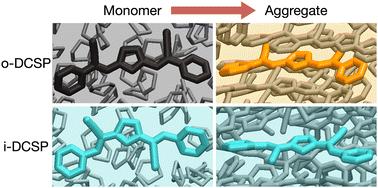
The molecular architecture and the positioning of the cyano group in cyanostilbene derivatives give rise to intriguing variations in their photophysical properties. The present study provides theoretical insights into the contrasting photoluminescence behaviors of bis(cyanostyryl)pyrrole derivatives with different cyano group positions. Using quantum mechanics/molecular mechanics (QM/MM) free energy perturbation methods, we investigated o-DCSP and i-DCSP isomers, which exhibited markedly different fluorescence quantum yields in the solution (Φf = 0.0036 vs. 0.43) and aggregated states (Φf = 0.15 vs. 0.12). We identified the minimum energy conical intersection (MECI) structures for both isomers, characterized by substantial rotation and pyramidalization of one ethylenic CC bond, and determined the minimum energy path (MEP) connecting the Franck–Condon point to the MECI using the string method. By calculating the free energy profiles along this MEP, we revealed significant differences in energy barriers: o-DCSP showed a low barrier in solution (0.57 eV), which dramatically increased upon aggregation (2.36 eV), explaining its aggregation-induced emission behavior, whereas i-DCSP maintains relatively high barriers in both states (1.40 eV and 1.67 eV), resulting in efficient emission regardless of the environment. These findings establish a quantitative molecular-level understanding of the structure–property relationships in fluorescent materials and provide design principles for developing high-performance luminescent compounds with tailored emission characteristics for specific applications.
期刊介绍:
Physical Chemistry Chemical Physics (PCCP) is an international journal co-owned by 19 physical chemistry and physics societies from around the world. This journal publishes original, cutting-edge research in physical chemistry, chemical physics and biophysical chemistry. To be suitable for publication in PCCP, articles must include significant innovation and/or insight into physical chemistry; this is the most important criterion that reviewers and Editors will judge against when evaluating submissions.
The journal has a broad scope and welcomes contributions spanning experiment, theory, computation and data science. Topical coverage includes spectroscopy, dynamics, kinetics, statistical mechanics, thermodynamics, electrochemistry, catalysis, surface science, quantum mechanics, quantum computing and machine learning. Interdisciplinary research areas such as polymers and soft matter, materials, nanoscience, energy, surfaces/interfaces, and biophysical chemistry are welcomed if they demonstrate significant innovation and/or insight into physical chemistry. Joined experimental/theoretical studies are particularly appreciated when complementary and based on up-to-date approaches.





 京公网安备 11010802042870号
京ICP备2023020795号-1
京公网安备 11010802042870号
京ICP备2023020795号-1

 分享
分享
 求助内容:
求助内容: 应助结果提醒方式:
 扫码关注我们
