Yanyan Zhang , Lingling Peng , Xinming Li , Xiaohu Zhang , Renjie Li , Yuexing Zhang , Tianyou Peng
{"title":"coii -卟啉调控的Cu2O/Cu纳米复合材料促进CO2电还原制乙烯","authors":"Yanyan Zhang , Lingling Peng , Xinming Li , Xiaohu Zhang , Renjie Li , Yuexing Zhang , Tianyou Peng","doi":"10.1016/j.jcat.2025.116109","DOIUrl":null,"url":null,"abstract":"<div><div>CO<sub>2</sub> electroreduction (CO<sub>2</sub>ER) into high value-added chemicals or fuels is of great significance to solve the current energy shortage and realize the carbon cycle. Although there are reports that Cu-based CO<sub>2</sub>ER catalysts can achieve multicarbon products, the influence of the microenvironment of Cu-based catalysts on their valence states, interface and CO<sub>2</sub>ER performance still deserve further investigation. Herein, a Co<sup>II</sup>-porphyrin derivative (<em>m</em>-CoTPyP) is used to decorate on Cu<sub>2</sub>O/Cu nanoparticles with Cu<sup>+</sup>/Cu<sup>0</sup> mixed valence states and Cu<sub>2</sub>O/Cu interface for constructing a novel CoTPyP-Cu<sub>2</sub>O/Cu composite, where <em>m</em>-CoTPyP as ultrathin layer on Cu<sub>2</sub>O/Cu nanoparticles can not only efficiently promote the adsorption/activation of CO<sub>2</sub> and the formation of *CO on the active sites by regulating the microenvironment <em>via</em> H-bonding, but also improve the stability of Cu valence states. Moreover, the Cu<sup>+</sup>/Cu<sup>0</sup> mixed valence states and abundant Cu<sub>2</sub>O/Cu interfaces of the Cu<sub>2</sub>O/Cu nanoparticles significantly enhance the electron transfer rate and C<img>C coupling kinetics. Specifically, the CoTPyP-Cu<sub>2</sub>O/Cu(1:15) delivers an ethylene (C<sub>2</sub>H<sub>4</sub>) Faraday efficiency up to 71 % and excellent stability (>50 h). This work provides a new perspective on the structural design of CO<sub>2</sub>ER catalyst with synergistic active sites, high Faraday efficiency and selectivity of C<sub>2</sub>H<sub>4</sub> by regulating the microenvironment.</div></div>","PeriodicalId":346,"journal":{"name":"Journal of Catalysis","volume":"447 ","pages":"Article 116109"},"PeriodicalIF":6.0000,"publicationDate":"2025-07-01","publicationTypes":"Journal Article","fieldsOfStudy":null,"isOpenAccess":false,"openAccessPdf":"","citationCount":"0","resultStr":"{\"title\":\"Boosting CO2 electroreduction to ethylene via CoII-porphyrin regulated Cu2O/Cu nanocomposite\",\"authors\":\"Yanyan Zhang , Lingling Peng , Xinming Li , Xiaohu Zhang , Renjie Li , Yuexing Zhang , Tianyou Peng\",\"doi\":\"10.1016/j.jcat.2025.116109\",\"DOIUrl\":null,\"url\":null,\"abstract\":\"<div><div>CO<sub>2</sub> electroreduction (CO<sub>2</sub>ER) into high value-added chemicals or fuels is of great significance to solve the current energy shortage and realize the carbon cycle. Although there are reports that Cu-based CO<sub>2</sub>ER catalysts can achieve multicarbon products, the influence of the microenvironment of Cu-based catalysts on their valence states, interface and CO<sub>2</sub>ER performance still deserve further investigation. Herein, a Co<sup>II</sup>-porphyrin derivative (<em>m</em>-CoTPyP) is used to decorate on Cu<sub>2</sub>O/Cu nanoparticles with Cu<sup>+</sup>/Cu<sup>0</sup> mixed valence states and Cu<sub>2</sub>O/Cu interface for constructing a novel CoTPyP-Cu<sub>2</sub>O/Cu composite, where <em>m</em>-CoTPyP as ultrathin layer on Cu<sub>2</sub>O/Cu nanoparticles can not only efficiently promote the adsorption/activation of CO<sub>2</sub> and the formation of *CO on the active sites by regulating the microenvironment <em>via</em> H-bonding, but also improve the stability of Cu valence states. Moreover, the Cu<sup>+</sup>/Cu<sup>0</sup> mixed valence states and abundant Cu<sub>2</sub>O/Cu interfaces of the Cu<sub>2</sub>O/Cu nanoparticles significantly enhance the electron transfer rate and C<img>C coupling kinetics. Specifically, the CoTPyP-Cu<sub>2</sub>O/Cu(1:15) delivers an ethylene (C<sub>2</sub>H<sub>4</sub>) Faraday efficiency up to 71 % and excellent stability (>50 h). This work provides a new perspective on the structural design of CO<sub>2</sub>ER catalyst with synergistic active sites, high Faraday efficiency and selectivity of C<sub>2</sub>H<sub>4</sub> by regulating the microenvironment.</div></div>\",\"PeriodicalId\":346,\"journal\":{\"name\":\"Journal of Catalysis\",\"volume\":\"447 \",\"pages\":\"Article 116109\"},\"PeriodicalIF\":6.0000,\"publicationDate\":\"2025-07-01\",\"publicationTypes\":\"Journal Article\",\"fieldsOfStudy\":null,\"isOpenAccess\":false,\"openAccessPdf\":\"\",\"citationCount\":\"0\",\"resultStr\":null,\"platform\":\"Semanticscholar\",\"paperid\":null,\"PeriodicalName\":\"Journal of Catalysis\",\"FirstCategoryId\":\"92\",\"ListUrlMain\":\"https://www.sciencedirect.com/science/article/pii/S0021951725001745\",\"RegionNum\":1,\"RegionCategory\":\"化学\",\"ArticlePicture\":[],\"TitleCN\":null,\"AbstractTextCN\":null,\"PMCID\":null,\"EPubDate\":\"2025/3/27 0:00:00\",\"PubModel\":\"Epub\",\"JCR\":\"Q2\",\"JCRName\":\"CHEMISTRY, PHYSICAL\",\"Score\":null,\"Total\":0}","platform":"Semanticscholar","paperid":null,"PeriodicalName":"Journal of Catalysis","FirstCategoryId":"92","ListUrlMain":"https://www.sciencedirect.com/science/article/pii/S0021951725001745","RegionNum":1,"RegionCategory":"化学","ArticlePicture":[],"TitleCN":null,"AbstractTextCN":null,"PMCID":null,"EPubDate":"2025/3/27 0:00:00","PubModel":"Epub","JCR":"Q2","JCRName":"CHEMISTRY, PHYSICAL","Score":null,"Total":0}
Boosting CO2 electroreduction to ethylene via CoII-porphyrin regulated Cu2O/Cu nanocomposite
CO2 electroreduction (CO2ER) into high value-added chemicals or fuels is of great significance to solve the current energy shortage and realize the carbon cycle. Although there are reports that Cu-based CO2ER catalysts can achieve multicarbon products, the influence of the microenvironment of Cu-based catalysts on their valence states, interface and CO2ER performance still deserve further investigation. Herein, a CoII-porphyrin derivative (m-CoTPyP) is used to decorate on Cu2O/Cu nanoparticles with Cu+/Cu0 mixed valence states and Cu2O/Cu interface for constructing a novel CoTPyP-Cu2O/Cu composite, where m-CoTPyP as ultrathin layer on Cu2O/Cu nanoparticles can not only efficiently promote the adsorption/activation of CO2 and the formation of *CO on the active sites by regulating the microenvironment via H-bonding, but also improve the stability of Cu valence states. Moreover, the Cu+/Cu0 mixed valence states and abundant Cu2O/Cu interfaces of the Cu2O/Cu nanoparticles significantly enhance the electron transfer rate and CC coupling kinetics. Specifically, the CoTPyP-Cu2O/Cu(1:15) delivers an ethylene (C2H4) Faraday efficiency up to 71 % and excellent stability (>50 h). This work provides a new perspective on the structural design of CO2ER catalyst with synergistic active sites, high Faraday efficiency and selectivity of C2H4 by regulating the microenvironment.
期刊介绍:
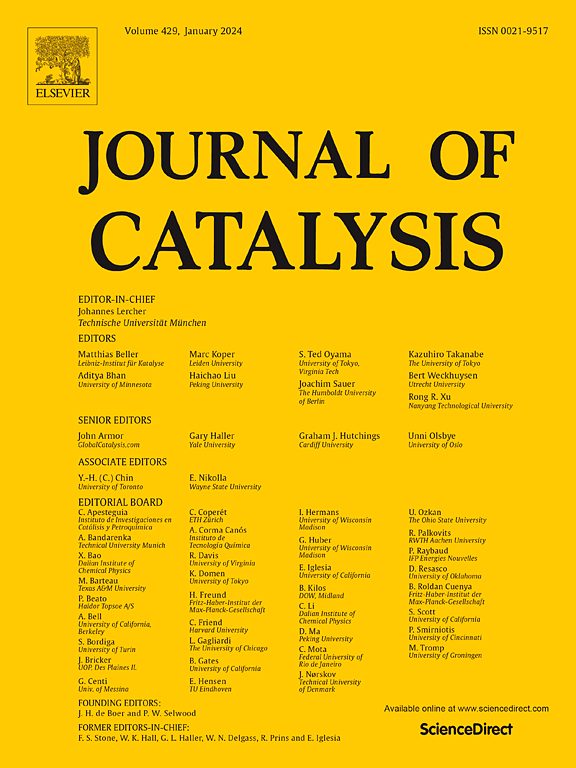
The Journal of Catalysis publishes scholarly articles on both heterogeneous and homogeneous catalysis, covering a wide range of chemical transformations. These include various types of catalysis, such as those mediated by photons, plasmons, and electrons. The focus of the studies is to understand the relationship between catalytic function and the underlying chemical properties of surfaces and metal complexes.
The articles in the journal offer innovative concepts and explore the synthesis and kinetics of inorganic solids and homogeneous complexes. Furthermore, they discuss spectroscopic techniques for characterizing catalysts, investigate the interaction of probes and reacting species with catalysts, and employ theoretical methods.
The research presented in the journal should have direct relevance to the field of catalytic processes, addressing either fundamental aspects or applications of catalysis.






 京公网安备 11010802042870号
京ICP备2023020795号-1
京公网安备 11010802042870号
京ICP备2023020795号-1

 分享
分享
 求助内容:
求助内容: 应助结果提醒方式:
 扫码关注我们
