Laura Ivette Paz Herrera , Randy Cortright , J. Will Medlin
{"title":"水蒸气对铝硅酸盐气相丙醛缩合反应活性的影响","authors":"Laura Ivette Paz Herrera , Randy Cortright , J. Will Medlin","doi":"10.1016/j.jcat.2025.116110","DOIUrl":null,"url":null,"abstract":"<div><div>Aluminosilicate materials have been extensively studied as efficient aldol catalysts for C–C coupling reactions due to their acidic nature, high surface area, thermal stability, and porous structure. This work investigated the impact of water vapor pressure on the catalytic reactivity of aluminosilicates for the aldol condensation of propanal to 2-methyl-2-pentenal (MP). The catalytic performance of amorphous SiO<sub>2</sub>-Al<sub>2</sub>O<sub>3</sub> (A-Si-Al) and aluminated MCM-41 (Al-MCM-41) for the vapor-phase aldol condensation of propanal was evaluated at 200 °C as a function of vapor-phase water content at atmospheric pressure. Our findings demonstrate that co-feeding low water vapor pressures (1–18 kPa) with propanal enhances the rates of MP production at 200 °C on A-Si-Al. Conversely, water vapor pressures of 25 kPa result in a decrease in aldol dimer formation rates. The rate of MP production evaluated on Al-MCM-41 also increased in the presence of 5 kPa water compared to anhydrous conditions. Propylamine temperature-programmed desorption analyses revealed an increase in Brønsted acid site density when both catalysts were exposed to water, which likely accounts for the observed enhancement in aldol condensation reactivity under hydrous conditions. Reversibility testing of the water vapor effect under reaction conditions, combined with X-ray diffraction analysis of fresh, spent, and regenerated catalysts, revealed no structural changes in either aluminosilicate upon exposure to water or reaction conditions. The rates of aldol condensation and the impact of water vapor were highly consistent across both materials, suggesting that zeolite crystallinity has minimal influence on the catalytic performance.</div></div>","PeriodicalId":346,"journal":{"name":"Journal of Catalysis","volume":"447 ","pages":"Article 116110"},"PeriodicalIF":6.0000,"publicationDate":"2025-07-01","publicationTypes":"Journal Article","fieldsOfStudy":null,"isOpenAccess":false,"openAccessPdf":"","citationCount":"0","resultStr":"{\"title\":\"Effects of water vapor on the reactivity of aluminosilicates in vapor-phase propanal aldol condensation\",\"authors\":\"Laura Ivette Paz Herrera , Randy Cortright , J. Will Medlin\",\"doi\":\"10.1016/j.jcat.2025.116110\",\"DOIUrl\":null,\"url\":null,\"abstract\":\"<div><div>Aluminosilicate materials have been extensively studied as efficient aldol catalysts for C–C coupling reactions due to their acidic nature, high surface area, thermal stability, and porous structure. This work investigated the impact of water vapor pressure on the catalytic reactivity of aluminosilicates for the aldol condensation of propanal to 2-methyl-2-pentenal (MP). The catalytic performance of amorphous SiO<sub>2</sub>-Al<sub>2</sub>O<sub>3</sub> (A-Si-Al) and aluminated MCM-41 (Al-MCM-41) for the vapor-phase aldol condensation of propanal was evaluated at 200 °C as a function of vapor-phase water content at atmospheric pressure. Our findings demonstrate that co-feeding low water vapor pressures (1–18 kPa) with propanal enhances the rates of MP production at 200 °C on A-Si-Al. Conversely, water vapor pressures of 25 kPa result in a decrease in aldol dimer formation rates. The rate of MP production evaluated on Al-MCM-41 also increased in the presence of 5 kPa water compared to anhydrous conditions. Propylamine temperature-programmed desorption analyses revealed an increase in Brønsted acid site density when both catalysts were exposed to water, which likely accounts for the observed enhancement in aldol condensation reactivity under hydrous conditions. Reversibility testing of the water vapor effect under reaction conditions, combined with X-ray diffraction analysis of fresh, spent, and regenerated catalysts, revealed no structural changes in either aluminosilicate upon exposure to water or reaction conditions. The rates of aldol condensation and the impact of water vapor were highly consistent across both materials, suggesting that zeolite crystallinity has minimal influence on the catalytic performance.</div></div>\",\"PeriodicalId\":346,\"journal\":{\"name\":\"Journal of Catalysis\",\"volume\":\"447 \",\"pages\":\"Article 116110\"},\"PeriodicalIF\":6.0000,\"publicationDate\":\"2025-07-01\",\"publicationTypes\":\"Journal Article\",\"fieldsOfStudy\":null,\"isOpenAccess\":false,\"openAccessPdf\":\"\",\"citationCount\":\"0\",\"resultStr\":null,\"platform\":\"Semanticscholar\",\"paperid\":null,\"PeriodicalName\":\"Journal of Catalysis\",\"FirstCategoryId\":\"92\",\"ListUrlMain\":\"https://www.sciencedirect.com/science/article/pii/S0021951725001757\",\"RegionNum\":1,\"RegionCategory\":\"化学\",\"ArticlePicture\":[],\"TitleCN\":null,\"AbstractTextCN\":null,\"PMCID\":null,\"EPubDate\":\"2025/3/28 0:00:00\",\"PubModel\":\"Epub\",\"JCR\":\"Q2\",\"JCRName\":\"CHEMISTRY, PHYSICAL\",\"Score\":null,\"Total\":0}","platform":"Semanticscholar","paperid":null,"PeriodicalName":"Journal of Catalysis","FirstCategoryId":"92","ListUrlMain":"https://www.sciencedirect.com/science/article/pii/S0021951725001757","RegionNum":1,"RegionCategory":"化学","ArticlePicture":[],"TitleCN":null,"AbstractTextCN":null,"PMCID":null,"EPubDate":"2025/3/28 0:00:00","PubModel":"Epub","JCR":"Q2","JCRName":"CHEMISTRY, PHYSICAL","Score":null,"Total":0}
Effects of water vapor on the reactivity of aluminosilicates in vapor-phase propanal aldol condensation
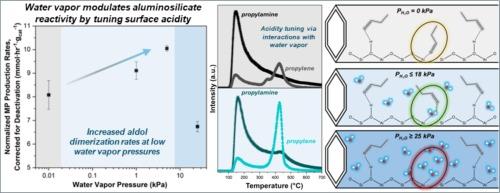
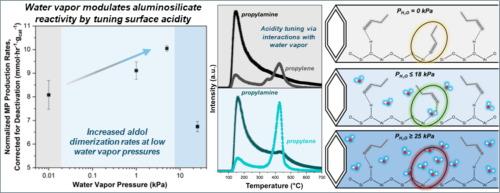
Aluminosilicate materials have been extensively studied as efficient aldol catalysts for C–C coupling reactions due to their acidic nature, high surface area, thermal stability, and porous structure. This work investigated the impact of water vapor pressure on the catalytic reactivity of aluminosilicates for the aldol condensation of propanal to 2-methyl-2-pentenal (MP). The catalytic performance of amorphous SiO2-Al2O3 (A-Si-Al) and aluminated MCM-41 (Al-MCM-41) for the vapor-phase aldol condensation of propanal was evaluated at 200 °C as a function of vapor-phase water content at atmospheric pressure. Our findings demonstrate that co-feeding low water vapor pressures (1–18 kPa) with propanal enhances the rates of MP production at 200 °C on A-Si-Al. Conversely, water vapor pressures of 25 kPa result in a decrease in aldol dimer formation rates. The rate of MP production evaluated on Al-MCM-41 also increased in the presence of 5 kPa water compared to anhydrous conditions. Propylamine temperature-programmed desorption analyses revealed an increase in Brønsted acid site density when both catalysts were exposed to water, which likely accounts for the observed enhancement in aldol condensation reactivity under hydrous conditions. Reversibility testing of the water vapor effect under reaction conditions, combined with X-ray diffraction analysis of fresh, spent, and regenerated catalysts, revealed no structural changes in either aluminosilicate upon exposure to water or reaction conditions. The rates of aldol condensation and the impact of water vapor were highly consistent across both materials, suggesting that zeolite crystallinity has minimal influence on the catalytic performance.
期刊介绍:
The Journal of Catalysis publishes scholarly articles on both heterogeneous and homogeneous catalysis, covering a wide range of chemical transformations. These include various types of catalysis, such as those mediated by photons, plasmons, and electrons. The focus of the studies is to understand the relationship between catalytic function and the underlying chemical properties of surfaces and metal complexes.
The articles in the journal offer innovative concepts and explore the synthesis and kinetics of inorganic solids and homogeneous complexes. Furthermore, they discuss spectroscopic techniques for characterizing catalysts, investigate the interaction of probes and reacting species with catalysts, and employ theoretical methods.
The research presented in the journal should have direct relevance to the field of catalytic processes, addressing either fundamental aspects or applications of catalysis.




 京公网安备 11010802042870号
京ICP备2023020795号-1
京公网安备 11010802042870号
京ICP备2023020795号-1

 分享
分享
 求助内容:
求助内容: 应助结果提醒方式:
 扫码关注我们
