Fuzhan Song, Xiang Ding, Yangyang Wan, Tong Zhang, Guogeng Yin, Jesse B. Brown, Yi Rao
{"title":"杂原子硼掺杂钴和氮化钴促进水氧化的界面电荷转移","authors":"Fuzhan Song, Xiang Ding, Yangyang Wan, Tong Zhang, Guogeng Yin, Jesse B. Brown, Yi Rao","doi":"10.1021/acs.jpclett.4c03374","DOIUrl":null,"url":null,"abstract":"Designing high-performance transition-metal electrocatalysts with controlled active heterointerfacial sites for catalyzing the electrochemical oxygen evolution reaction (OER) is very desirable but remains a great challenge. Here, a facile strategy for the synthesis of transition-metal nitride-based interfacial electrocatalysts boron-doped cobalt/cobalt nitride (B–Co/Co<sub>2</sub>N) is demonstrated with optimal heterointerfaces between Co and Co<sub>2</sub>N electrocatalysts by introducing boron as a dopant to the former. Benefiting from the unique electronegativity of B, the obtained B–Co/Co<sub>2</sub>N electrocatalysts show excellent OER performance with overpotential inputs of as low as 262 and 310 mV for 10 and 100 mA cm<sup>–2</sup>, which are 1.4 and 6.6 times higher than those of Co/Co<sub>2</sub>N with the same potential input, respectively. The experimental and theoretical results demonstrate the role of the B dopant in inducing charge redistribution of Co active sites in the Co/Co<sub>2</sub>N interfacial region, which results in a downshift of the Co <i>3d</i> band center, the optimal oxidation state of active sites for *OOH formation, and lower energy barriers. Furthermore, the assembled electrolyzer can steadily produce an industrial-grade current density of 1000 mA cm<sup>–2</sup> at a cell voltage input of only 1.81 V for at least 100 h with a Faradaic efficiency near 100%. This study provides a promising strategy for heteroatom-doped interfacial electrocatalysts with high performance for energy and environmental applications.","PeriodicalId":62,"journal":{"name":"The Journal of Physical Chemistry Letters","volume":"11 1","pages":""},"PeriodicalIF":4.6000,"publicationDate":"2025-03-31","publicationTypes":"Journal Article","fieldsOfStudy":null,"isOpenAccess":false,"openAccessPdf":"","citationCount":"0","resultStr":"{\"title\":\"Interface Charge Transfer of Heteroatom Boron Doping Cobalt and Cobalt Nitride for Boosting Water Oxidation\",\"authors\":\"Fuzhan Song, Xiang Ding, Yangyang Wan, Tong Zhang, Guogeng Yin, Jesse B. Brown, Yi Rao\",\"doi\":\"10.1021/acs.jpclett.4c03374\",\"DOIUrl\":null,\"url\":null,\"abstract\":\"Designing high-performance transition-metal electrocatalysts with controlled active heterointerfacial sites for catalyzing the electrochemical oxygen evolution reaction (OER) is very desirable but remains a great challenge. Here, a facile strategy for the synthesis of transition-metal nitride-based interfacial electrocatalysts boron-doped cobalt/cobalt nitride (B–Co/Co<sub>2</sub>N) is demonstrated with optimal heterointerfaces between Co and Co<sub>2</sub>N electrocatalysts by introducing boron as a dopant to the former. Benefiting from the unique electronegativity of B, the obtained B–Co/Co<sub>2</sub>N electrocatalysts show excellent OER performance with overpotential inputs of as low as 262 and 310 mV for 10 and 100 mA cm<sup>–2</sup>, which are 1.4 and 6.6 times higher than those of Co/Co<sub>2</sub>N with the same potential input, respectively. The experimental and theoretical results demonstrate the role of the B dopant in inducing charge redistribution of Co active sites in the Co/Co<sub>2</sub>N interfacial region, which results in a downshift of the Co <i>3d</i> band center, the optimal oxidation state of active sites for *OOH formation, and lower energy barriers. Furthermore, the assembled electrolyzer can steadily produce an industrial-grade current density of 1000 mA cm<sup>–2</sup> at a cell voltage input of only 1.81 V for at least 100 h with a Faradaic efficiency near 100%. This study provides a promising strategy for heteroatom-doped interfacial electrocatalysts with high performance for energy and environmental applications.\",\"PeriodicalId\":62,\"journal\":{\"name\":\"The Journal of Physical Chemistry Letters\",\"volume\":\"11 1\",\"pages\":\"\"},\"PeriodicalIF\":4.6000,\"publicationDate\":\"2025-03-31\",\"publicationTypes\":\"Journal Article\",\"fieldsOfStudy\":null,\"isOpenAccess\":false,\"openAccessPdf\":\"\",\"citationCount\":\"0\",\"resultStr\":null,\"platform\":\"Semanticscholar\",\"paperid\":null,\"PeriodicalName\":\"The Journal of Physical Chemistry Letters\",\"FirstCategoryId\":\"1\",\"ListUrlMain\":\"https://doi.org/10.1021/acs.jpclett.4c03374\",\"RegionNum\":2,\"RegionCategory\":\"化学\",\"ArticlePicture\":[],\"TitleCN\":null,\"AbstractTextCN\":null,\"PMCID\":null,\"EPubDate\":\"\",\"PubModel\":\"\",\"JCR\":\"Q2\",\"JCRName\":\"CHEMISTRY, PHYSICAL\",\"Score\":null,\"Total\":0}","platform":"Semanticscholar","paperid":null,"PeriodicalName":"The Journal of Physical Chemistry Letters","FirstCategoryId":"1","ListUrlMain":"https://doi.org/10.1021/acs.jpclett.4c03374","RegionNum":2,"RegionCategory":"化学","ArticlePicture":[],"TitleCN":null,"AbstractTextCN":null,"PMCID":null,"EPubDate":"","PubModel":"","JCR":"Q2","JCRName":"CHEMISTRY, PHYSICAL","Score":null,"Total":0}
引用次数: 0
摘要
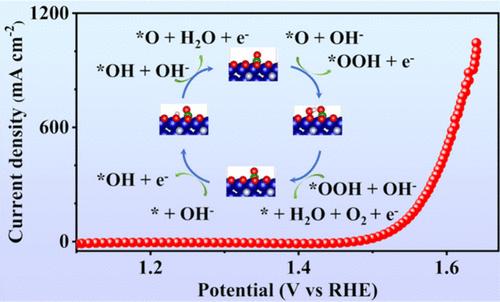
设计具有可控活性异质界面位的高性能过渡金属电催化剂来催化电化学析氧反应(OER)是非常需要的,但仍然是一个巨大的挑战。本文通过在过渡金属氮基硼掺杂钴/氮化钴(B-Co /Co2N)电催化剂中引入硼作为掺杂剂,实现了钴和Co2N电催化剂之间的最佳异质界面。得益于B特有的电负性,所制备的B - Co/Co2N电催化剂在10和100 mA cm-2下的过电位输入分别为262和310 mV时表现出优异的OER性能,分别比相同电位输入的Co/Co2N高1.4和6.6倍。实验和理论结果表明,B掺杂剂在Co/Co2N界面区诱导Co活性位的电荷重新分布,导致Co 3d带中心的下移,活性位形成*OOH的最佳氧化态,以及较低的能垒。此外,组装的电解槽可以在电池电压仅为1.81 V的情况下稳定地产生1000 mA cm-2的工业级电流密度,持续至少100小时,法拉第效率接近100%。本研究为制备高性能的杂原子掺杂界面电催化剂提供了一条新的途径。
Interface Charge Transfer of Heteroatom Boron Doping Cobalt and Cobalt Nitride for Boosting Water Oxidation
Designing high-performance transition-metal electrocatalysts with controlled active heterointerfacial sites for catalyzing the electrochemical oxygen evolution reaction (OER) is very desirable but remains a great challenge. Here, a facile strategy for the synthesis of transition-metal nitride-based interfacial electrocatalysts boron-doped cobalt/cobalt nitride (B–Co/Co2N) is demonstrated with optimal heterointerfaces between Co and Co2N electrocatalysts by introducing boron as a dopant to the former. Benefiting from the unique electronegativity of B, the obtained B–Co/Co2N electrocatalysts show excellent OER performance with overpotential inputs of as low as 262 and 310 mV for 10 and 100 mA cm–2, which are 1.4 and 6.6 times higher than those of Co/Co2N with the same potential input, respectively. The experimental and theoretical results demonstrate the role of the B dopant in inducing charge redistribution of Co active sites in the Co/Co2N interfacial region, which results in a downshift of the Co 3d band center, the optimal oxidation state of active sites for *OOH formation, and lower energy barriers. Furthermore, the assembled electrolyzer can steadily produce an industrial-grade current density of 1000 mA cm–2 at a cell voltage input of only 1.81 V for at least 100 h with a Faradaic efficiency near 100%. This study provides a promising strategy for heteroatom-doped interfacial electrocatalysts with high performance for energy and environmental applications.
期刊介绍:
The Journal of Physical Chemistry (JPC) Letters is devoted to reporting new and original experimental and theoretical basic research of interest to physical chemists, biophysical chemists, chemical physicists, physicists, material scientists, and engineers. An important criterion for acceptance is that the paper reports a significant scientific advance and/or physical insight such that rapid publication is essential. Two issues of JPC Letters are published each month.




 京公网安备 11010802042870号
京ICP备2023020795号-1
京公网安备 11010802042870号
京ICP备2023020795号-1

 分享
分享
 求助内容:
求助内容: 应助结果提醒方式:
 扫码关注我们
