{"title":"血清25(OH)D水平对阑尾肌肉质量的因果影响:来自NHANES数据和孟德尔随机分析的证据","authors":"Qian Ren, Jinrong Liang, Yanmei Su, Ruijing Tian, Junxian Wu, Sheng Ge, Peizhan Chen","doi":"10.1002/jcsm.13778","DOIUrl":null,"url":null,"abstract":"<div>\n \n \n <section>\n \n <h3> Background</h3>\n \n <p>Low serum vitamin D status was reported to be associated with reduced muscle mass; however, it is inconclusive whether this relationship is causal. This study used data from the National Health and Nutrition Examination Survey (NHANES) and two-sample Mendelian randomization (MR) analyses to ascertain the causal relationship between serum 25-hydroxyvitamin D [25(OH)D] and appendicular muscle mass (AMM).</p>\n </section>\n \n <section>\n \n <h3> Methods</h3>\n \n <p>In the NHANES 2011–2018 dataset, 11 242 participants (5588 males and 5654 females) aged 18–59 years old were included, and multivariant linear regression was performed to assess the relationship between 25(OH)D and AMM measured by dual-energy X-ray absorptiometry. In two-sample MR analysis, 167 single nucleotide polymorphisms significantly associated with serum 25(OH)D at the genome-wide association level (<i>p</i> < 5 × 10<sup>−8</sup>) were applied as instrumental variables (IVs) to assess vitamin D effects on AMM in the UK Biobank (417 580 Europeans) using univariable and multivariable MR (MVMR) models.</p>\n </section>\n \n <section>\n \n <h3> Results</h3>\n \n <p>In the NHANES dataset, serum 25(OH)D concentrations were positively associated with AMM (<i>β</i> = 0.013, SE = 0.001, <i>p</i> < 0.001) in all participants, after adjustment for age, race, season of blood collection, education, income, body mass index and physical activity. In stratification analysis by sex, males (<i>β</i> = 0.024, SE = 0.002, <i>p</i> < 0.001) showed more pronounced positive associations than females (<i>β</i> = 0.003, SE = 0.002, <i>p</i> = 0.024). In univariable MR, genetically higher serum 25(OH)D levels were positively associated with AMM in all participants (<i>β</i> = 0.049, SE = 0.024, <i>p</i> = 0.039) and males (<i>β</i> = 0.057, SE = 0.025, <i>p</i> = 0.021), but only marginally significant in females (<i>β</i> = 0.043, SE = 0.025, <i>p</i> = 0.090) based on IVW models was noticed. No significant pleiotropy effects were detected for the IVs in the two-sample MR investigations. In MVMR analysis, a positive causal effect of 25(OH)D on AMM was observed in the total population (<i>β</i> = 0.116, SE = 0.051, <i>p</i> = 0.022), males (<i>β</i> = 0.111, SE = 0.053, <i>p</i> = 0.036) and females (<i>β</i> = 0.124, SE = 0.054, <i>p</i> = 0.021).</p>\n </section>\n \n <section>\n \n <h3> Conclusions</h3>\n \n <p>Our results suggested a positive causal effect of serum 25(OH)D concentration on AMM; however, more researches are warranted to unveil the underlying biological mechanisms and evaluate the effects of vitamin D intervention on AMM.</p>\n </section>\n </div>","PeriodicalId":48911,"journal":{"name":"Journal of Cachexia Sarcopenia and Muscle","volume":"16 2","pages":""},"PeriodicalIF":9.9000,"publicationDate":"2025-03-31","publicationTypes":"Journal Article","fieldsOfStudy":null,"isOpenAccess":false,"openAccessPdf":"https://onlinelibrary.wiley.com/doi/epdf/10.1002/jcsm.13778","citationCount":"0","resultStr":"{\"title\":\"A Causal Effect of Serum 25(OH)D Level on Appendicular Muscle Mass: Evidence From NHANES Data and Mendelian Randomization Analyses\",\"authors\":\"Qian Ren, Jinrong Liang, Yanmei Su, Ruijing Tian, Junxian Wu, Sheng Ge, Peizhan Chen\",\"doi\":\"10.1002/jcsm.13778\",\"DOIUrl\":null,\"url\":null,\"abstract\":\"<div>\\n \\n \\n <section>\\n \\n <h3> Background</h3>\\n \\n <p>Low serum vitamin D status was reported to be associated with reduced muscle mass; however, it is inconclusive whether this relationship is causal. This study used data from the National Health and Nutrition Examination Survey (NHANES) and two-sample Mendelian randomization (MR) analyses to ascertain the causal relationship between serum 25-hydroxyvitamin D [25(OH)D] and appendicular muscle mass (AMM).</p>\\n </section>\\n \\n <section>\\n \\n <h3> Methods</h3>\\n \\n <p>In the NHANES 2011–2018 dataset, 11 242 participants (5588 males and 5654 females) aged 18–59 years old were included, and multivariant linear regression was performed to assess the relationship between 25(OH)D and AMM measured by dual-energy X-ray absorptiometry. In two-sample MR analysis, 167 single nucleotide polymorphisms significantly associated with serum 25(OH)D at the genome-wide association level (<i>p</i> < 5 × 10<sup>−8</sup>) were applied as instrumental variables (IVs) to assess vitamin D effects on AMM in the UK Biobank (417 580 Europeans) using univariable and multivariable MR (MVMR) models.</p>\\n </section>\\n \\n <section>\\n \\n <h3> Results</h3>\\n \\n <p>In the NHANES dataset, serum 25(OH)D concentrations were positively associated with AMM (<i>β</i> = 0.013, SE = 0.001, <i>p</i> < 0.001) in all participants, after adjustment for age, race, season of blood collection, education, income, body mass index and physical activity. In stratification analysis by sex, males (<i>β</i> = 0.024, SE = 0.002, <i>p</i> < 0.001) showed more pronounced positive associations than females (<i>β</i> = 0.003, SE = 0.002, <i>p</i> = 0.024). In univariable MR, genetically higher serum 25(OH)D levels were positively associated with AMM in all participants (<i>β</i> = 0.049, SE = 0.024, <i>p</i> = 0.039) and males (<i>β</i> = 0.057, SE = 0.025, <i>p</i> = 0.021), but only marginally significant in females (<i>β</i> = 0.043, SE = 0.025, <i>p</i> = 0.090) based on IVW models was noticed. No significant pleiotropy effects were detected for the IVs in the two-sample MR investigations. In MVMR analysis, a positive causal effect of 25(OH)D on AMM was observed in the total population (<i>β</i> = 0.116, SE = 0.051, <i>p</i> = 0.022), males (<i>β</i> = 0.111, SE = 0.053, <i>p</i> = 0.036) and females (<i>β</i> = 0.124, SE = 0.054, <i>p</i> = 0.021).</p>\\n </section>\\n \\n <section>\\n \\n <h3> Conclusions</h3>\\n \\n <p>Our results suggested a positive causal effect of serum 25(OH)D concentration on AMM; however, more researches are warranted to unveil the underlying biological mechanisms and evaluate the effects of vitamin D intervention on AMM.</p>\\n </section>\\n </div>\",\"PeriodicalId\":48911,\"journal\":{\"name\":\"Journal of Cachexia Sarcopenia and Muscle\",\"volume\":\"16 2\",\"pages\":\"\"},\"PeriodicalIF\":9.9000,\"publicationDate\":\"2025-03-31\",\"publicationTypes\":\"Journal Article\",\"fieldsOfStudy\":null,\"isOpenAccess\":false,\"openAccessPdf\":\"https://onlinelibrary.wiley.com/doi/epdf/10.1002/jcsm.13778\",\"citationCount\":\"0\",\"resultStr\":null,\"platform\":\"Semanticscholar\",\"paperid\":null,\"PeriodicalName\":\"Journal of Cachexia Sarcopenia and Muscle\",\"FirstCategoryId\":\"3\",\"ListUrlMain\":\"https://onlinelibrary.wiley.com/doi/10.1002/jcsm.13778\",\"RegionNum\":1,\"RegionCategory\":\"医学\",\"ArticlePicture\":[],\"TitleCN\":null,\"AbstractTextCN\":null,\"PMCID\":null,\"EPubDate\":\"\",\"PubModel\":\"\",\"JCR\":\"Q1\",\"JCRName\":\"GERIATRICS & GERONTOLOGY\",\"Score\":null,\"Total\":0}","platform":"Semanticscholar","paperid":null,"PeriodicalName":"Journal of Cachexia Sarcopenia and Muscle","FirstCategoryId":"3","ListUrlMain":"https://onlinelibrary.wiley.com/doi/10.1002/jcsm.13778","RegionNum":1,"RegionCategory":"医学","ArticlePicture":[],"TitleCN":null,"AbstractTextCN":null,"PMCID":null,"EPubDate":"","PubModel":"","JCR":"Q1","JCRName":"GERIATRICS & GERONTOLOGY","Score":null,"Total":0}
A Causal Effect of Serum 25(OH)D Level on Appendicular Muscle Mass: Evidence From NHANES Data and Mendelian Randomization Analyses
Background
Low serum vitamin D status was reported to be associated with reduced muscle mass; however, it is inconclusive whether this relationship is causal. This study used data from the National Health and Nutrition Examination Survey (NHANES) and two-sample Mendelian randomization (MR) analyses to ascertain the causal relationship between serum 25-hydroxyvitamin D [25(OH)D] and appendicular muscle mass (AMM).
Methods
In the NHANES 2011–2018 dataset, 11 242 participants (5588 males and 5654 females) aged 18–59 years old were included, and multivariant linear regression was performed to assess the relationship between 25(OH)D and AMM measured by dual-energy X-ray absorptiometry. In two-sample MR analysis, 167 single nucleotide polymorphisms significantly associated with serum 25(OH)D at the genome-wide association level (p < 5 × 10⁻⁸) were applied as instrumental variables (IVs) to assess vitamin D effects on AMM in the UK Biobank (417 580 Europeans) using univariable and multivariable MR (MVMR) models.
Results
In the NHANES dataset, serum 25(OH)D concentrations were positively associated with AMM (β = 0.013, SE = 0.001, p < 0.001) in all participants, after adjustment for age, race, season of blood collection, education, income, body mass index and physical activity. In stratification analysis by sex, males (β = 0.024, SE = 0.002, p < 0.001) showed more pronounced positive associations than females (β = 0.003, SE = 0.002, p = 0.024). In univariable MR, genetically higher serum 25(OH)D levels were positively associated with AMM in all participants (β = 0.049, SE = 0.024, p = 0.039) and males (β = 0.057, SE = 0.025, p = 0.021), but only marginally significant in females (β = 0.043, SE = 0.025, p = 0.090) based on IVW models was noticed. No significant pleiotropy effects were detected for the IVs in the two-sample MR investigations. In MVMR analysis, a positive causal effect of 25(OH)D on AMM was observed in the total population (β = 0.116, SE = 0.051, p = 0.022), males (β = 0.111, SE = 0.053, p = 0.036) and females (β = 0.124, SE = 0.054, p = 0.021).
Conclusions
Our results suggested a positive causal effect of serum 25(OH)D concentration on AMM; however, more researches are warranted to unveil the underlying biological mechanisms and evaluate the effects of vitamin D intervention on AMM.
期刊介绍:
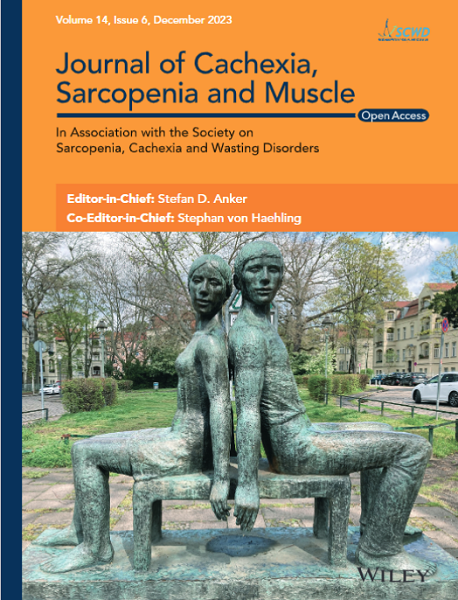
The Journal of Cachexia, Sarcopenia and Muscle is a peer-reviewed international journal dedicated to publishing materials related to cachexia and sarcopenia, as well as body composition and its physiological and pathophysiological changes across the lifespan and in response to various illnesses from all fields of life sciences. The journal aims to provide a reliable resource for professionals interested in related research or involved in the clinical care of affected patients, such as those suffering from AIDS, cancer, chronic heart failure, chronic lung disease, liver cirrhosis, chronic kidney failure, rheumatoid arthritis, or sepsis.





 京公网安备 11010802042870号
京ICP备2023020795号-1
京公网安备 11010802042870号
京ICP备2023020795号-1

 分享
分享
 求助内容:
求助内容: 应助结果提醒方式:
 扫码关注我们
