Heng Lu, Jianbo Li, Kunyan Nie, Ruilin Zhang, Yu’an Chen, Fusheng Pan
{"title":"Ti3C2Tx负载单原子Cu催化MgH2储氢","authors":"Heng Lu, Jianbo Li, Kunyan Nie, Ruilin Zhang, Yu’an Chen, Fusheng Pan","doi":"10.1021/acs.jpclett.5c00482","DOIUrl":null,"url":null,"abstract":"Magnesium hydride (MgH<sub>2</sub>) has been considered a promising hydrogen storage material, but its commercial application is severely limited by high operating temperature and slow de/hydrogenation kinetics. Herein, an efficient catalyst, Cu<sub>SA</sub>/Ti<sub>3</sub>C<sub>2</sub>T<sub><i>x</i></sub>, is successfully synthesized by introducing a Cu single-atom into Ti<sub>3</sub>C<sub>2</sub>T<sub><i>x</i></sub> MXene nanosheets and applied to MgH<sub>2</sub>. The synthesized MgH<sub>2</sub> + 5 wt %Cu<sub>SA</sub>/Ti<sub>3</sub>C<sub>2</sub>T<sub><i>x</i></sub> (Cu<sub>SA</sub>/Ti<sub>3</sub>C<sub>2</sub>T<sub><i>x</i></sub>/MgH<sub>2</sub>) composite exhibits low initial dehydrogenation temperature (<i>T</i> = 241.73 °C) and rapidly dehydrogenation kinetics (<i>E</i><sub>a</sub> = 76.38 kJ/mol H<sub>2</sub>). Impressively, the Cu<sub>SA</sub>/Ti<sub>3</sub>C<sub>2</sub>T<sub><i>x</i></sub>/MgH<sub>2</sub> composite desorbs 3.3 wt % of hydrogen within 240 min at 180 °C after 20 cycles, as well as an initial dehydrogenation temperature of 164.29 °C. The superior catalytic effect of Cu<sub>SA</sub>/Ti<sub>3</sub>C<sub>2</sub>T<sub><i>x</i></sub> catalyst is ascribed to the numerous catalytic active area, in-situ-formed active metallic Ti, and multivalent Ti species, accelerating the electron transfer and weakening the strength of Mg–H bonds. In particular, the Cu single-atom improved the stability of Ti<sup>4+</sup> in Ti<sub>3</sub>C<sub>2</sub>T<sub><i>x</i></sub>, thereby enhancing its catalytic ability. This work provides a new perspective for ameliorating the catalytic ability of MXene.","PeriodicalId":62,"journal":{"name":"The Journal of Physical Chemistry Letters","volume":"58 1","pages":""},"PeriodicalIF":4.6000,"publicationDate":"2025-03-31","publicationTypes":"Journal Article","fieldsOfStudy":null,"isOpenAccess":false,"openAccessPdf":"","citationCount":"0","resultStr":"{\"title\":\"Single-Atom Cu Supported on Ti3C2Tx for Catalyzing Hydrogen Storage in MgH2\",\"authors\":\"Heng Lu, Jianbo Li, Kunyan Nie, Ruilin Zhang, Yu’an Chen, Fusheng Pan\",\"doi\":\"10.1021/acs.jpclett.5c00482\",\"DOIUrl\":null,\"url\":null,\"abstract\":\"Magnesium hydride (MgH<sub>2</sub>) has been considered a promising hydrogen storage material, but its commercial application is severely limited by high operating temperature and slow de/hydrogenation kinetics. Herein, an efficient catalyst, Cu<sub>SA</sub>/Ti<sub>3</sub>C<sub>2</sub>T<sub><i>x</i></sub>, is successfully synthesized by introducing a Cu single-atom into Ti<sub>3</sub>C<sub>2</sub>T<sub><i>x</i></sub> MXene nanosheets and applied to MgH<sub>2</sub>. The synthesized MgH<sub>2</sub> + 5 wt %Cu<sub>SA</sub>/Ti<sub>3</sub>C<sub>2</sub>T<sub><i>x</i></sub> (Cu<sub>SA</sub>/Ti<sub>3</sub>C<sub>2</sub>T<sub><i>x</i></sub>/MgH<sub>2</sub>) composite exhibits low initial dehydrogenation temperature (<i>T</i> = 241.73 °C) and rapidly dehydrogenation kinetics (<i>E</i><sub>a</sub> = 76.38 kJ/mol H<sub>2</sub>). Impressively, the Cu<sub>SA</sub>/Ti<sub>3</sub>C<sub>2</sub>T<sub><i>x</i></sub>/MgH<sub>2</sub> composite desorbs 3.3 wt % of hydrogen within 240 min at 180 °C after 20 cycles, as well as an initial dehydrogenation temperature of 164.29 °C. The superior catalytic effect of Cu<sub>SA</sub>/Ti<sub>3</sub>C<sub>2</sub>T<sub><i>x</i></sub> catalyst is ascribed to the numerous catalytic active area, in-situ-formed active metallic Ti, and multivalent Ti species, accelerating the electron transfer and weakening the strength of Mg–H bonds. In particular, the Cu single-atom improved the stability of Ti<sup>4+</sup> in Ti<sub>3</sub>C<sub>2</sub>T<sub><i>x</i></sub>, thereby enhancing its catalytic ability. This work provides a new perspective for ameliorating the catalytic ability of MXene.\",\"PeriodicalId\":62,\"journal\":{\"name\":\"The Journal of Physical Chemistry Letters\",\"volume\":\"58 1\",\"pages\":\"\"},\"PeriodicalIF\":4.6000,\"publicationDate\":\"2025-03-31\",\"publicationTypes\":\"Journal Article\",\"fieldsOfStudy\":null,\"isOpenAccess\":false,\"openAccessPdf\":\"\",\"citationCount\":\"0\",\"resultStr\":null,\"platform\":\"Semanticscholar\",\"paperid\":null,\"PeriodicalName\":\"The Journal of Physical Chemistry Letters\",\"FirstCategoryId\":\"1\",\"ListUrlMain\":\"https://doi.org/10.1021/acs.jpclett.5c00482\",\"RegionNum\":2,\"RegionCategory\":\"化学\",\"ArticlePicture\":[],\"TitleCN\":null,\"AbstractTextCN\":null,\"PMCID\":null,\"EPubDate\":\"\",\"PubModel\":\"\",\"JCR\":\"Q2\",\"JCRName\":\"CHEMISTRY, PHYSICAL\",\"Score\":null,\"Total\":0}","platform":"Semanticscholar","paperid":null,"PeriodicalName":"The Journal of Physical Chemistry Letters","FirstCategoryId":"1","ListUrlMain":"https://doi.org/10.1021/acs.jpclett.5c00482","RegionNum":2,"RegionCategory":"化学","ArticlePicture":[],"TitleCN":null,"AbstractTextCN":null,"PMCID":null,"EPubDate":"","PubModel":"","JCR":"Q2","JCRName":"CHEMISTRY, PHYSICAL","Score":null,"Total":0}
Single-Atom Cu Supported on Ti3C2Tx for Catalyzing Hydrogen Storage in MgH2
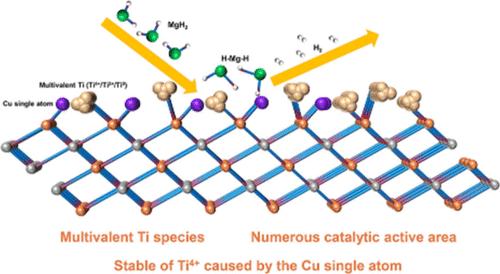
Magnesium hydride (MgH2) has been considered a promising hydrogen storage material, but its commercial application is severely limited by high operating temperature and slow de/hydrogenation kinetics. Herein, an efficient catalyst, CuSA/Ti3C2Tx, is successfully synthesized by introducing a Cu single-atom into Ti3C2Tx MXene nanosheets and applied to MgH2. The synthesized MgH2 + 5 wt %CuSA/Ti3C2Tx (CuSA/Ti3C2Tx/MgH2) composite exhibits low initial dehydrogenation temperature (T = 241.73 °C) and rapidly dehydrogenation kinetics (Ea = 76.38 kJ/mol H2). Impressively, the CuSA/Ti3C2Tx/MgH2 composite desorbs 3.3 wt % of hydrogen within 240 min at 180 °C after 20 cycles, as well as an initial dehydrogenation temperature of 164.29 °C. The superior catalytic effect of CuSA/Ti3C2Tx catalyst is ascribed to the numerous catalytic active area, in-situ-formed active metallic Ti, and multivalent Ti species, accelerating the electron transfer and weakening the strength of Mg–H bonds. In particular, the Cu single-atom improved the stability of Ti4+ in Ti3C2Tx, thereby enhancing its catalytic ability. This work provides a new perspective for ameliorating the catalytic ability of MXene.
期刊介绍:
The Journal of Physical Chemistry (JPC) Letters is devoted to reporting new and original experimental and theoretical basic research of interest to physical chemists, biophysical chemists, chemical physicists, physicists, material scientists, and engineers. An important criterion for acceptance is that the paper reports a significant scientific advance and/or physical insight such that rapid publication is essential. Two issues of JPC Letters are published each month.




 京公网安备 11010802042870号
京ICP备2023020795号-1
京公网安备 11010802042870号
京ICP备2023020795号-1

 分享
分享
 求助内容:
求助内容: 应助结果提醒方式:
 扫码关注我们
