Jonathan Vandenwijngaerden, Bapi Pradhan, Bob Van Hout, Eduard Fron, Yasuyuki Araki, Xianjun Zhang, Yutaka Shibata, Dario Santantonio, Roger Bresoli-Obach, Santi Nonell, Haifeng Yuan, Jialiang Xu, Mark Van der Auweraer, Maarten Roeffaers, Johan Hofkens, Hiroshi Fukumura, Elke Debroye
{"title":"CsPbBr3微晶体中深能级阱的近红外发光","authors":"Jonathan Vandenwijngaerden, Bapi Pradhan, Bob Van Hout, Eduard Fron, Yasuyuki Araki, Xianjun Zhang, Yutaka Shibata, Dario Santantonio, Roger Bresoli-Obach, Santi Nonell, Haifeng Yuan, Jialiang Xu, Mark Van der Auweraer, Maarten Roeffaers, Johan Hofkens, Hiroshi Fukumura, Elke Debroye","doi":"10.1021/acs.jpclett.5c00545","DOIUrl":null,"url":null,"abstract":"In this study, we report the first observation of a near-infrared (NIR) emission band from all-inorganic CsPbBr<sub>3</sub> and CsPb(Br/Cl)<sub>3</sub> perovskite microcrystals. By means of temperature- and power-dependent NIR and visible luminescence spectroscopy, we demonstrate that a fraction of the excited states in these materials relax through radiative transitions involving traps located deep within the band gap, leading to broadband NIR emission. The quantum yield of this deep trap emission is quantitatively determined for the first time and amounts to approximately 0.3% at room temperature. Furthermore, by examining the picosecond-to-nanosecond dynamics of the excited states, using time-resolved luminescence spectroscopy, we observe that the population of NIR initial states occurs on a 660 ps time scale, consistent with the capture of free carriers by deep trap sites. Hence, this work deepens our fundamental understanding of previously unexplored recombination channels in metal halide perovskite microcrystals.","PeriodicalId":62,"journal":{"name":"The Journal of Physical Chemistry Letters","volume":"4 1","pages":""},"PeriodicalIF":4.6000,"publicationDate":"2025-03-31","publicationTypes":"Journal Article","fieldsOfStudy":null,"isOpenAccess":false,"openAccessPdf":"","citationCount":"0","resultStr":"{\"title\":\"NIR Luminescence from Deep-Level Traps in CsPbBr3 Microcrystals\",\"authors\":\"Jonathan Vandenwijngaerden, Bapi Pradhan, Bob Van Hout, Eduard Fron, Yasuyuki Araki, Xianjun Zhang, Yutaka Shibata, Dario Santantonio, Roger Bresoli-Obach, Santi Nonell, Haifeng Yuan, Jialiang Xu, Mark Van der Auweraer, Maarten Roeffaers, Johan Hofkens, Hiroshi Fukumura, Elke Debroye\",\"doi\":\"10.1021/acs.jpclett.5c00545\",\"DOIUrl\":null,\"url\":null,\"abstract\":\"In this study, we report the first observation of a near-infrared (NIR) emission band from all-inorganic CsPbBr<sub>3</sub> and CsPb(Br/Cl)<sub>3</sub> perovskite microcrystals. By means of temperature- and power-dependent NIR and visible luminescence spectroscopy, we demonstrate that a fraction of the excited states in these materials relax through radiative transitions involving traps located deep within the band gap, leading to broadband NIR emission. The quantum yield of this deep trap emission is quantitatively determined for the first time and amounts to approximately 0.3% at room temperature. Furthermore, by examining the picosecond-to-nanosecond dynamics of the excited states, using time-resolved luminescence spectroscopy, we observe that the population of NIR initial states occurs on a 660 ps time scale, consistent with the capture of free carriers by deep trap sites. Hence, this work deepens our fundamental understanding of previously unexplored recombination channels in metal halide perovskite microcrystals.\",\"PeriodicalId\":62,\"journal\":{\"name\":\"The Journal of Physical Chemistry Letters\",\"volume\":\"4 1\",\"pages\":\"\"},\"PeriodicalIF\":4.6000,\"publicationDate\":\"2025-03-31\",\"publicationTypes\":\"Journal Article\",\"fieldsOfStudy\":null,\"isOpenAccess\":false,\"openAccessPdf\":\"\",\"citationCount\":\"0\",\"resultStr\":null,\"platform\":\"Semanticscholar\",\"paperid\":null,\"PeriodicalName\":\"The Journal of Physical Chemistry Letters\",\"FirstCategoryId\":\"1\",\"ListUrlMain\":\"https://doi.org/10.1021/acs.jpclett.5c00545\",\"RegionNum\":2,\"RegionCategory\":\"化学\",\"ArticlePicture\":[],\"TitleCN\":null,\"AbstractTextCN\":null,\"PMCID\":null,\"EPubDate\":\"\",\"PubModel\":\"\",\"JCR\":\"Q2\",\"JCRName\":\"CHEMISTRY, PHYSICAL\",\"Score\":null,\"Total\":0}","platform":"Semanticscholar","paperid":null,"PeriodicalName":"The Journal of Physical Chemistry Letters","FirstCategoryId":"1","ListUrlMain":"https://doi.org/10.1021/acs.jpclett.5c00545","RegionNum":2,"RegionCategory":"化学","ArticlePicture":[],"TitleCN":null,"AbstractTextCN":null,"PMCID":null,"EPubDate":"","PubModel":"","JCR":"Q2","JCRName":"CHEMISTRY, PHYSICAL","Score":null,"Total":0}
NIR Luminescence from Deep-Level Traps in CsPbBr3 Microcrystals
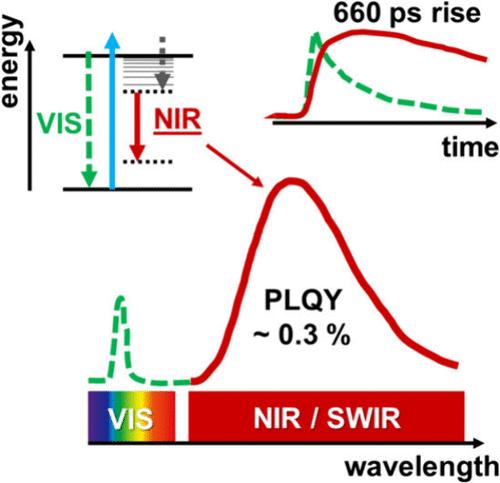
In this study, we report the first observation of a near-infrared (NIR) emission band from all-inorganic CsPbBr3 and CsPb(Br/Cl)3 perovskite microcrystals. By means of temperature- and power-dependent NIR and visible luminescence spectroscopy, we demonstrate that a fraction of the excited states in these materials relax through radiative transitions involving traps located deep within the band gap, leading to broadband NIR emission. The quantum yield of this deep trap emission is quantitatively determined for the first time and amounts to approximately 0.3% at room temperature. Furthermore, by examining the picosecond-to-nanosecond dynamics of the excited states, using time-resolved luminescence spectroscopy, we observe that the population of NIR initial states occurs on a 660 ps time scale, consistent with the capture of free carriers by deep trap sites. Hence, this work deepens our fundamental understanding of previously unexplored recombination channels in metal halide perovskite microcrystals.
期刊介绍:
The Journal of Physical Chemistry (JPC) Letters is devoted to reporting new and original experimental and theoretical basic research of interest to physical chemists, biophysical chemists, chemical physicists, physicists, material scientists, and engineers. An important criterion for acceptance is that the paper reports a significant scientific advance and/or physical insight such that rapid publication is essential. Two issues of JPC Letters are published each month.




 京公网安备 11010802042870号
京ICP备2023020795号-1
京公网安备 11010802042870号
京ICP备2023020795号-1

 分享
分享
 求助内容:
求助内容: 应助结果提醒方式:
 扫码关注我们
