Wentao Liu, Yishun Xie, Qinhui Ni, Qiong Hu, Aiying Lei, Chengqing Deng, Guobao Huang and Feiyan Lai
{"title":"可控醌导入N,N,N ',N ' -四(4-氨基酚)-1,4-苯二胺作为锌离子电池正极材料","authors":"Wentao Liu, Yishun Xie, Qinhui Ni, Qiong Hu, Aiying Lei, Chengqing Deng, Guobao Huang and Feiyan Lai","doi":"10.1039/D4NJ05518G","DOIUrl":null,"url":null,"abstract":"<p >Benzoquinone was introduced into <em>N</em>,<em>N</em>,<em>N</em>′,<em>N</em>′-tetra(4-aminophenol)-1,4-phenylenediamine (TAPA) to obtain an organic polymer (N4HQ) by irradiation using a microwave method. N4HQ changes from bulk to dispersed particles after long cycling, which is conducive for inserting/extracting Zn<small><sup>2+</sup></small> ions. There are abundant –C<img>O groups in N4HQ to capture Zn<small><sup>2+</sup></small>, enabling a high charge storage capacity for zinc-ion batteries (ZIBs). The N4HQ electrode delivers a high initial discharge capacity of 166 mA h g<small><sup>−1</sup></small> at 0.5 A g<small><sup>−1</sup></small> without obvious capacitive decay after 10 000 cycles at 1 A g<small><sup>−1</sup></small>.</p>","PeriodicalId":95,"journal":{"name":"New Journal of Chemistry","volume":" 14","pages":" 5865-5870"},"PeriodicalIF":2.6000,"publicationDate":"2025-03-07","publicationTypes":"Journal Article","fieldsOfStudy":null,"isOpenAccess":false,"openAccessPdf":"","citationCount":"0","resultStr":"{\"title\":\"Controlled quinone introduction into N,N,N′,N′-tetra(4-aminophenol)-1,4-phenylenediamine as a cathode material for zinc-ion batteries\",\"authors\":\"Wentao Liu, Yishun Xie, Qinhui Ni, Qiong Hu, Aiying Lei, Chengqing Deng, Guobao Huang and Feiyan Lai\",\"doi\":\"10.1039/D4NJ05518G\",\"DOIUrl\":null,\"url\":null,\"abstract\":\"<p >Benzoquinone was introduced into <em>N</em>,<em>N</em>,<em>N</em>′,<em>N</em>′-tetra(4-aminophenol)-1,4-phenylenediamine (TAPA) to obtain an organic polymer (N4HQ) by irradiation using a microwave method. N4HQ changes from bulk to dispersed particles after long cycling, which is conducive for inserting/extracting Zn<small><sup>2+</sup></small> ions. There are abundant –C<img>O groups in N4HQ to capture Zn<small><sup>2+</sup></small>, enabling a high charge storage capacity for zinc-ion batteries (ZIBs). The N4HQ electrode delivers a high initial discharge capacity of 166 mA h g<small><sup>−1</sup></small> at 0.5 A g<small><sup>−1</sup></small> without obvious capacitive decay after 10 000 cycles at 1 A g<small><sup>−1</sup></small>.</p>\",\"PeriodicalId\":95,\"journal\":{\"name\":\"New Journal of Chemistry\",\"volume\":\" 14\",\"pages\":\" 5865-5870\"},\"PeriodicalIF\":2.6000,\"publicationDate\":\"2025-03-07\",\"publicationTypes\":\"Journal Article\",\"fieldsOfStudy\":null,\"isOpenAccess\":false,\"openAccessPdf\":\"\",\"citationCount\":\"0\",\"resultStr\":null,\"platform\":\"Semanticscholar\",\"paperid\":null,\"PeriodicalName\":\"New Journal of Chemistry\",\"FirstCategoryId\":\"92\",\"ListUrlMain\":\"https://pubs.rsc.org/en/content/articlelanding/2025/nj/d4nj05518g\",\"RegionNum\":3,\"RegionCategory\":\"化学\",\"ArticlePicture\":[],\"TitleCN\":null,\"AbstractTextCN\":null,\"PMCID\":null,\"EPubDate\":\"\",\"PubModel\":\"\",\"JCR\":\"Q2\",\"JCRName\":\"CHEMISTRY, MULTIDISCIPLINARY\",\"Score\":null,\"Total\":0}","platform":"Semanticscholar","paperid":null,"PeriodicalName":"New Journal of Chemistry","FirstCategoryId":"92","ListUrlMain":"https://pubs.rsc.org/en/content/articlelanding/2025/nj/d4nj05518g","RegionNum":3,"RegionCategory":"化学","ArticlePicture":[],"TitleCN":null,"AbstractTextCN":null,"PMCID":null,"EPubDate":"","PubModel":"","JCR":"Q2","JCRName":"CHEMISTRY, MULTIDISCIPLINARY","Score":null,"Total":0}
引用次数: 0
摘要
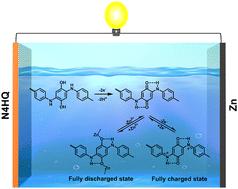
将苯醌引入N,N,N ',N ' -四(4-氨基酚)-1,4-苯二胺(TAPA)中,采用微波辐照法制备有机聚合物(N4HQ)。经过长时间循环后,N4HQ由块状变为分散颗粒,有利于Zn2+离子的插入/提取。N4HQ中含有丰富的-CO基团,可以捕获Zn2+,使锌离子电池具有较高的电荷存储能力。N4HQ电极在0.5 a g−1下具有166 mA h g−1的高初始放电容量,在1 a g−1下循环10000次后无明显的电容衰减。
Controlled quinone introduction into N,N,N′,N′-tetra(4-aminophenol)-1,4-phenylenediamine as a cathode material for zinc-ion batteries
Benzoquinone was introduced into N,N,N′,N′-tetra(4-aminophenol)-1,4-phenylenediamine (TAPA) to obtain an organic polymer (N4HQ) by irradiation using a microwave method. N4HQ changes from bulk to dispersed particles after long cycling, which is conducive for inserting/extracting Zn2+ ions. There are abundant –CO groups in N4HQ to capture Zn2+, enabling a high charge storage capacity for zinc-ion batteries (ZIBs). The N4HQ electrode delivers a high initial discharge capacity of 166 mA h g−1 at 0.5 A g−1 without obvious capacitive decay after 10 000 cycles at 1 A g−1.




 京公网安备 11010802042870号
京ICP备2023020795号-1
京公网安备 11010802042870号
京ICP备2023020795号-1

 分享
分享
 求助内容:
求助内容: 应助结果提醒方式:
 扫码关注我们
