Pengcheng Wang, Yang Yang, Hongda Shi, Jiahe Yang, Xingyan Chen, Xi Lin, Qianwang Chen and Mingzai Wu
{"title":"Ru-MoC异质结构电催化剂在碱性介质中高效稳定的氢氧化反应","authors":"Pengcheng Wang, Yang Yang, Hongda Shi, Jiahe Yang, Xingyan Chen, Xi Lin, Qianwang Chen and Mingzai Wu","doi":"10.1039/D5TA00941C","DOIUrl":null,"url":null,"abstract":"<p >Owing to its higher oxophilicity and similar hydrogen adsorption strength to Pt, Ru has been regarded as a promising alternative to overcome sluggish hydrogen oxidation reaction (HOR) kinetics in alkaline media. However, the strong oxophilicity of Ru also results in insufficient hydrogen adsorption sites on Ru catalysts and poor stability. Herein, a rationally designed Ru-based heterostructure catalyst with abundant Ru and MoC interfaces (Ru–MoC/C) was prepared. Ru–MoC/C exhibits great stability and excellent mass activity (1.74 mA μg<small><sub>PGM</sub></small><small><sup>−1</sup></small>), which is approximately 4 and 3 times greater than that of Ru/C and Pt/C, respectively. And Ru–MoC/C displays stable operation for 10000 s at 0.1 V <em>versus</em> the reversible hydrogen electrode (RHE) in a chronoamperometry test. Experimental results and theoretical simulations revealed that the electron transfer from Ru to MoC at heterostructure interfaces, driven by differences in work functions, causes the d band center of Ru in Ru–MoC/C to shift downward, thus weakening the hydrogen binding as well as hydroxyl binding at Ru sites. Meanwhile, the strongly oxophilic MoC can substitute Ru as a hydroxyl adsorption site, resulting in enhanced hydroxyl binding at the heterostructure interfaces. Consequently, these factors synergistically accelerate the HOR kinetics on Ru–MoC/C and promote the stability of Ru–MoC/C.</p>","PeriodicalId":82,"journal":{"name":"Journal of Materials Chemistry A","volume":" 19","pages":" 13865-13871"},"PeriodicalIF":9.2000,"publicationDate":"2025-04-01","publicationTypes":"Journal Article","fieldsOfStudy":null,"isOpenAccess":false,"openAccessPdf":"","citationCount":"0","resultStr":"{\"title\":\"A Ru–MoC heterostructure electrocatalyst for efficient and stable hydrogen oxidation reaction in alkaline media†\",\"authors\":\"Pengcheng Wang, Yang Yang, Hongda Shi, Jiahe Yang, Xingyan Chen, Xi Lin, Qianwang Chen and Mingzai Wu\",\"doi\":\"10.1039/D5TA00941C\",\"DOIUrl\":null,\"url\":null,\"abstract\":\"<p >Owing to its higher oxophilicity and similar hydrogen adsorption strength to Pt, Ru has been regarded as a promising alternative to overcome sluggish hydrogen oxidation reaction (HOR) kinetics in alkaline media. However, the strong oxophilicity of Ru also results in insufficient hydrogen adsorption sites on Ru catalysts and poor stability. Herein, a rationally designed Ru-based heterostructure catalyst with abundant Ru and MoC interfaces (Ru–MoC/C) was prepared. Ru–MoC/C exhibits great stability and excellent mass activity (1.74 mA μg<small><sub>PGM</sub></small><small><sup>−1</sup></small>), which is approximately 4 and 3 times greater than that of Ru/C and Pt/C, respectively. And Ru–MoC/C displays stable operation for 10000 s at 0.1 V <em>versus</em> the reversible hydrogen electrode (RHE) in a chronoamperometry test. Experimental results and theoretical simulations revealed that the electron transfer from Ru to MoC at heterostructure interfaces, driven by differences in work functions, causes the d band center of Ru in Ru–MoC/C to shift downward, thus weakening the hydrogen binding as well as hydroxyl binding at Ru sites. Meanwhile, the strongly oxophilic MoC can substitute Ru as a hydroxyl adsorption site, resulting in enhanced hydroxyl binding at the heterostructure interfaces. Consequently, these factors synergistically accelerate the HOR kinetics on Ru–MoC/C and promote the stability of Ru–MoC/C.</p>\",\"PeriodicalId\":82,\"journal\":{\"name\":\"Journal of Materials Chemistry A\",\"volume\":\" 19\",\"pages\":\" 13865-13871\"},\"PeriodicalIF\":9.2000,\"publicationDate\":\"2025-04-01\",\"publicationTypes\":\"Journal Article\",\"fieldsOfStudy\":null,\"isOpenAccess\":false,\"openAccessPdf\":\"\",\"citationCount\":\"0\",\"resultStr\":null,\"platform\":\"Semanticscholar\",\"paperid\":null,\"PeriodicalName\":\"Journal of Materials Chemistry A\",\"FirstCategoryId\":\"88\",\"ListUrlMain\":\"https://pubs.rsc.org/en/content/articlelanding/2025/ta/d5ta00941c\",\"RegionNum\":2,\"RegionCategory\":\"材料科学\",\"ArticlePicture\":[],\"TitleCN\":null,\"AbstractTextCN\":null,\"PMCID\":null,\"EPubDate\":\"\",\"PubModel\":\"\",\"JCR\":\"Q1\",\"JCRName\":\"CHEMISTRY, PHYSICAL\",\"Score\":null,\"Total\":0}","platform":"Semanticscholar","paperid":null,"PeriodicalName":"Journal of Materials Chemistry A","FirstCategoryId":"88","ListUrlMain":"https://pubs.rsc.org/en/content/articlelanding/2025/ta/d5ta00941c","RegionNum":2,"RegionCategory":"材料科学","ArticlePicture":[],"TitleCN":null,"AbstractTextCN":null,"PMCID":null,"EPubDate":"","PubModel":"","JCR":"Q1","JCRName":"CHEMISTRY, PHYSICAL","Score":null,"Total":0}
引用次数: 0
摘要
由于其较高的亲氧性和与Pt相似的氢吸附强度,Ru被认为是克服碱性介质中缓慢的氢氧化反应(HOR)动力学的有希望的替代品。然而,Ru的强亲氧性也导致Ru催化剂上的氢吸附位点不足,稳定性差。在此基础上,合理设计了Ru-MoC界面丰富的钌基异质结构催化剂(Ru-MoC/C)。Ru- moc /C具有良好的稳定性和优良的质量活性(1.74 mA μgPGM-1),分别是Ru/C和Pt/C的4倍和3倍。在0.1V时测中,Ru-MoC/C可稳定工作10000s。实验结果和理论模拟表明,由于功函数的差异,异质结构界面上Ru向MoC的电子转移导致Ru-MoC/C中Ru的d带中心下移,从而削弱了Ru位点的氢键和羟基键。而强亲氧MoC可以代替Ru作为羟基的吸附位点,从而增强羟基在异质结构界面的结合。因此,这些因素协同加速了Ru-MoC/C的HOR动力学,促进了Ru-MoC/C的稳定性。
A Ru–MoC heterostructure electrocatalyst for efficient and stable hydrogen oxidation reaction in alkaline media†
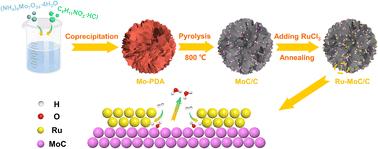
Owing to its higher oxophilicity and similar hydrogen adsorption strength to Pt, Ru has been regarded as a promising alternative to overcome sluggish hydrogen oxidation reaction (HOR) kinetics in alkaline media. However, the strong oxophilicity of Ru also results in insufficient hydrogen adsorption sites on Ru catalysts and poor stability. Herein, a rationally designed Ru-based heterostructure catalyst with abundant Ru and MoC interfaces (Ru–MoC/C) was prepared. Ru–MoC/C exhibits great stability and excellent mass activity (1.74 mA μgPGM−1), which is approximately 4 and 3 times greater than that of Ru/C and Pt/C, respectively. And Ru–MoC/C displays stable operation for 10000 s at 0.1 V versus the reversible hydrogen electrode (RHE) in a chronoamperometry test. Experimental results and theoretical simulations revealed that the electron transfer from Ru to MoC at heterostructure interfaces, driven by differences in work functions, causes the d band center of Ru in Ru–MoC/C to shift downward, thus weakening the hydrogen binding as well as hydroxyl binding at Ru sites. Meanwhile, the strongly oxophilic MoC can substitute Ru as a hydroxyl adsorption site, resulting in enhanced hydroxyl binding at the heterostructure interfaces. Consequently, these factors synergistically accelerate the HOR kinetics on Ru–MoC/C and promote the stability of Ru–MoC/C.
期刊介绍:
The Journal of Materials Chemistry A, B & C covers a wide range of high-quality studies in the field of materials chemistry, with each section focusing on specific applications of the materials studied. Journal of Materials Chemistry A emphasizes applications in energy and sustainability, including topics such as artificial photosynthesis, batteries, and fuel cells. Journal of Materials Chemistry B focuses on applications in biology and medicine, while Journal of Materials Chemistry C covers applications in optical, magnetic, and electronic devices. Example topic areas within the scope of Journal of Materials Chemistry A include catalysis, green/sustainable materials, sensors, and water treatment, among others.




 京公网安备 11010802042870号
京ICP备2023020795号-1
京公网安备 11010802042870号
京ICP备2023020795号-1

 分享
分享
 求助内容:
求助内容: 应助结果提醒方式:
 扫码关注我们
