Ramon G. de Oliveira, Luiza R. Cruz, Marco A. Dessoy, Paul J. Koovits, Deborah A. dos Santos, Luiz F. N. de Oliveira, Rafael A. Ferreira, María C. Mollo, Eun Lee, Simone M. Duarte, Renata Krogh, Leonardo L. G. Ferreira, Rafael C. Chelucci, Maria Dichiara, Quillon J. Simpson, Clarissa Feltrin, Adriana C. da Silva, Benedito M. dos Santos, Milena F. Broering, Michael P. Pollastri, Lori Ferrins, Carolina B. Moraes, Adriano D. Andricopulo, Jadel M. Kratz, Peter Sjö, Charles E. Mowbray, Luiz C. Dias
{"title":"具有抗克氏锥虫活性的1h -吲哚-2-羧胺类化合物的发现及早期优化","authors":"Ramon G. de Oliveira, Luiza R. Cruz, Marco A. Dessoy, Paul J. Koovits, Deborah A. dos Santos, Luiz F. N. de Oliveira, Rafael A. Ferreira, María C. Mollo, Eun Lee, Simone M. Duarte, Renata Krogh, Leonardo L. G. Ferreira, Rafael C. Chelucci, Maria Dichiara, Quillon J. Simpson, Clarissa Feltrin, Adriana C. da Silva, Benedito M. dos Santos, Milena F. Broering, Michael P. Pollastri, Lori Ferrins, Carolina B. Moraes, Adriano D. Andricopulo, Jadel M. Kratz, Peter Sjö, Charles E. Mowbray, Luiz C. Dias","doi":"10.1021/acs.jmedchem.4c02942","DOIUrl":null,"url":null,"abstract":"Chagas disease (CD), caused by the flagellate protozoan <i>Trypanosoma cruzi</i>, is a neglected tropical disease endemic in 21 countries. The only two antiparasitic drugs approved for its treatment, benznidazole and nifurtimox, have significant drawbacks. We present herein the optimization of a series of substituted indoles that were identified through phenotypic screening against <i>T. cruzi</i>. Early lead compounds with balanced potency and physicochemical properties were advanced to animal studies but showed limited plasma exposure. Medicinal chemistry strategies were used to improve metabolic stability and solubility, but unfortunately, this effort failed to yield compounds with improvements in both exposure and potency. Still, the best compound was progressed for a proof-of-concept efficacy study using acute and chronic mice models of Chagas disease. Despite showing antiparasitic activity in these in vivo studies, the optimization work with this series was stopped due to unfavorable drug metabolism and pharmacokinetic (DMPK) properties and a deprioritized mechanism of action (CYP51 inhibition).","PeriodicalId":46,"journal":{"name":"Journal of Medicinal Chemistry","volume":"19 1","pages":""},"PeriodicalIF":7.3000,"publicationDate":"2025-03-31","publicationTypes":"Journal Article","fieldsOfStudy":null,"isOpenAccess":false,"openAccessPdf":"","citationCount":"0","resultStr":"{\"title\":\"Discovery and Early Optimization of 1H-Indole-2-carboxamides with Anti-Trypanosoma cruzi Activity\",\"authors\":\"Ramon G. de Oliveira, Luiza R. Cruz, Marco A. Dessoy, Paul J. Koovits, Deborah A. dos Santos, Luiz F. N. de Oliveira, Rafael A. Ferreira, María C. Mollo, Eun Lee, Simone M. Duarte, Renata Krogh, Leonardo L. G. Ferreira, Rafael C. Chelucci, Maria Dichiara, Quillon J. Simpson, Clarissa Feltrin, Adriana C. da Silva, Benedito M. dos Santos, Milena F. Broering, Michael P. Pollastri, Lori Ferrins, Carolina B. Moraes, Adriano D. Andricopulo, Jadel M. Kratz, Peter Sjö, Charles E. Mowbray, Luiz C. Dias\",\"doi\":\"10.1021/acs.jmedchem.4c02942\",\"DOIUrl\":null,\"url\":null,\"abstract\":\"Chagas disease (CD), caused by the flagellate protozoan <i>Trypanosoma cruzi</i>, is a neglected tropical disease endemic in 21 countries. The only two antiparasitic drugs approved for its treatment, benznidazole and nifurtimox, have significant drawbacks. We present herein the optimization of a series of substituted indoles that were identified through phenotypic screening against <i>T. cruzi</i>. Early lead compounds with balanced potency and physicochemical properties were advanced to animal studies but showed limited plasma exposure. Medicinal chemistry strategies were used to improve metabolic stability and solubility, but unfortunately, this effort failed to yield compounds with improvements in both exposure and potency. Still, the best compound was progressed for a proof-of-concept efficacy study using acute and chronic mice models of Chagas disease. Despite showing antiparasitic activity in these in vivo studies, the optimization work with this series was stopped due to unfavorable drug metabolism and pharmacokinetic (DMPK) properties and a deprioritized mechanism of action (CYP51 inhibition).\",\"PeriodicalId\":46,\"journal\":{\"name\":\"Journal of Medicinal Chemistry\",\"volume\":\"19 1\",\"pages\":\"\"},\"PeriodicalIF\":7.3000,\"publicationDate\":\"2025-03-31\",\"publicationTypes\":\"Journal Article\",\"fieldsOfStudy\":null,\"isOpenAccess\":false,\"openAccessPdf\":\"\",\"citationCount\":\"0\",\"resultStr\":null,\"platform\":\"Semanticscholar\",\"paperid\":null,\"PeriodicalName\":\"Journal of Medicinal Chemistry\",\"FirstCategoryId\":\"3\",\"ListUrlMain\":\"https://doi.org/10.1021/acs.jmedchem.4c02942\",\"RegionNum\":1,\"RegionCategory\":\"医学\",\"ArticlePicture\":[],\"TitleCN\":null,\"AbstractTextCN\":null,\"PMCID\":null,\"EPubDate\":\"\",\"PubModel\":\"\",\"JCR\":\"Q1\",\"JCRName\":\"CHEMISTRY, MEDICINAL\",\"Score\":null,\"Total\":0}","platform":"Semanticscholar","paperid":null,"PeriodicalName":"Journal of Medicinal Chemistry","FirstCategoryId":"3","ListUrlMain":"https://doi.org/10.1021/acs.jmedchem.4c02942","RegionNum":1,"RegionCategory":"医学","ArticlePicture":[],"TitleCN":null,"AbstractTextCN":null,"PMCID":null,"EPubDate":"","PubModel":"","JCR":"Q1","JCRName":"CHEMISTRY, MEDICINAL","Score":null,"Total":0}
Discovery and Early Optimization of 1H-Indole-2-carboxamides with Anti-Trypanosoma cruzi Activity
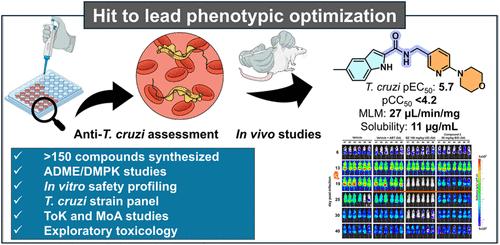
Chagas disease (CD), caused by the flagellate protozoan Trypanosoma cruzi, is a neglected tropical disease endemic in 21 countries. The only two antiparasitic drugs approved for its treatment, benznidazole and nifurtimox, have significant drawbacks. We present herein the optimization of a series of substituted indoles that were identified through phenotypic screening against T. cruzi. Early lead compounds with balanced potency and physicochemical properties were advanced to animal studies but showed limited plasma exposure. Medicinal chemistry strategies were used to improve metabolic stability and solubility, but unfortunately, this effort failed to yield compounds with improvements in both exposure and potency. Still, the best compound was progressed for a proof-of-concept efficacy study using acute and chronic mice models of Chagas disease. Despite showing antiparasitic activity in these in vivo studies, the optimization work with this series was stopped due to unfavorable drug metabolism and pharmacokinetic (DMPK) properties and a deprioritized mechanism of action (CYP51 inhibition).
期刊介绍:
The Journal of Medicinal Chemistry is a prestigious biweekly peer-reviewed publication that focuses on the multifaceted field of medicinal chemistry. Since its inception in 1959 as the Journal of Medicinal and Pharmaceutical Chemistry, it has evolved to become a cornerstone in the dissemination of research findings related to the design, synthesis, and development of therapeutic agents.
The Journal of Medicinal Chemistry is recognized for its significant impact in the scientific community, as evidenced by its 2022 impact factor of 7.3. This metric reflects the journal's influence and the importance of its content in shaping the future of drug discovery and development. The journal serves as a vital resource for chemists, pharmacologists, and other researchers interested in the molecular mechanisms of drug action and the optimization of therapeutic compounds.




 京公网安备 11010802042870号
京ICP备2023020795号-1
京公网安备 11010802042870号
京ICP备2023020795号-1

 分享
分享
 求助内容:
求助内容: 应助结果提醒方式:
 扫码关注我们
