Heiner Schmidt, Ramadan C. Oglou, Hüseyin O. Tunçer, Turkan G. U. Ghobadi, Şafak Tekir, Kubra N. O. Sertcelik, Abdelrahman Ibrahim, Lotta Döhler, Salih Özçubukçu, Stephan Kupfer, Benjamin Dietzek-Ivanšić, Ferdi Karadaş
{"title":"设计铁光敏剂的非正统方法:五氰铁酸盐(II)与单齿联吡啶/吡嗪基受体配体的配合物","authors":"Heiner Schmidt, Ramadan C. Oglou, Hüseyin O. Tunçer, Turkan G. U. Ghobadi, Şafak Tekir, Kubra N. O. Sertcelik, Abdelrahman Ibrahim, Lotta Döhler, Salih Özçubukçu, Stephan Kupfer, Benjamin Dietzek-Ivanšić, Ferdi Karadaş","doi":"10.1021/acs.inorgchem.5c00412","DOIUrl":null,"url":null,"abstract":"The main obstacle in replacing well-established precious ruthenium photosensitizers with earth-abundant iron analogs is the short excited state lifetimes of metal-to-ligand charge transfer (MLCT) states due to relatively weak octahedral field splitting and relaxation via metal-centered (MC) states. In this study, we address the issue of short lifetime by using pentacyanoferrate(II) complexes and combat facile photodissociation by utilizing positively charged pyrazinium or bipyridinium ligands. We utilize femtosecond transient absorption spectroscopy alongside quantum chemical calculations to probe the excited states of three 4,4′-bipyridinium- or pyrazinium-based pentacyanoferrate(II) complexes. The 4,4′-bipyridinium-based complexes exhibit <sup>3</sup>MLCT lifetimes of about 20 ps, while the pyrazinium-based complex exhibits a lifetime of 61 ps in an aqueous solution, setting a benchmark for cyanoferrate complexes. These results mark the foundation for a new group of easy-to-prepare iron photosensitizers that can be used for harvesting visible light.","PeriodicalId":40,"journal":{"name":"Inorganic Chemistry","volume":"38 1","pages":""},"PeriodicalIF":4.6000,"publicationDate":"2025-04-01","publicationTypes":"Journal Article","fieldsOfStudy":null,"isOpenAccess":false,"openAccessPdf":"","citationCount":"0","resultStr":"{\"title\":\"A Heterodox Approach for Designing Iron Photosensitizers: Pentacyanoferrate(II) Complexes with Monodentate Bipyridinium/Pyrazinium-Based Acceptor Ligands\",\"authors\":\"Heiner Schmidt, Ramadan C. Oglou, Hüseyin O. Tunçer, Turkan G. U. Ghobadi, Şafak Tekir, Kubra N. O. Sertcelik, Abdelrahman Ibrahim, Lotta Döhler, Salih Özçubukçu, Stephan Kupfer, Benjamin Dietzek-Ivanšić, Ferdi Karadaş\",\"doi\":\"10.1021/acs.inorgchem.5c00412\",\"DOIUrl\":null,\"url\":null,\"abstract\":\"The main obstacle in replacing well-established precious ruthenium photosensitizers with earth-abundant iron analogs is the short excited state lifetimes of metal-to-ligand charge transfer (MLCT) states due to relatively weak octahedral field splitting and relaxation via metal-centered (MC) states. In this study, we address the issue of short lifetime by using pentacyanoferrate(II) complexes and combat facile photodissociation by utilizing positively charged pyrazinium or bipyridinium ligands. We utilize femtosecond transient absorption spectroscopy alongside quantum chemical calculations to probe the excited states of three 4,4′-bipyridinium- or pyrazinium-based pentacyanoferrate(II) complexes. The 4,4′-bipyridinium-based complexes exhibit <sup>3</sup>MLCT lifetimes of about 20 ps, while the pyrazinium-based complex exhibits a lifetime of 61 ps in an aqueous solution, setting a benchmark for cyanoferrate complexes. These results mark the foundation for a new group of easy-to-prepare iron photosensitizers that can be used for harvesting visible light.\",\"PeriodicalId\":40,\"journal\":{\"name\":\"Inorganic Chemistry\",\"volume\":\"38 1\",\"pages\":\"\"},\"PeriodicalIF\":4.6000,\"publicationDate\":\"2025-04-01\",\"publicationTypes\":\"Journal Article\",\"fieldsOfStudy\":null,\"isOpenAccess\":false,\"openAccessPdf\":\"\",\"citationCount\":\"0\",\"resultStr\":null,\"platform\":\"Semanticscholar\",\"paperid\":null,\"PeriodicalName\":\"Inorganic Chemistry\",\"FirstCategoryId\":\"92\",\"ListUrlMain\":\"https://doi.org/10.1021/acs.inorgchem.5c00412\",\"RegionNum\":2,\"RegionCategory\":\"化学\",\"ArticlePicture\":[],\"TitleCN\":null,\"AbstractTextCN\":null,\"PMCID\":null,\"EPubDate\":\"\",\"PubModel\":\"\",\"JCR\":\"Q1\",\"JCRName\":\"CHEMISTRY, INORGANIC & NUCLEAR\",\"Score\":null,\"Total\":0}","platform":"Semanticscholar","paperid":null,"PeriodicalName":"Inorganic Chemistry","FirstCategoryId":"92","ListUrlMain":"https://doi.org/10.1021/acs.inorgchem.5c00412","RegionNum":2,"RegionCategory":"化学","ArticlePicture":[],"TitleCN":null,"AbstractTextCN":null,"PMCID":null,"EPubDate":"","PubModel":"","JCR":"Q1","JCRName":"CHEMISTRY, INORGANIC & NUCLEAR","Score":null,"Total":0}
A Heterodox Approach for Designing Iron Photosensitizers: Pentacyanoferrate(II) Complexes with Monodentate Bipyridinium/Pyrazinium-Based Acceptor Ligands
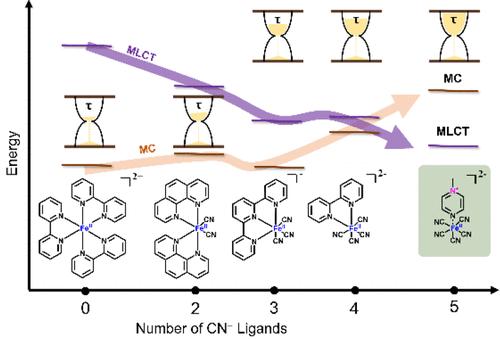
The main obstacle in replacing well-established precious ruthenium photosensitizers with earth-abundant iron analogs is the short excited state lifetimes of metal-to-ligand charge transfer (MLCT) states due to relatively weak octahedral field splitting and relaxation via metal-centered (MC) states. In this study, we address the issue of short lifetime by using pentacyanoferrate(II) complexes and combat facile photodissociation by utilizing positively charged pyrazinium or bipyridinium ligands. We utilize femtosecond transient absorption spectroscopy alongside quantum chemical calculations to probe the excited states of three 4,4′-bipyridinium- or pyrazinium-based pentacyanoferrate(II) complexes. The 4,4′-bipyridinium-based complexes exhibit 3MLCT lifetimes of about 20 ps, while the pyrazinium-based complex exhibits a lifetime of 61 ps in an aqueous solution, setting a benchmark for cyanoferrate complexes. These results mark the foundation for a new group of easy-to-prepare iron photosensitizers that can be used for harvesting visible light.
期刊介绍:
Inorganic Chemistry publishes fundamental studies in all phases of inorganic chemistry. Coverage includes experimental and theoretical reports on quantitative studies of structure and thermodynamics, kinetics, mechanisms of inorganic reactions, bioinorganic chemistry, and relevant aspects of organometallic chemistry, solid-state phenomena, and chemical bonding theory. Emphasis is placed on the synthesis, structure, thermodynamics, reactivity, spectroscopy, and bonding properties of significant new and known compounds.




 京公网安备 11010802042870号
京ICP备2023020795号-1
京公网安备 11010802042870号
京ICP备2023020795号-1

 分享
分享
 求助内容:
求助内容: 应助结果提醒方式:
 扫码关注我们
