Enhanced herbicidal activity of coumarin via carbon dot nanoformulation: synthesis and evaluation
BACKGROUND
The integration of nanocarriers with biochemicals can markedly enhance the stability and efficacy of these agents, which will help to diminish the reliance on chemical pesticides, and contribute to the advancement of sustainable agricultural practices.
RESULTS
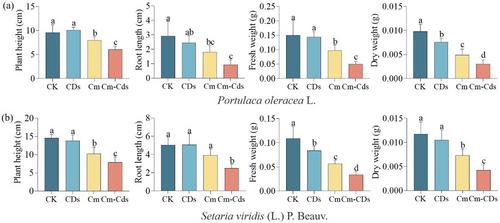
We prepared nanometer carbon dots (CDs) from black wolfberry (Lycium ruthenicum Murr.) and synthesized coumarin-loaded carbon dots (Cm-CDs) nanocomposites. The CDs exhibited a uniform distribution and high stability, with a coumarin loading rate of 65.45%. Experimental results on the herbicidal activity of both coumarin and Cm-CDs against Portulaca oleracea and Setaria viridis showed that, compared with coumarin alone, Cm-CDs completely inhibit the germination of S. viridis or prevent further development of P. oleracea post-germination at lower concentrations. The application of Cm-CDs has the potential to significantly diminish the biomass of P. oleracea and S. viridis (the dry weight decreased by 69.3% and 63.61% respectively), leading to a cessation of growth and the manifestation of wilting symptoms (P < 0.05). This indicates that the binding of coumarin to CDs markedly enhances the herbicidal efficacy of coumarin. Both coumarin and Cm-CDs exhibit consistent alterations in biomass, hormone levels, antioxidant enzyme activity, malondialdehyde (MDA) content, root morphology, and vitality, however, the effects observed with Cm-CDs were consistently more pronounced than those associated with coumarin (P < 0.05).
期刊介绍:
Pest Management Science is the international journal of research and development in crop protection and pest control. Since its launch in 1970, the journal has become the premier forum for papers on the discovery, application, and impact on the environment of products and strategies designed for pest management.
Published for SCI by John Wiley & Sons Ltd.






 京公网安备 11010802042870号
京ICP备2023020795号-1
京公网安备 11010802042870号
京ICP备2023020795号-1

 分享
分享
 求助内容:
求助内容: 应助结果提醒方式:
 扫码关注我们
