Emma D. Stephens, Fereshteh Oustadi, Hunter Marcelo, Jaqueline L. Vierra, Kartikeya Murari, Philip Egberts and Maryam Badv
{"title":"逐渐冷冻排列细菌纳米纤维素膜装载没食子酸表现出增强的机械和双重抗血栓抗菌性能。","authors":"Emma D. Stephens, Fereshteh Oustadi, Hunter Marcelo, Jaqueline L. Vierra, Kartikeya Murari, Philip Egberts and Maryam Badv","doi":"10.1039/D5BM00176E","DOIUrl":null,"url":null,"abstract":"<p >Bacterial nanocellulose (BNC) is a versatile natural polymer with unique morphological properties. However, its susceptibility to biofouling limits its utility in healthcare. To address this challenge, this study explores the incorporation of gallic acid, a phenolic acid with potent antimicrobial and antithrombotic properties, into BNC membranes. Additionally, a novel drying method termed gradual freezing is introduced, resulting in a directionally-aligned BNC membrane with enhanced mechanical integrity and high porosity. Using glycerol as a solvent and plasticizer, gallic acid was loaded into air-dried BNC (AD-BNC), freeze-dried BNC (FD-BNC), and gradually-frozen BNC (GF-BNC) membranes. Successful drug-loading into FD-BNC and GF-BNC significantly increased the elasticity of the films, however mechanical testing indicated that GF-BNC and its gallic acid/glycerol loaded counterpart (GF-GG-BNC) achieved overall optimal mechanical strength and elasticity. These samples were selected for further antifouling testing. Antibacterial assays demonstrated the practical efficacy of GF-GG-BNC in inhibiting the proliferation and biofilm formation of <em>E. coli</em> and <em>S. aureus</em>, while favorable antithrombotic behaviour prevented clot formation and red blood cell adhesion on the material's surface when compared to GF-BNC membranes. These findings highlight the potential of GF-GG-BNC as a multifunctional biomaterial for the prevention of biofouling in biomedical applications.</p>","PeriodicalId":65,"journal":{"name":"Biomaterials Science","volume":" 10","pages":" 2673-2689"},"PeriodicalIF":5.7000,"publicationDate":"2025-04-02","publicationTypes":"Journal Article","fieldsOfStudy":null,"isOpenAccess":false,"openAccessPdf":"https://pubs.rsc.org/en/content/articlepdf/2025/bm/d5bm00176e?page=search","citationCount":"0","resultStr":"{\"title\":\"Gradually-frozen aligned bacterial nanocellulose membranes loaded with gallic acid exhibit enhanced mechanical and dual antithrombotic-antimicrobial properties†\",\"authors\":\"Emma D. Stephens, Fereshteh Oustadi, Hunter Marcelo, Jaqueline L. Vierra, Kartikeya Murari, Philip Egberts and Maryam Badv\",\"doi\":\"10.1039/D5BM00176E\",\"DOIUrl\":null,\"url\":null,\"abstract\":\"<p >Bacterial nanocellulose (BNC) is a versatile natural polymer with unique morphological properties. However, its susceptibility to biofouling limits its utility in healthcare. To address this challenge, this study explores the incorporation of gallic acid, a phenolic acid with potent antimicrobial and antithrombotic properties, into BNC membranes. Additionally, a novel drying method termed gradual freezing is introduced, resulting in a directionally-aligned BNC membrane with enhanced mechanical integrity and high porosity. Using glycerol as a solvent and plasticizer, gallic acid was loaded into air-dried BNC (AD-BNC), freeze-dried BNC (FD-BNC), and gradually-frozen BNC (GF-BNC) membranes. Successful drug-loading into FD-BNC and GF-BNC significantly increased the elasticity of the films, however mechanical testing indicated that GF-BNC and its gallic acid/glycerol loaded counterpart (GF-GG-BNC) achieved overall optimal mechanical strength and elasticity. These samples were selected for further antifouling testing. Antibacterial assays demonstrated the practical efficacy of GF-GG-BNC in inhibiting the proliferation and biofilm formation of <em>E. coli</em> and <em>S. aureus</em>, while favorable antithrombotic behaviour prevented clot formation and red blood cell adhesion on the material's surface when compared to GF-BNC membranes. These findings highlight the potential of GF-GG-BNC as a multifunctional biomaterial for the prevention of biofouling in biomedical applications.</p>\",\"PeriodicalId\":65,\"journal\":{\"name\":\"Biomaterials Science\",\"volume\":\" 10\",\"pages\":\" 2673-2689\"},\"PeriodicalIF\":5.7000,\"publicationDate\":\"2025-04-02\",\"publicationTypes\":\"Journal Article\",\"fieldsOfStudy\":null,\"isOpenAccess\":false,\"openAccessPdf\":\"https://pubs.rsc.org/en/content/articlepdf/2025/bm/d5bm00176e?page=search\",\"citationCount\":\"0\",\"resultStr\":null,\"platform\":\"Semanticscholar\",\"paperid\":null,\"PeriodicalName\":\"Biomaterials Science\",\"FirstCategoryId\":\"5\",\"ListUrlMain\":\"https://pubs.rsc.org/en/content/articlelanding/2025/bm/d5bm00176e\",\"RegionNum\":3,\"RegionCategory\":\"医学\",\"ArticlePicture\":[],\"TitleCN\":null,\"AbstractTextCN\":null,\"PMCID\":null,\"EPubDate\":\"\",\"PubModel\":\"\",\"JCR\":\"Q1\",\"JCRName\":\"MATERIALS SCIENCE, BIOMATERIALS\",\"Score\":null,\"Total\":0}","platform":"Semanticscholar","paperid":null,"PeriodicalName":"Biomaterials Science","FirstCategoryId":"5","ListUrlMain":"https://pubs.rsc.org/en/content/articlelanding/2025/bm/d5bm00176e","RegionNum":3,"RegionCategory":"医学","ArticlePicture":[],"TitleCN":null,"AbstractTextCN":null,"PMCID":null,"EPubDate":"","PubModel":"","JCR":"Q1","JCRName":"MATERIALS SCIENCE, BIOMATERIALS","Score":null,"Total":0}
Gradually-frozen aligned bacterial nanocellulose membranes loaded with gallic acid exhibit enhanced mechanical and dual antithrombotic-antimicrobial properties†
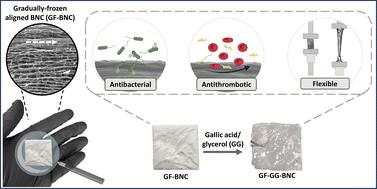
Bacterial nanocellulose (BNC) is a versatile natural polymer with unique morphological properties. However, its susceptibility to biofouling limits its utility in healthcare. To address this challenge, this study explores the incorporation of gallic acid, a phenolic acid with potent antimicrobial and antithrombotic properties, into BNC membranes. Additionally, a novel drying method termed gradual freezing is introduced, resulting in a directionally-aligned BNC membrane with enhanced mechanical integrity and high porosity. Using glycerol as a solvent and plasticizer, gallic acid was loaded into air-dried BNC (AD-BNC), freeze-dried BNC (FD-BNC), and gradually-frozen BNC (GF-BNC) membranes. Successful drug-loading into FD-BNC and GF-BNC significantly increased the elasticity of the films, however mechanical testing indicated that GF-BNC and its gallic acid/glycerol loaded counterpart (GF-GG-BNC) achieved overall optimal mechanical strength and elasticity. These samples were selected for further antifouling testing. Antibacterial assays demonstrated the practical efficacy of GF-GG-BNC in inhibiting the proliferation and biofilm formation of E. coli and S. aureus, while favorable antithrombotic behaviour prevented clot formation and red blood cell adhesion on the material's surface when compared to GF-BNC membranes. These findings highlight the potential of GF-GG-BNC as a multifunctional biomaterial for the prevention of biofouling in biomedical applications.
期刊介绍:
Biomaterials Science is an international high impact journal exploring the science of biomaterials and their translation towards clinical use. Its scope encompasses new concepts in biomaterials design, studies into the interaction of biomaterials with the body, and the use of materials to answer fundamental biological questions.




 京公网安备 11010802042870号
京ICP备2023020795号-1
京公网安备 11010802042870号
京ICP备2023020795号-1

 分享
分享
 求助内容:
求助内容: 应助结果提醒方式:
 扫码关注我们
