Lingling Luo, Yuying Zhou, Yaqin Chai, Ruo Yuan, Hongyan Liu
{"title":"均匀多周期级联DNA电路灵敏的“信号开关-超开”PEC生物传感","authors":"Lingling Luo, Yuying Zhou, Yaqin Chai, Ruo Yuan, Hongyan Liu","doi":"10.1021/acs.analchem.5c00373","DOIUrl":null,"url":null,"abstract":"The minor changes of miRNA levels due to various diseases and cancers bring great challenges for early diagnosis. Here we propose a “signal on-off-super on” PEC biosensor based on a homogeneous multicycle cascaded DNA circuit and a SnSe/CdS photoanode for sensitive detection of biomarker miRNA-222. Specifically, a Z-type SnSe/CdS heterojunction with greatly enhanced photoanodic performance was developed to provide the initial “on” signal. The target miRNA-222 was converted to a dendritic DNA structure through a cascade DNA circuit. The PEC signal can be switched off by the dendritic DNA structure and further switched super on by the loading of photosensitizer manganese porphyrin (MnPP). It is worth noting that the homogeneous multicycle cascaded DNA circuit not only improved the reaction kinetics but also avoided the leakage of signal. Compared with the traditional “signal-on” or “signal-off” readout, this “signal on-off-super on” strategy avoids the false response and background, thereby enhancing the sensitivity and accuracy of the PEC biosensor. The detection limit of the constructed PEC sensor is 0.3 fM in the linear range from 1 fM to 10 nM. The PEC biosensor with outstanding reproducibility, stability, and sensitivity provides a promising platform for biomarker detection and early disease diagnosis.","PeriodicalId":27,"journal":{"name":"Analytical Chemistry","volume":"128 1","pages":""},"PeriodicalIF":6.7000,"publicationDate":"2025-04-02","publicationTypes":"Journal Article","fieldsOfStudy":null,"isOpenAccess":false,"openAccessPdf":"","citationCount":"0","resultStr":"{\"title\":\"Homogeneous Multicycle Cascaded DNA Circuit for Sensitive “Signal On-Off-Super On” PEC Biosensing\",\"authors\":\"Lingling Luo, Yuying Zhou, Yaqin Chai, Ruo Yuan, Hongyan Liu\",\"doi\":\"10.1021/acs.analchem.5c00373\",\"DOIUrl\":null,\"url\":null,\"abstract\":\"The minor changes of miRNA levels due to various diseases and cancers bring great challenges for early diagnosis. Here we propose a “signal on-off-super on” PEC biosensor based on a homogeneous multicycle cascaded DNA circuit and a SnSe/CdS photoanode for sensitive detection of biomarker miRNA-222. Specifically, a Z-type SnSe/CdS heterojunction with greatly enhanced photoanodic performance was developed to provide the initial “on” signal. The target miRNA-222 was converted to a dendritic DNA structure through a cascade DNA circuit. The PEC signal can be switched off by the dendritic DNA structure and further switched super on by the loading of photosensitizer manganese porphyrin (MnPP). It is worth noting that the homogeneous multicycle cascaded DNA circuit not only improved the reaction kinetics but also avoided the leakage of signal. Compared with the traditional “signal-on” or “signal-off” readout, this “signal on-off-super on” strategy avoids the false response and background, thereby enhancing the sensitivity and accuracy of the PEC biosensor. The detection limit of the constructed PEC sensor is 0.3 fM in the linear range from 1 fM to 10 nM. The PEC biosensor with outstanding reproducibility, stability, and sensitivity provides a promising platform for biomarker detection and early disease diagnosis.\",\"PeriodicalId\":27,\"journal\":{\"name\":\"Analytical Chemistry\",\"volume\":\"128 1\",\"pages\":\"\"},\"PeriodicalIF\":6.7000,\"publicationDate\":\"2025-04-02\",\"publicationTypes\":\"Journal Article\",\"fieldsOfStudy\":null,\"isOpenAccess\":false,\"openAccessPdf\":\"\",\"citationCount\":\"0\",\"resultStr\":null,\"platform\":\"Semanticscholar\",\"paperid\":null,\"PeriodicalName\":\"Analytical Chemistry\",\"FirstCategoryId\":\"92\",\"ListUrlMain\":\"https://doi.org/10.1021/acs.analchem.5c00373\",\"RegionNum\":1,\"RegionCategory\":\"化学\",\"ArticlePicture\":[],\"TitleCN\":null,\"AbstractTextCN\":null,\"PMCID\":null,\"EPubDate\":\"\",\"PubModel\":\"\",\"JCR\":\"Q1\",\"JCRName\":\"CHEMISTRY, ANALYTICAL\",\"Score\":null,\"Total\":0}","platform":"Semanticscholar","paperid":null,"PeriodicalName":"Analytical Chemistry","FirstCategoryId":"92","ListUrlMain":"https://doi.org/10.1021/acs.analchem.5c00373","RegionNum":1,"RegionCategory":"化学","ArticlePicture":[],"TitleCN":null,"AbstractTextCN":null,"PMCID":null,"EPubDate":"","PubModel":"","JCR":"Q1","JCRName":"CHEMISTRY, ANALYTICAL","Score":null,"Total":0}
引用次数: 0
摘要
由于各种疾病和癌症导致的miRNA水平的微小变化给早期诊断带来了巨大的挑战。在这里,我们提出了一种基于均匀多循环级联DNA电路和SnSe/CdS光阳极的“信号开关-超开”PEC生物传感器,用于灵敏检测生物标志物miRNA-222。具体来说,开发了一种具有大大增强的光阳极性能的z型SnSe/CdS异质结,以提供初始“打开”信号。目标miRNA-222通过级联DNA电路转化为树突状DNA结构。PEC信号可以被树突状DNA结构关闭,并通过负载光敏剂卟啉锰(MnPP)进一步打开。值得注意的是,均质多循环级联DNA电路不仅提高了反应动力学,而且避免了信号的泄漏。与传统的“信号开”或“信号关”读出相比,这种“信号开-关-超开”策略避免了假响应和背景,从而提高了PEC生物传感器的灵敏度和准确性。所构建的PEC传感器在1 fM ~ 10 nM线性范围内的检测限为0.3 fM。PEC生物传感器具有良好的重现性、稳定性和灵敏度,为生物标志物检测和疾病早期诊断提供了一个有前景的平台。
Homogeneous Multicycle Cascaded DNA Circuit for Sensitive “Signal On-Off-Super On” PEC Biosensing
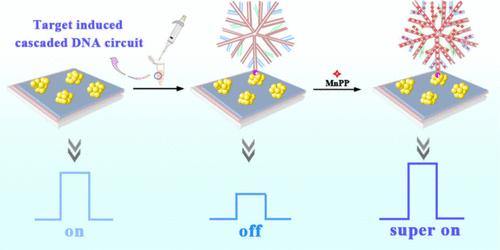
The minor changes of miRNA levels due to various diseases and cancers bring great challenges for early diagnosis. Here we propose a “signal on-off-super on” PEC biosensor based on a homogeneous multicycle cascaded DNA circuit and a SnSe/CdS photoanode for sensitive detection of biomarker miRNA-222. Specifically, a Z-type SnSe/CdS heterojunction with greatly enhanced photoanodic performance was developed to provide the initial “on” signal. The target miRNA-222 was converted to a dendritic DNA structure through a cascade DNA circuit. The PEC signal can be switched off by the dendritic DNA structure and further switched super on by the loading of photosensitizer manganese porphyrin (MnPP). It is worth noting that the homogeneous multicycle cascaded DNA circuit not only improved the reaction kinetics but also avoided the leakage of signal. Compared with the traditional “signal-on” or “signal-off” readout, this “signal on-off-super on” strategy avoids the false response and background, thereby enhancing the sensitivity and accuracy of the PEC biosensor. The detection limit of the constructed PEC sensor is 0.3 fM in the linear range from 1 fM to 10 nM. The PEC biosensor with outstanding reproducibility, stability, and sensitivity provides a promising platform for biomarker detection and early disease diagnosis.
期刊介绍:
Analytical Chemistry, a peer-reviewed research journal, focuses on disseminating new and original knowledge across all branches of analytical chemistry. Fundamental articles may explore general principles of chemical measurement science and need not directly address existing or potential analytical methodology. They can be entirely theoretical or report experimental results. Contributions may cover various phases of analytical operations, including sampling, bioanalysis, electrochemistry, mass spectrometry, microscale and nanoscale systems, environmental analysis, separations, spectroscopy, chemical reactions and selectivity, instrumentation, imaging, surface analysis, and data processing. Papers discussing known analytical methods should present a significant, original application of the method, a notable improvement, or results on an important analyte.





 京公网安备 11010802042870号
京ICP备2023020795号-1
京公网安备 11010802042870号
京ICP备2023020795号-1

 分享
分享
 求助内容:
求助内容: 应助结果提醒方式:
 扫码关注我们
