Guirong Yu, Na Li, Xiao Li, Yuhao Guo and Tingjiang Yan
{"title":"表面受挫刘易斯对和局域表面等离子体共振对光催化CO2加氢催化剂由惰性向高活性转变的协同效应","authors":"Guirong Yu, Na Li, Xiao Li, Yuhao Guo and Tingjiang Yan","doi":"10.1039/D5TA01792K","DOIUrl":null,"url":null,"abstract":"<p >Aluminum oxides (Al<small><sub>2</sub></small>O<small><sub>3</sub></small>, AlOOH) have been extensively studied as adsorbents, porous materials, and catalyst supports. However, they rarely exhibit photocatalytic applications due to the lack of active centers and light absorption properties. In this work, we present a novel approach in which highly dispersed copper (Cu) nanoparticles are loaded onto defect-laden AlO(OH)<small><sub><em>x</em></sub></small> nanocrystals, serving as an effective photocatalyst for the reverse water gas shift (RWGS) reaction with a remarkable near-unity (∼99%) selectivity. The surface frustrated Lewis pair (SFLP) on AlO(OH)<small><sub><em>x</em></sub></small> provides catalytic sites to activate H<small><sub>2</sub></small> and CO<small><sub>2</sub></small> molecules. Meanwhile, the localized surface plasmon resonance (LSPR) of Cu nanoparticles can generate sufficient hot electrons to facilitate H<small><sub>2</sub></small> dissociation and thereby the reduction of CO<small><sub>2</sub></small>. The synergetic effect of SFLP and LSPR tunes the catalyst from inert to highly reactive by tailoring the surface structure and electronic properties, providing a new perspective for the potential application of traditional industrial catalysts and/or supports.</p>","PeriodicalId":82,"journal":{"name":"Journal of Materials Chemistry A","volume":" 19","pages":" 13843-13855"},"PeriodicalIF":9.5000,"publicationDate":"2025-04-03","publicationTypes":"Journal Article","fieldsOfStudy":null,"isOpenAccess":false,"openAccessPdf":"","citationCount":"0","resultStr":"{\"title\":\"Synergetic effect of surface frustrated Lewis pair and localized surface plasmon resonance on tuning the catalyst from inert to highly reactive for photocatalytic CO2 hydrogenation†\",\"authors\":\"Guirong Yu, Na Li, Xiao Li, Yuhao Guo and Tingjiang Yan\",\"doi\":\"10.1039/D5TA01792K\",\"DOIUrl\":null,\"url\":null,\"abstract\":\"<p >Aluminum oxides (Al<small><sub>2</sub></small>O<small><sub>3</sub></small>, AlOOH) have been extensively studied as adsorbents, porous materials, and catalyst supports. However, they rarely exhibit photocatalytic applications due to the lack of active centers and light absorption properties. In this work, we present a novel approach in which highly dispersed copper (Cu) nanoparticles are loaded onto defect-laden AlO(OH)<small><sub><em>x</em></sub></small> nanocrystals, serving as an effective photocatalyst for the reverse water gas shift (RWGS) reaction with a remarkable near-unity (∼99%) selectivity. The surface frustrated Lewis pair (SFLP) on AlO(OH)<small><sub><em>x</em></sub></small> provides catalytic sites to activate H<small><sub>2</sub></small> and CO<small><sub>2</sub></small> molecules. Meanwhile, the localized surface plasmon resonance (LSPR) of Cu nanoparticles can generate sufficient hot electrons to facilitate H<small><sub>2</sub></small> dissociation and thereby the reduction of CO<small><sub>2</sub></small>. The synergetic effect of SFLP and LSPR tunes the catalyst from inert to highly reactive by tailoring the surface structure and electronic properties, providing a new perspective for the potential application of traditional industrial catalysts and/or supports.</p>\",\"PeriodicalId\":82,\"journal\":{\"name\":\"Journal of Materials Chemistry A\",\"volume\":\" 19\",\"pages\":\" 13843-13855\"},\"PeriodicalIF\":9.5000,\"publicationDate\":\"2025-04-03\",\"publicationTypes\":\"Journal Article\",\"fieldsOfStudy\":null,\"isOpenAccess\":false,\"openAccessPdf\":\"\",\"citationCount\":\"0\",\"resultStr\":null,\"platform\":\"Semanticscholar\",\"paperid\":null,\"PeriodicalName\":\"Journal of Materials Chemistry A\",\"FirstCategoryId\":\"88\",\"ListUrlMain\":\"https://pubs.rsc.org/en/content/articlelanding/2025/ta/d5ta01792k\",\"RegionNum\":2,\"RegionCategory\":\"材料科学\",\"ArticlePicture\":[],\"TitleCN\":null,\"AbstractTextCN\":null,\"PMCID\":null,\"EPubDate\":\"\",\"PubModel\":\"\",\"JCR\":\"Q1\",\"JCRName\":\"CHEMISTRY, PHYSICAL\",\"Score\":null,\"Total\":0}","platform":"Semanticscholar","paperid":null,"PeriodicalName":"Journal of Materials Chemistry A","FirstCategoryId":"88","ListUrlMain":"https://pubs.rsc.org/en/content/articlelanding/2025/ta/d5ta01792k","RegionNum":2,"RegionCategory":"材料科学","ArticlePicture":[],"TitleCN":null,"AbstractTextCN":null,"PMCID":null,"EPubDate":"","PubModel":"","JCR":"Q1","JCRName":"CHEMISTRY, PHYSICAL","Score":null,"Total":0}
Synergetic effect of surface frustrated Lewis pair and localized surface plasmon resonance on tuning the catalyst from inert to highly reactive for photocatalytic CO2 hydrogenation†
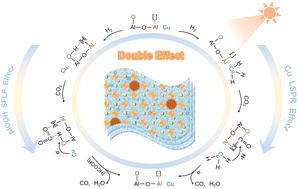
Aluminum oxides (Al2O3, AlOOH) have been extensively studied as adsorbents, porous materials, and catalyst supports. However, they rarely exhibit photocatalytic applications due to the lack of active centers and light absorption properties. In this work, we present a novel approach in which highly dispersed copper (Cu) nanoparticles are loaded onto defect-laden AlO(OH)x nanocrystals, serving as an effective photocatalyst for the reverse water gas shift (RWGS) reaction with a remarkable near-unity (∼99%) selectivity. The surface frustrated Lewis pair (SFLP) on AlO(OH)x provides catalytic sites to activate H2 and CO2 molecules. Meanwhile, the localized surface plasmon resonance (LSPR) of Cu nanoparticles can generate sufficient hot electrons to facilitate H2 dissociation and thereby the reduction of CO2. The synergetic effect of SFLP and LSPR tunes the catalyst from inert to highly reactive by tailoring the surface structure and electronic properties, providing a new perspective for the potential application of traditional industrial catalysts and/or supports.
期刊介绍:
The Journal of Materials Chemistry A, B & C covers a wide range of high-quality studies in the field of materials chemistry, with each section focusing on specific applications of the materials studied. Journal of Materials Chemistry A emphasizes applications in energy and sustainability, including topics such as artificial photosynthesis, batteries, and fuel cells. Journal of Materials Chemistry B focuses on applications in biology and medicine, while Journal of Materials Chemistry C covers applications in optical, magnetic, and electronic devices. Example topic areas within the scope of Journal of Materials Chemistry A include catalysis, green/sustainable materials, sensors, and water treatment, among others.




 京公网安备 11010802042870号
京ICP备2023020795号-1
京公网安备 11010802042870号
京ICP备2023020795号-1

 分享
分享
 求助内容:
求助内容: 应助结果提醒方式:
 扫码关注我们
