Tianhui Cheng, Weixing Min, Mingli Wang, Shuangshuang Zhu, Lengwan Li, Shilun Gao, Zhenxi Li, Jia Tian, Dandan Yang, Huabin Yang and Peng-Fei Cao
{"title":"高压稳定锂金属电池用深共晶溶剂基半互穿聚合物电解质","authors":"Tianhui Cheng, Weixing Min, Mingli Wang, Shuangshuang Zhu, Lengwan Li, Shilun Gao, Zhenxi Li, Jia Tian, Dandan Yang, Huabin Yang and Peng-Fei Cao","doi":"10.1039/D5TA00020C","DOIUrl":null,"url":null,"abstract":"<p >Although solid polymer electrolytes (SPEs) hold great promise for high-performance lithium metal batteries (LMBs), the low ionic conductivity and narrow electrochemical window limit their practical application. Herein, we report ethyl cyanoacrylate (ECA) based semi-interpenetrating polymer network (SIPN) structured SPEs without a traditional solvent removal process. The fabricated deep eutectic solvent (DES) is utilized as both a plasticizer and initiator to trigger the anionic polymerization of ECA to form the linear PECA (DES–PECA). The polymer network formed by copolymerization of poly(ethylene glycol)dimethacrylate and methyl methacrylate is further incorporated to afford the SIPN-based SPEs with lithium difluoro(oxalato)borate as an additive (DESD-SIPN). Benefitting from the unique SIPN structure with a crosslinked polymer network affording mechanical robustness and linear polymer providing high mobility, the DESD-SIPN-GF achieves a decent tensile strength of 1.3 MPa and a high ionic conductivity of 0.139 mS cm<small><sup>−1</sup></small>. The DES and PECA also endow the DESD-SIPN-GF with a voltage stability of up to 4.97 V. Accordingly, the LCO/DESD-SIPN-GF/Li cell stably cycles 500 times at 1 C and 4.6 V, and the NCM811/DESD-SIPN-GF/Li cell delivers a steady cycling performance at different cutoff voltages of 4.3 V, 4.5 V, and even 4.7 V.</p>","PeriodicalId":82,"journal":{"name":"Journal of Materials Chemistry A","volume":" 19","pages":" 14392-14400"},"PeriodicalIF":9.2000,"publicationDate":"2025-04-03","publicationTypes":"Journal Article","fieldsOfStudy":null,"isOpenAccess":false,"openAccessPdf":"","citationCount":"0","resultStr":"{\"title\":\"A deep eutectic solvent-based semi-interpenetrating polymer electrolyte for high-voltage stable lithium-metal batteries†\",\"authors\":\"Tianhui Cheng, Weixing Min, Mingli Wang, Shuangshuang Zhu, Lengwan Li, Shilun Gao, Zhenxi Li, Jia Tian, Dandan Yang, Huabin Yang and Peng-Fei Cao\",\"doi\":\"10.1039/D5TA00020C\",\"DOIUrl\":null,\"url\":null,\"abstract\":\"<p >Although solid polymer electrolytes (SPEs) hold great promise for high-performance lithium metal batteries (LMBs), the low ionic conductivity and narrow electrochemical window limit their practical application. Herein, we report ethyl cyanoacrylate (ECA) based semi-interpenetrating polymer network (SIPN) structured SPEs without a traditional solvent removal process. The fabricated deep eutectic solvent (DES) is utilized as both a plasticizer and initiator to trigger the anionic polymerization of ECA to form the linear PECA (DES–PECA). The polymer network formed by copolymerization of poly(ethylene glycol)dimethacrylate and methyl methacrylate is further incorporated to afford the SIPN-based SPEs with lithium difluoro(oxalato)borate as an additive (DESD-SIPN). Benefitting from the unique SIPN structure with a crosslinked polymer network affording mechanical robustness and linear polymer providing high mobility, the DESD-SIPN-GF achieves a decent tensile strength of 1.3 MPa and a high ionic conductivity of 0.139 mS cm<small><sup>−1</sup></small>. The DES and PECA also endow the DESD-SIPN-GF with a voltage stability of up to 4.97 V. Accordingly, the LCO/DESD-SIPN-GF/Li cell stably cycles 500 times at 1 C and 4.6 V, and the NCM811/DESD-SIPN-GF/Li cell delivers a steady cycling performance at different cutoff voltages of 4.3 V, 4.5 V, and even 4.7 V.</p>\",\"PeriodicalId\":82,\"journal\":{\"name\":\"Journal of Materials Chemistry A\",\"volume\":\" 19\",\"pages\":\" 14392-14400\"},\"PeriodicalIF\":9.2000,\"publicationDate\":\"2025-04-03\",\"publicationTypes\":\"Journal Article\",\"fieldsOfStudy\":null,\"isOpenAccess\":false,\"openAccessPdf\":\"\",\"citationCount\":\"0\",\"resultStr\":null,\"platform\":\"Semanticscholar\",\"paperid\":null,\"PeriodicalName\":\"Journal of Materials Chemistry A\",\"FirstCategoryId\":\"88\",\"ListUrlMain\":\"https://pubs.rsc.org/en/content/articlelanding/2025/ta/d5ta00020c\",\"RegionNum\":2,\"RegionCategory\":\"材料科学\",\"ArticlePicture\":[],\"TitleCN\":null,\"AbstractTextCN\":null,\"PMCID\":null,\"EPubDate\":\"\",\"PubModel\":\"\",\"JCR\":\"Q1\",\"JCRName\":\"CHEMISTRY, PHYSICAL\",\"Score\":null,\"Total\":0}","platform":"Semanticscholar","paperid":null,"PeriodicalName":"Journal of Materials Chemistry A","FirstCategoryId":"88","ListUrlMain":"https://pubs.rsc.org/en/content/articlelanding/2025/ta/d5ta00020c","RegionNum":2,"RegionCategory":"材料科学","ArticlePicture":[],"TitleCN":null,"AbstractTextCN":null,"PMCID":null,"EPubDate":"","PubModel":"","JCR":"Q1","JCRName":"CHEMISTRY, PHYSICAL","Score":null,"Total":0}
A deep eutectic solvent-based semi-interpenetrating polymer electrolyte for high-voltage stable lithium-metal batteries†
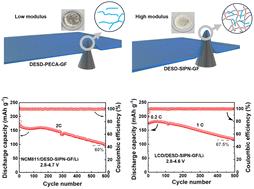
Although solid polymer electrolytes (SPEs) hold great promise for high-performance lithium metal batteries (LMBs), the low ionic conductivity and narrow electrochemical window limit their practical application. Herein, we report ethyl cyanoacrylate (ECA) based semi-interpenetrating polymer network (SIPN) structured SPEs without a traditional solvent removal process. The fabricated deep eutectic solvent (DES) is utilized as both a plasticizer and initiator to trigger the anionic polymerization of ECA to form the linear PECA (DES–PECA). The polymer network formed by copolymerization of poly(ethylene glycol)dimethacrylate and methyl methacrylate is further incorporated to afford the SIPN-based SPEs with lithium difluoro(oxalato)borate as an additive (DESD-SIPN). Benefitting from the unique SIPN structure with a crosslinked polymer network affording mechanical robustness and linear polymer providing high mobility, the DESD-SIPN-GF achieves a decent tensile strength of 1.3 MPa and a high ionic conductivity of 0.139 mS cm−1. The DES and PECA also endow the DESD-SIPN-GF with a voltage stability of up to 4.97 V. Accordingly, the LCO/DESD-SIPN-GF/Li cell stably cycles 500 times at 1 C and 4.6 V, and the NCM811/DESD-SIPN-GF/Li cell delivers a steady cycling performance at different cutoff voltages of 4.3 V, 4.5 V, and even 4.7 V.
期刊介绍:
The Journal of Materials Chemistry A, B & C covers a wide range of high-quality studies in the field of materials chemistry, with each section focusing on specific applications of the materials studied. Journal of Materials Chemistry A emphasizes applications in energy and sustainability, including topics such as artificial photosynthesis, batteries, and fuel cells. Journal of Materials Chemistry B focuses on applications in biology and medicine, while Journal of Materials Chemistry C covers applications in optical, magnetic, and electronic devices. Example topic areas within the scope of Journal of Materials Chemistry A include catalysis, green/sustainable materials, sensors, and water treatment, among others.




 京公网安备 11010802042870号
京ICP备2023020795号-1
京公网安备 11010802042870号
京ICP备2023020795号-1

 分享
分享
 求助内容:
求助内容: 应助结果提醒方式:
 扫码关注我们
